


Listen to the article
Former Myanmar leader Aung San Suu Kyi has been moved from prison to house arrest as part of a prisoner amnesty announced by Myanmar’s military government during a Buddhist holiday celebration, officials confirmed Thursday night.
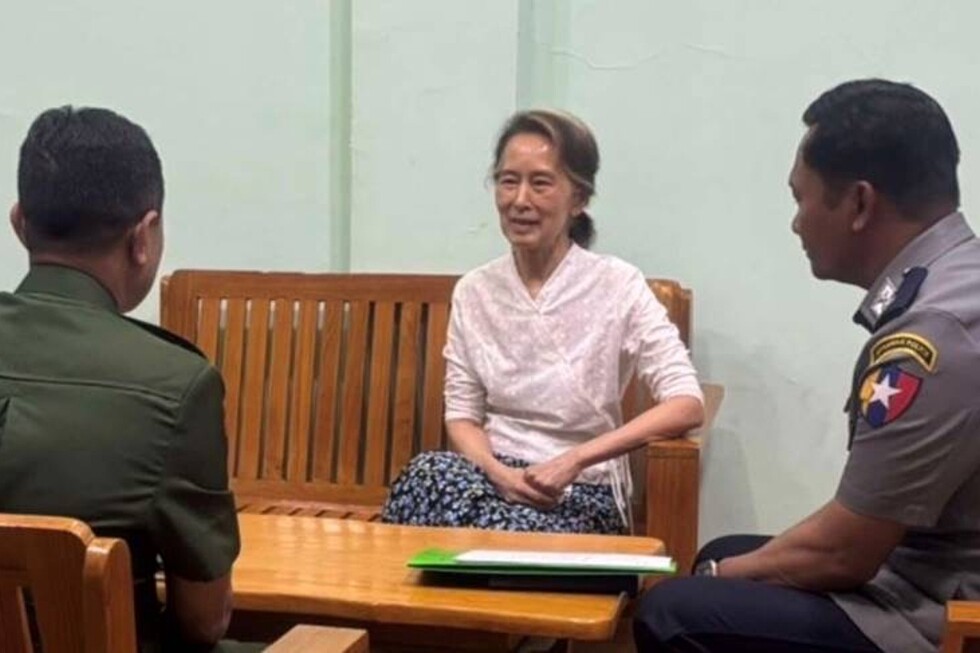
The 80-year-old Nobel Peace Prize laureate, who has been detained since the February 2021 military coup, will serve the remainder of her reduced sentence at an undisclosed residence rather than in Naypyitaw’s main prison. Military authorities released a rare photograph showing Suu Kyi dressed in traditional white attire, seated before men in military and police uniforms, though the photo’s date and location remain unclear.
The amnesty, marking the Full Moon Day of Kason that honors Buddha’s birthday, covered 1,519 prisoners and reduced sentences by one-sixth for those still imprisoned. For Suu Kyi, this reduction would bring her original 33-year prison sentence down to approximately 18 years, with about 13 years remaining to serve.
This marks the second recent amnesty affecting Suu Kyi, following a separate amnesty nearly two weeks ago that freed ousted President Win Myint, a longtime Suu Kyi ally who was arrested alongside her during the coup.
Military authorities described the transfer as being made “to celebrate Buddha Day, to show humanitarian concern, and to demonstrate the state’s benevolence and goodwill.” However, critics view these actions as part of a calculated public relations strategy by Senior General Min Aung Hlaing’s regime.
The amnesty follows Min Aung Hlaing’s April 10 inauguration as president after an election widely condemned as a mechanism to maintain military control. During his inauguration speech, he promised amnesty measures to promote “social reconciliation, justice and peace.”
Human rights organizations remain skeptical about the military’s motives. “Moving Aung San Suu Kyi isn’t about change or reform, it’s about public relations designed to preserve military rule,” said Mark Farmaner, director of Burma Campaign UK. “No-one should be fooled.”
Nay Phone Latt, spokesperson for the opposition National Unity Government, echoed this sentiment, telling The Associated Press that the move was designed to distract from the ongoing resistance movement. “It is important that we do not fall for these tricks. We will continue until the revolution achieves its six goals,” he said, referring to the opposition’s roadmap that includes ending military involvement in politics.
Concerns about Suu Kyi’s health and well-being have mounted over the past three years, with her legal team barred from meeting her in person since December 2022. Unverified reports in 2024 and 2025 suggested she was suffering from low blood pressure, dizziness, and heart problems.
Her son, Kim Aris, who lives in London, has been campaigning online under the “Proof of Life” banner, demanding verifiable evidence of his mother’s condition. Following the announcement of her house arrest, Aris stated, “Moving her is not freeing her. My request is simple: verified information that my mother is alive, the ability to communicate with her, and to see her free.”
U.N. Secretary-General António Guterres viewed the transfer as “a meaningful step toward conditions conducive to a credible political process,” according to his spokesman Stéphane Dujarric. The U.N. has called for the release of all political prisoners as a fundamental step toward resolving Myanmar’s crisis.
The 2021 military takeover sparked massive public resistance that was violently suppressed, igniting a bloody civil war that has claimed thousands of lives. According to the Assistance Association for Political Prisoners, over 22,000 people have been detained for political reasons since the coup.
Suu Kyi, daughter of Myanmar’s independence hero General Aung San, previously spent almost 15 years under house arrest between 1989 and 2010. Her peaceful resistance to military rule earned her the Nobel Peace Prize in 1991 and established her as a global symbol for democracy.
The military’s recent actions, including the amnesty and transfer to house arrest, come as Myanmar faces continued international pressure and domestic armed resistance across much of the country, with the junta struggling to establish full control more than three years after seizing power.
Fact Checker
Verify the accuracy of this article using The Disinformation Commission analysis and real-time sources.

8 Comments
While any reduction in Suu Kyi’s sentence is positive, the military’s continued crackdown on dissent in Myanmar is deeply concerning. True progress will require substantive steps towards reconciliation and the protection of human rights.
Suu Kyi’s release to house arrest is a welcome development, but the military regime must go further and release all political prisoners and restore the democratically elected government. Myanmar’s people deserve to live in a free and just society.
The move from prison to house arrest is a small step, but Suu Kyi should be freed unconditionally. Myanmar’s military rulers have shown little willingness to meaningfully address the country’s human rights abuses and political repression.
While any release of Aung San Suu Kyi is welcome, the military’s continued suppression of political freedoms in Myanmar is deeply troubling. True progress will require the junta to engage in genuine dialogue with the opposition and restore the democratic process.
This is a positive development, but the military junta in Myanmar still has a long way to go to make amends for its brutal crackdown on democracy. Suu Kyi and other political prisoners should be unconditionally released.
I agree. The military regime needs to make more meaningful concessions to the pro-democracy movement if there is to be any true reconciliation in Myanmar.
Good to see Aung San Suu Kyi moved to house arrest, though the reduced sentence is still overly harsh. Myanmar’s military has long persecuted her and other dissidents. Hopefully this signals a step towards restoring democracy and human rights in the country.
This prisoner amnesty is a public relations move by Myanmar’s military junta. True reform will require the full restoration of democracy, rule of law, and protection of fundamental freedoms that Suu Kyi and others have long fought for.