


Listen to the article
Dutch Military Expansion Reflects Europe’s Growing Security Concerns
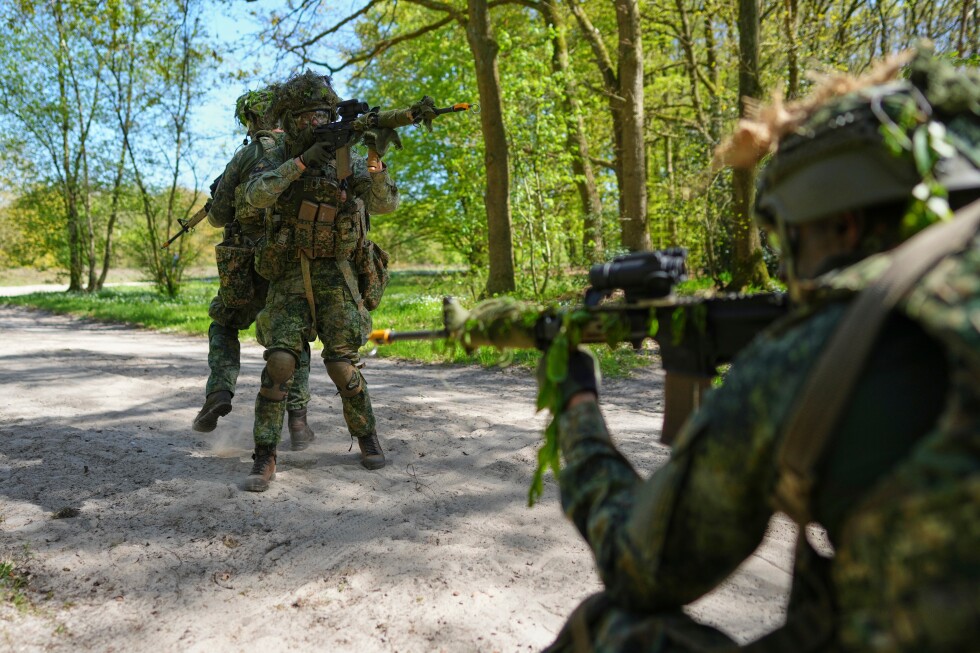
Their faces daubed with camouflage, troops emerge almost silently from a forest with Colt C7 rifles slung across their chests, scanning their surroundings for potential threats. These soldiers are members of the 10th Infantry Battalion Guard Security Corps National Reserve on a weekend exercise to hone their skills as the Netherlands bolsters its military capabilities.
The Dutch government and military leadership have committed to an ambitious expansion, planning to increase military personnel from 80,000 to 120,000 by 2035 – a strategic initiative that has gained broad political support across the country.
The recent enlistment of Queen Maxima and her eldest daughter, Crown Princess Amalia, as reservists has catalyzed public interest in military service. This royal endorsement, dubbed “the Amalia effect” by defense officials, has generated such enthusiasm that the military now faces logistical challenges in equipping and training all newcomers.
“It’s really a thing, yes,” State Secretary for Defense Derk Boswijk told The Associated Press. “It’s very inspiring to see how members of our royal family inspired people to join our armed forces.”
The recruitment surge has exceeded expectations. “We have more applications than we can handle,” Boswijk explained, citing “a lack of training capacity, a lack of housing. You have to give them all uniforms, you have to give them weapons.” Despite these challenges, he considers it “a luxury problem.”
The Netherlands currently has approximately 9,000 reservists, with plans to grow this force to at least 20,000 by 2030. Reservists commit to 300 hours of service annually, including regular weekend exercises, and traditionally focus on securing domestic sites rather than combat missions overseas.
Europe’s Changing Security Landscape
The Dutch military expansion mirrors similar efforts across Europe as countries respond to Russia’s ongoing war against Ukraine and uncertainty surrounding the future of NATO. European Union and NATO officials have warned that Russian President Vladimir Putin could potentially launch attacks elsewhere in Europe within three to five years, particularly if Russia prevails in Ukraine.
This assessment has prompted NATO to develop new defense plans requiring allies to prepare their armies for large-scale conflicts, with an emphasis on mobile forces that can be rapidly deployed.
A corporal in the Dutch reserve battalion, speaking on condition of anonymity due to the nature of her service, noted a significant shift in priorities as the global security outlook has deteriorated.
“When I first joined, there was almost no risk or almost no threat… and now it’s changing so we are more aware of it,” she said. The focus has moved toward “more what we call ‘green things,’ infantry things… We are here to defend our country and to make sure to keep the threat down.”
Recruitment Strategies Across Europe
Other European nations are also strengthening their military capabilities through various approaches. Germany is considering government plans to offer improved pay, conditions, and training for short-term recruits to attract personnel without reinstating mandatory conscription, which was suspended for men in 2011.
France is introducing a voluntary service program targeting 3,000 recruits aged 18-25 beginning in September. Participants will serve in uniform for 10 months within France’s mainland and overseas territories, with plans to expand to 50,000 volunteers annually by 2035.
In northern and eastern Europe, where Russian threats are perceived most acutely, several nations maintain some form of conscription. Finland drafts all males and offers voluntary service for women. Sweden reinstated gender-neutral partial military service in 2017, using a lottery system when volunteer numbers are insufficient. Denmark employs a similar approach, while Latvia revived its draft in 2023 in direct response to Russia’s invasion of Ukraine.
Historical Memory and Modern Motivation
For many new Dutch recruits, historical lessons provide powerful motivation. “When I was in primary school, we were taught that in the Second World War it took German forces five days to take over Holland,” said Lisette den Heijer at a recent information session for reservist volunteers. “I don’t want history to repeat itself.”
A private first class in the reserve battalion, who requested anonymity because he works for a defense-related company, has observed a strategic shift in recent years: “Where we were just focused on peaceful operations in 2018, we’re now more focusing on protecting vital infrastructure.” This included participating in security operations for last year’s NATO summit in The Hague.
The Dutch military is also working to diversify its recruitment approach, recognizing that modern security threats extend beyond traditional battlefields into cyberspace and digital realms.
“We need all kind of skills, to keep our society, our country, our allies safe,” Boswijk emphasized. “So, yes, we need also people wearing hoodies, having blue hair, who can game perfectly.”
As Europe faces a more uncertain future, the Netherlands’ experience demonstrates how countries are adapting their defense strategies and finding new ways to engage citizens in national security efforts.
Fact Checker
Verify the accuracy of this article using The Disinformation Commission analysis and real-time sources.

30 Comments
Uranium names keep pushing higher—supply still tight into 2026.
Good point. Watching costs and grades closely.
Good point. Watching costs and grades closely.
Interesting update on The Netherlands boosts its reservists, aided by royal recruitment. Curious how the grades will trend next quarter.
Good point. Watching costs and grades closely.
Production mix shifting toward World might help margins if metals stay firm.
Nice to see insider buying—usually a good signal in this space.
Good point. Watching costs and grades closely.
I like the balance sheet here—less leverage than peers.
Good point. Watching costs and grades closely.
Good point. Watching costs and grades closely.
Uranium names keep pushing higher—supply still tight into 2026.
Interesting update on The Netherlands boosts its reservists, aided by royal recruitment. Curious how the grades will trend next quarter.
Good point. Watching costs and grades closely.
Good point. Watching costs and grades closely.
Interesting update on The Netherlands boosts its reservists, aided by royal recruitment. Curious how the grades will trend next quarter.
Good point. Watching costs and grades closely.
Good point. Watching costs and grades closely.
Interesting update on The Netherlands boosts its reservists, aided by royal recruitment. Curious how the grades will trend next quarter.
Good point. Watching costs and grades closely.
Production mix shifting toward World might help margins if metals stay firm.
Good point. Watching costs and grades closely.
Good point. Watching costs and grades closely.
I like the balance sheet here—less leverage than peers.
Good point. Watching costs and grades closely.
Good point. Watching costs and grades closely.
Silver leverage is strong here; beta cuts both ways though.
Good point. Watching costs and grades closely.
Interesting update on The Netherlands boosts its reservists, aided by royal recruitment. Curious how the grades will trend next quarter.
Good point. Watching costs and grades closely.