


Listen to the article
Myanmar’s Military Regains Momentum in Civil War as Resistance Fragments
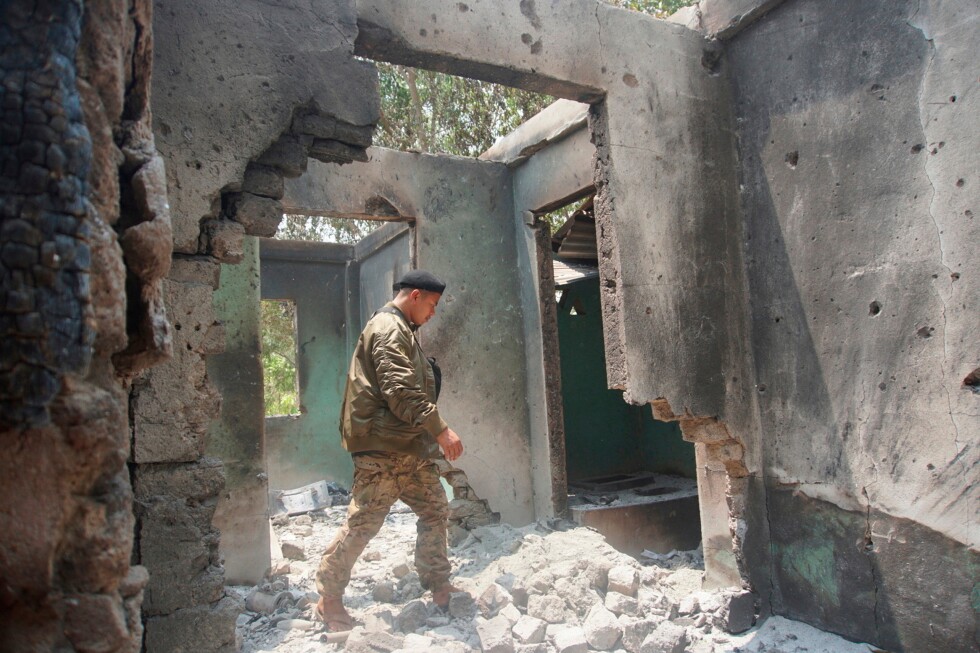
A shifting power dynamic has emerged in Myanmar’s bloody civil war, with the military now regaining ground against resistance forces that once held significant advantage. Just over a year ago, the Myanmar military—known as the Tatmadaw—appeared on the defensive, having lost substantial territory in the country’s north to an alliance of experienced militias while facing pressure from other armed groups nationwide.
Today, that picture has dramatically changed. Bolstered by tens of thousands of new conscripts, the Tatmadaw has reversed some of its territorial losses and appears poised to resume offensive operations. Meanwhile, several opposition groups have withdrawn from fighting, while others struggle with infighting and supply challenges.
“I think we’re nearing a crescendo here where the Tatmadaw is going to reassert itself and the resistance movement is going to peter out,” said Morgan Michaels, a Singapore-based analyst with the International Institute of Strategic Studies who runs its Myanmar Conflict Map project.
Despite this shift, Michaels emphasizes the conflict is far from over. “Armed resistance will always continue in Myanmar until there’s a comprehensive, negotiated political solution, but the Tatmadaw has retaken the strategic initiative and everything is in the Tatmadaw’s favor.”
After five years of conflict that has claimed tens of thousands of lives—including approximately 8,000 civilians—and displaced millions, a general weariness has settled over both combatants and civilians alike. Aung Thu Nyein, a Myanmar political analyst now based in Thailand, notes: “There are many saying that the local population doesn’t care much who will win the war, but just want to stop fighting.”
China’s influence looms large over the conflict. Beijing has invested billions in Myanmar’s mines, oil and gas pipelines, and other infrastructure projects. The country is a critical source of rare earth elements and natural resources for China, which has become a major arms supplier to the Tatmadaw alongside Russia.
Initially, China supported the October 2023 offensive against the Tatmadaw by the Three Brotherhood Alliance—a coalition of ethnic armed groups—largely due to Beijing’s frustration with the military government’s failure to control organized crime operations in border regions. However, China has since cut arms supplies to these militias and pressured them to cease hostilities.
Two key members of the Three Brotherhood Alliance—the Myanmar National Democratic Alliance Army and the Ta’ang National Liberation Army—agreed to ceasefires last year following Chinese-mediated talks. This has left the Arakan Army as the only alliance member still actively fighting the Tatmadaw in western Rakhine State.
The resistance against Myanmar’s military government comprises both long-standing Ethnic Armed Organizations (EAOs) organized around minority ethnic groups and newer pro-democracy militias known as People’s Defense Forces (PDFs). Many PDFs are affiliated with the shadow National Unity Government, established by former members of ousted leader Aung San Suu Kyi’s party.
The Burma Liberation Democratic Front, a pro-democracy group fighting in the Sagaing and Mandalay regions, told The Associated Press that improved coordination between resistance forces is urgently needed. “Although there is a shared understanding of the need to overthrow the military dictatorship and move toward a future federal union, there are still gaps and differences in overall grand strategy and tactics,” the group said.
“There are still differences in positions, perspectives, and approaches. Many continue to hold onto ethnic, regional, and organizational interests and attachments,” they added, noting that the Tatmadaw was actively “attempting to divide and weaken the situation by creating divisions.”
The military junta recently conducted elections widely criticized by UN experts as neither free nor fair. Min Aung Hlaing, who led the 2021 coup that ousted Suu Kyi, was sworn in as president earlier this month—a move seen as an attempt to legitimize his rule internationally as Myanmar struggles under sanctions.
China immediately congratulated Min Aung Hlaing and dispatched its foreign minister for a face-to-face meeting. The TNLA militia group also sent congratulations, reaffirming their commitment to the Chinese-brokered ceasefire.
In one of his first acts as president, Min Aung Hlaing invited resistance forces to peace talks, setting a July 31 deadline for participation. However, the offer came with the stipulation that groups should not bring “unrealistic demands.” The National Unity Government promptly rejected the offer, describing it as “aimed at prolonging people’s subjugation under military rule.”
In a possible conciliatory gesture, the military recently announced that Aung San Suu Kyi had been moved from prison to house arrest. She was originally sentenced to 33 years imprisonment in late 2022, in what critics described as an attempt to prevent her return to politics.
Meanwhile, military operations continue. The Tatmadaw is pressing a large-scale offensive in Sagaing region to recapture the northern city of Indaw, while simultaneously defending against a push by the Karen National Liberation Army near the Thai border.
“The Tatmadaw can always accept some degree of opposition and, in fact, needs some level of active armed resistance to justify its rule,” Michaels noted. “But the current level of armed resistance across the country is not tenable.”
Fact Checker
Verify the accuracy of this article using The Disinformation Commission analysis and real-time sources.

20 Comments
I like the balance sheet here—less leverage than peers.
Good point. Watching costs and grades closely.
Production mix shifting toward World might help margins if metals stay firm.
Good point. Watching costs and grades closely.
Interesting update on Myanmar’s military, filled with new conscripts, seems set to reassert itself. Curious how the grades will trend next quarter.
Good point. Watching costs and grades closely.
Interesting update on Myanmar’s military, filled with new conscripts, seems set to reassert itself. Curious how the grades will trend next quarter.
Good point. Watching costs and grades closely.
Good point. Watching costs and grades closely.
Silver leverage is strong here; beta cuts both ways though.
Good point. Watching costs and grades closely.
Exploration results look promising, but permitting will be the key risk.
Good point. Watching costs and grades closely.
Uranium names keep pushing higher—supply still tight into 2026.
Good point. Watching costs and grades closely.
Good point. Watching costs and grades closely.
Production mix shifting toward World might help margins if metals stay firm.
Good point. Watching costs and grades closely.
If AISC keeps dropping, this becomes investable for me.
Good point. Watching costs and grades closely.