


Listen to the article
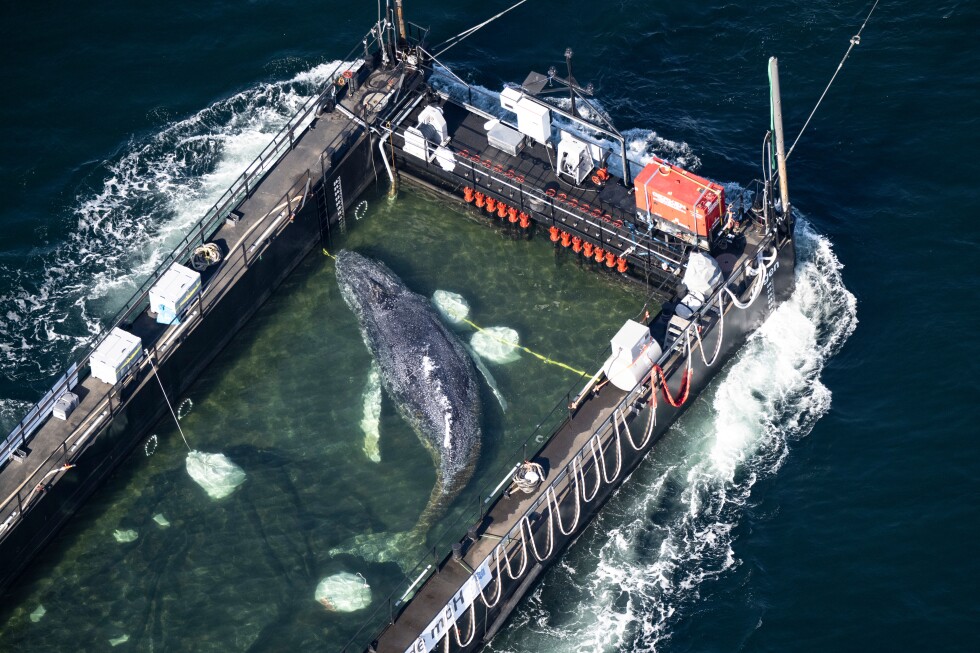
A barge carrying a humpback whale that had been stranded in shallow waters near Germany’s Baltic Sea coast since March has successfully begun its journey toward the North Sea, reaching Danish waters on Wednesday, German authorities confirmed.
The whale, nicknamed “Timmy” by German media, was first spotted on March 3 swimming in the Baltic Sea, far from its natural habitat in the Atlantic Ocean. Over several weeks, the mammal’s health deteriorated as it became repeatedly stranded in shallow waters, prompting multiple rescue attempts that garnered international attention through livestreams.
After previous failed efforts to guide the whale toward deeper waters, rescuers on Tuesday implemented a new strategy. They used straps to pull the distressed marine mammal onto a flooded barge via a specially dredged channel created to facilitate access to the vessel, according to the German press agency dpa.
The barge is now traveling around the northern tip of Denmark via the strait of Skagerrak with the ultimate destination being the North Sea, where officials hope the whale can return to its natural environment.
“Something like this has never happened before in Germany, where a life-saving operation of this kind has been carried out,” said Till Backhaus, Minister for Climate Protection, Agriculture, Rural Areas and Environment for the state of Mecklenburg-Vorpommern, during a press conference. “This was an experiment, and the experiment was a success, and that’s wonderful.”
Backhaus reported that the whale appeared to be resting peacefully during transport. He noted that the animal had vocalized Tuesday night, which experts interpreted as a positive sign of its wellbeing during this unprecedented rescue operation.
The minister had authorized this latest rescue attempt, proposed by a private initiative, despite reservations from some members of the scientific community who expressed concerns that the transportation process might cause additional stress to the already compromised whale.
The fate of the stranded humpback has sparked intense debate throughout Germany over the past several weeks. The question of whether to let the animal die peacefully or attempt to assist its return to the Atlantic Ocean divided marine experts, conservationists, and the public. Activists organized beach protests in Wismar advocating for the whale’s rescue, while others supported various transportation proposals or argued for natural intervention.
Thilo Maack, a marine biologist with Greenpeace, had expressed skepticism about the rescue efforts earlier this month, telling The Associated Press that the attempts had likely caused the animal severe stress.
“I believe the whale will die very soon now. And I would also like to raise the question: What is actually so bad about that?” Maack said at the time. “Yes, animals live, animals die. This animal is really, really very, very, very sick. And it has decided to seek rest.”
Some scientists had theorized that the whale specifically sought shallow waters because it was weakened and needed rest. This perspective conflicted with the assessment from veterinarians involved with the private rescue initiative, who determined that the animal was physically fit enough for transport.
Humpback whales typically migrate between feeding grounds in polar regions and breeding areas in tropical waters. Finding one in the Baltic Sea is extremely unusual, as these mammals normally stay in deeper Atlantic waters with access to their preferred food sources.
The rescue operation represents an extraordinary intervention that will be closely monitored by marine conservation experts worldwide, potentially establishing a precedent for future responses to marine mammal strandings in unusual locations.
Fact Checker
Verify the accuracy of this article using The Disinformation Commission analysis and real-time sources.

12 Comments
Fascinating rescue operation to save this stranded humpback whale. I hope the journey to the North Sea is successful and Timmy can return to its natural habitat.
Agreed, it’s great to see such a coordinated effort to help this whale. The whale’s health must have been a real concern during the rescue.
Carrying a large whale on a barge must have been an engineering challenge. I’m impressed the rescue team was able to devise a plan to safely transport Timmy to the North Sea.
Yes, it seems like an incredibly complex and delicate operation. I’m glad the authorities were able to come up with a solution to get the whale back to its natural habitat.
It’s heartening to see the international attention and effort put into saving this lost humpback whale. Timmy’s story highlights the importance of wildlife conservation efforts.
Absolutely. Protecting endangered species like humpback whales is crucial, even when they find themselves in unexpected places. This rescue mission is a positive example of that.
This is quite an unusual situation – a humpback whale stranded so far from its normal Atlantic range. I’m curious what led Timmy to wander into the Baltic Sea in the first place.
That’s a good question. Perhaps Timmy got disoriented or was following a food source. Hopefully the North Sea environment will be more suitable for the whale.
This is quite an unusual and fascinating story. I’m curious to learn more about how Timmy the humpback whale ended up so far from the Atlantic Ocean. Hopefully the journey to the North Sea goes smoothly.
Indeed, it will be interesting to see if the authorities can determine what led Timmy to wander into the Baltic Sea in the first place. A successful relocation to the North Sea would be a great outcome.
While an unusual situation, I’m glad to see the authorities taking the necessary steps to safely transport Timmy the whale back to the North Sea. Hopefully this gives the whale the best chance of survival.
Yes, the health and safety of the whale seems to be the top priority. Relocating Timmy to its natural habitat is the best course of action, even if it’s a complex logistical challenge.