


Listen to the article
Chinese State Media Expands Footprint in Spain Through University Deal
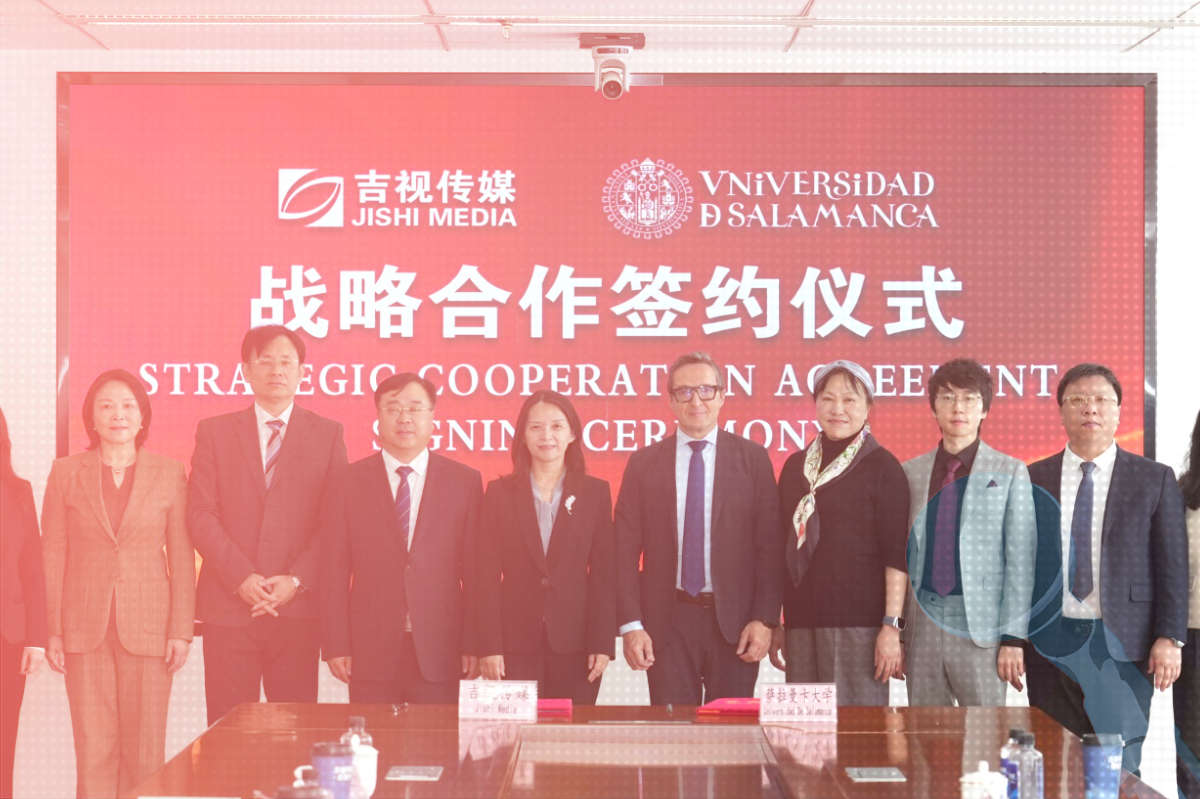
A delegation from Spain’s University of Salamanca, one of Europe’s oldest academic institutions, recently toured a conservation center in northeast China focused on protecting Siberian tigers and Amur leopards. The visit culminated in a strategic cooperation agreement between the university and Jilin Province’s state-run Jishi Media to “jointly promote the development of Sino-Spanish humanities and international communication.”
The agreement, signed by Jishi Media Party Secretary You Zhiqiang and Salamanca Rector Juan Corchado on April 23, outlines plans for collaborative documentary production on ecological themes, enhanced “international communication capacity,” and exchanges in journalism, culture, and artificial intelligence technologies.
While presented as a cultural exchange initiative, the deal represents China’s ongoing efforts to enhance what officials call “discourse power” abroad – essentially the ability to shape international narratives about China. The agreement adds to an extensive pattern of Chinese media engagement in Spain dating back more than a decade.
Behind the seemingly straightforward cultural partnership lies a complex web of Chinese Communist Party (CCP) influence. The signing ceremony was notably overseen by the propaganda office of Jilin’s Provincial CCP Committee and the China Public Relations Association (CPRA), an organization directly controlled by the CCP’s Central Propaganda Department despite its non-profit facade.
“The CPRA is a prime example of how the cloaking of Party-state ties is a key strategic aspect of China’s international outreach,” said a media analyst familiar with Chinese communication strategies. The association’s stated goals include “strengthening international exchanges and continuously expanding the international influence of China’s public relations work.”
The Northeast Tiger Leopard Cultural International Communication Center, which hosted the Spanish delegation, represents another element in China’s external messaging apparatus. Established in January 2025 as a joint venture between Jishi Media and the Northeast Tiger Leopard National Park Administration, it functions as one of Jilin Province’s four provincial-level international communication centers.
These centers form part of a nationwide network built since 2018 under what experts call “Centralization+” – a strategy placing local media outreach efforts under provincial propaganda departments while maintaining alignment with central messaging priorities.
The University of Salamanca appeared unaware of these political dimensions when announcing the deal, describing it simply as “a roadmap for the development of joint projects in the field of media communication, especially in areas linked to digital innovation, content production and specialized training.”
This agreement follows an earlier memorandum signed by Jishi Media with Madrid’s Fundación Conocer China (Spain Know China Foundation) in April 2025, which pledged to develop materials “helpful for Spain to understand 21st century Chinese reality” – phrasing that echoes Beijing’s position that Western media portrayal requires counterbalancing through strategic partnerships.
The Salamanca deal represents just one example in China’s accelerating media engagement with Spain. Over the past decade, Chinese state entities including Xinhua News Agency, China Media Group, and China International Communications Group have established partnerships with Spain’s public broadcaster RTVE, private news agencies like Europa Press, and media conglomerate Mediapro Group.
Media experts express concern that European institutions may not fully understand the nature of such arrangements. “The idea of China’s Central Propaganda Department offering substantive exchange on ‘media communication’ to a leading European university sits uneasily with the core purpose of educational institutions, whose interest is in openness and the free exchange of ideas,” noted one observer.
As China continues expanding its global media footprint, agreements like the Salamanca-Jilin partnership highlight the increasingly sophisticated methods used to advance state narratives abroad while obscuring the direct involvement of China’s propaganda apparatus.
Fact Checker
Verify the accuracy of this article using The Disinformation Commission analysis and real-time sources.

10 Comments
China’s pursuit of ‘discourse power’ abroad through strategic media deals is an intriguing development. I wonder how this agreement with the University of Salamanca will impact the information landscape in Spain.
It’s a complex issue – cultural exchange can be valuable, but there are valid concerns about the potential for propaganda and influence operations.
While the stated focus on ecological themes is positive, the broader context of China’s state-run media expanding its footprint raises questions about the true motivations behind this university partnership.
While the ecological themes are positive, the broader context of China’s state media expanding its global footprint raises questions about the motivations behind this deal with the University of Salamanca.
The agreement to ‘jointly promote the development of Sino-Spanish humanities and international communication’ raises some red flags. Enhancing ‘discourse power’ abroad could be a concerning tactic for influencing global narratives.
Agreed. China’s efforts to shape international perceptions through strategic media deals deserve close scrutiny.
Interesting to see China expanding its media presence in Spain through this university collaboration. I wonder what the broader implications are for shaping international narratives about China’s environmental policies and practices.
Yes, it will be important to closely examine the content and framing of any joint documentaries that come out of this partnership.
This deal adds to an established pattern of Chinese media engagement in Spain. It will be important for the public to critically evaluate the content and framing of any joint productions that result from this collaboration.
The focus on ‘international communication capacity’ is particularly concerning. Enhancing China’s ability to shape global narratives through this university partnership merits close scrutiny.