


Listen to the article
In a community where health information flows freely, the line between free speech and public responsibility has become increasingly blurred. One local blog’s recent content has sparked renewed debate about the impact of vaccine-related messaging on community wellbeing.
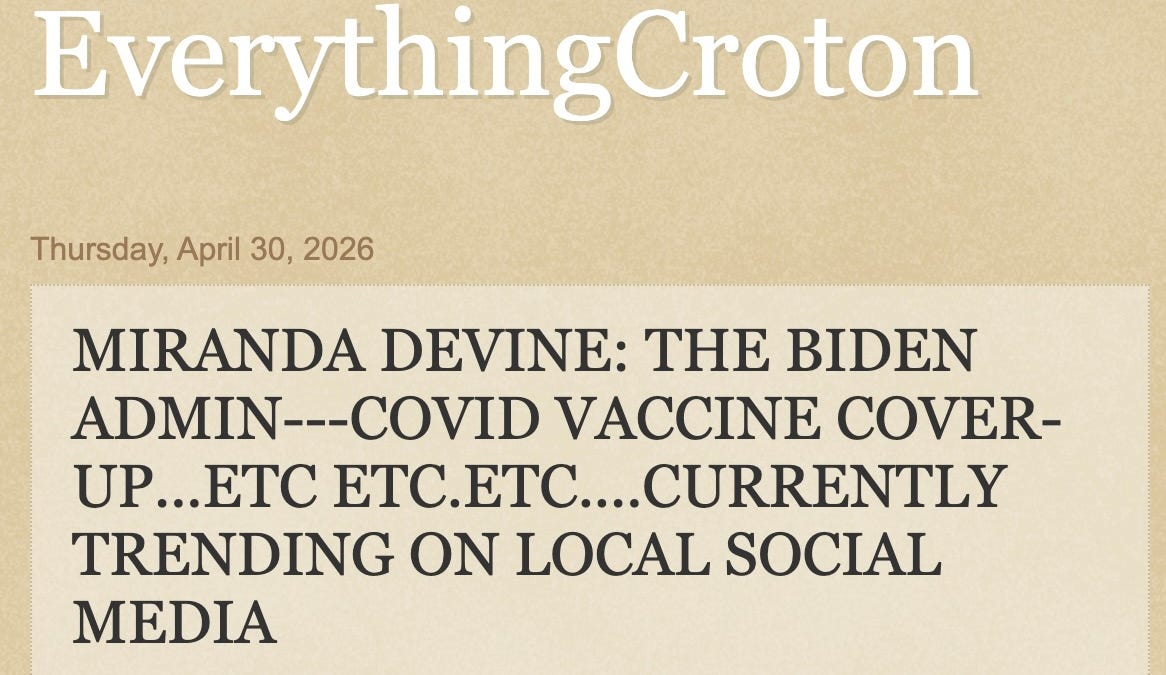
Maria Cudequest, a longtime Croton resident and publisher of the EverythingCroton blog, recently shared an opinion piece from the New York Post authored by Miranda Devine. The piece claims that Biden administration health officials attempted to conceal early evidence from 2021 suggesting potential adverse effects from COVID-19 vaccines.
Community health advocates have expressed concern that sharing such content without proper context could mislead local residents, particularly families with young children. They point out that Cudequest has previously identified as an opponent of vaccines beyond just the COVID-19 immunizations.
The controversy highlights the broader tensions around vaccine information in communities nationwide. While early COVID vaccine rollouts did involve some oversimplification of effectiveness and potential side effects, subsequent large-scale studies have provided substantial clarity on the risk-benefit equation.
Multiple international studies examining tens of millions of vaccinated and unvaccinated individuals have demonstrated that COVID vaccination significantly reduces mortality from all causes – not just from the virus itself. These findings suggest that while rare adverse reactions do occur, the protective benefits substantially outweigh the potential risks.
This local dispute mirrors national trends, as measles – a disease declared eliminated in the United States 25 years ago – has recently resurged in several communities. South Carolina has reported nearly a thousand confirmed measles cases, primarily among unvaccinated children and teenagers. Public health officials attribute this resurgence directly to declining vaccination rates.
“For communities like Croton with many young families, access to accurate, current health information is essential,” noted one local pediatrician who requested anonymity. “While everyone has the right to express their views, sharing incomplete medical information can have real consequences.”
The EverythingCroton blog has built a substantial following over years of covering local events and community news. Supporters value its commitment to documenting Croton’s daily life and community events, considering it an important local resource.
Critics, however, argue that the platform’s influence makes its occasional forays into controversial health topics particularly concerning. They point out that the blog has previously shared content from Alex Berenson, another writer who has faced criticism for his claims about vaccine safety.
Public health experts emphasize that the mRNA technology used in COVID-19 vaccines, while relatively new, has undergone rigorous safety monitoring. The unprecedented scale of COVID vaccine distribution has actually provided more safety data than is typically available for medical interventions.
The local disagreement reflects broader societal tensions around information sources, expertise, and the responsibilities that come with public platforms. While free speech protections certainly apply to blog content, community members suggest that platforms with substantial followings bear an added responsibility to present balanced health information.
For Croton parents making decisions about their children’s health, sorting through conflicting claims remains challenging. Local medical providers continue to recommend following guidance from major medical organizations, which overwhelmingly support vaccination as a critical public health tool.
As one resident commented, “In a small community like ours, what we share with our neighbors matters. We all want what’s best for our families, but we need good information to make those choices.”
The dispute underscores that even in close-knit communities, profound differences in perspective about public health, individual choice, and information sharing continue to shape local discourse in the post-pandemic era.
Fact Checker
Verify the accuracy of this article using The Disinformation Commission analysis and real-time sources.

8 Comments
This blog post raises valid concerns about the potential impact of sharing unsubstantiated claims related to COVID vaccines. While free speech is crucial, we must also consider the public health ramifications, especially for families with young children.
Well said. Vaccine hesitancy can have real consequences, so it’s important that information sources exercise caution and provide proper context, even for controversial topics. Balanced, evidence-based reporting is the responsible approach.
Interesting debate on the balance of free speech and public health information. We should be cautious about spreading unverified claims that could mislead the community, especially on sensitive topics like vaccines. Fact-checking and proper context is key.
I agree. Early vaccine data wasn’t perfect, but the scientific consensus has become much clearer over time. Responsible reporting is important, to avoid fueling misinformation that could put vulnerable people at risk.
This is a complex issue without easy answers. I appreciate the blog’s effort to cover it, but sharing unsubstantiated vaccine claims seems risky, even if under the guise of free speech. Responsible reporting on public health is crucial.
Agreed. Maintaining public trust in health authorities is vital, especially during a pandemic. Promoting misinformation, even inadvertently, can undermine critical efforts to protect vulnerable populations. Balance and nuance are needed here.
The tensions around vaccine information in local communities are understandable, but spreading unverified claims could be very harmful. I hope this blog can find a way to discuss these issues responsibly, without risking public health.
While I understand the desire for open dialogue, publishing unverified claims about vaccine safety could have serious consequences for this community. I hope the blog will reconsider its approach and prioritize evidence-based, contextual reporting on this sensitive topic.