


Listen to the article
In the foothills of Japan’s Northern Alps, an unusual confrontation plays out daily. Men and women in bright orange vests move methodically through bamboo groves and forest underbrush, ringing bells and striking trees with walking sticks. Armed with GPS trackers and radios, they coordinate their movements with military precision. Their quarry: Japanese macaques that have strayed too close to human settlements.
This is the Monkey Chasing Squad, a group of about 50 part-time civil servants in Azumino city tasked with herding the primates back into their natural mountain habitat. The goal is simple but challenging – keep the monkeys away from farms and neighborhoods where they cause damage and disruption.
“We’re just returning them to where they’re supposed to be,” explains Masaya Miyake, who leads the squad. “Naturally, the food in the village is more nutritious and tastier. They’re not simply being mischievous; they’re just coming down to eat.”
The situation highlights Japan’s complex relationship with its native wildlife. Just 90 kilometers south of Azumino, the Jigokudani Monkey Park attracts over 200,000 visitors annually, half from overseas, who come to photograph macaques bathing in hot springs. Yet in farming communities, these same animals are considered pests.
While the monetary damage from monkeys is relatively small compared to other wildlife – Japan’s Agriculture Ministry reported total crop damage from wild animals at 15.6 billion yen ($100 million) in 2022, with deer and wild boar causing most of the destruction – macaques create unique problems. They break into homes, steal food, and damage crops, leading to growing frustration among residents.
Before 2023, nearly all the monkeys in Ariake, a district of Azumino, lived within the town, with only 1% remaining in the mountains. According to city officials, the macaques now spend about half their time in the hills, an improvement attributed to the Monkey Chasing Squad’s persistent efforts.
Not everyone views the monkeys as nuisances. Takumi Matsuda, who moved to Azumino a decade ago and experienced monkeys breaking into his home, now documents their natural behaviors through photography. His Instagram account, with over 60,000 followers, showcases the animals not as pests or pets but as wild creatures in their natural habitat.
“I want to share with as many people as possible the peaceful behavior of monkeys in their natural habitat,” Matsuda told The Associated Press.
His perspective shifted after encountering a hunter authorized to cull monkeys. When Matsuda asked why the hunter had killed a specific animal, the response was simply, “because I had seen it.” This exchange made Matsuda question the effectiveness of current control methods.
“In Japan today, opinions have become polarized between ‘don’t kill a single one’ and ‘kill them all,'” he said. “I oppose the wasteful taking of life and want effective measures so we don’t have to keep killing monkeys forever.”
Despite the squad’s year-round patrols, calls for more aggressive culling are growing. Azumino City Councilman Yoichi Tsujitani advocates for removing macaques entirely from human-adjacent areas, estimating it would take two to three years to accomplish.
However, ecologists warn that culling may be counterproductive. Shigeyuki Izumiyama of Nagano’s Shinshu University explains that when entire troops are removed, neighboring groups simply move into the vacated territory. Additionally, smaller troop sizes can push surviving monkeys deeper into farmland in search of food and safety.
“Part of the issue is that legislators don’t have enough time and are being asked to produce quick results,” said Takayo Soma, a primate researcher at Kyoto University. “But ecology doesn’t work that way. Macaques live about 20 years, so we need to take a long-term approach.”
The irony of the situation isn’t lost on Michael Johnson, a retired English professor living in Azumino since 2011. After monkeys broke into his house four times – including a raid by 12 animals that required a five-hour cleanup – he’s skeptical of official mitigation efforts.
“I stopped going to City Hall,” Johnson said, referring to local programs offering free rocket fireworks and one-month air gun rentals. “What’s the point? I think my slingshot is better, though they’re smart enough to stay out of range.”
Japanese macaques received protective status in 1947 to rebuild populations decimated during World War II. Today, experts like Professor Izumiyama advocate for more sustainable solutions, including clearing vegetation near farms, tracking monkeys with GPS collars, and installing electric fences.
Some farmers have found success with such approaches. Kazuo Matsuda, an apple grower, installed electric fencing around his orchard, though he notes the system is expensive to maintain. Others, like retired teacher Shigeru Maruyama – who serves on the Monkey Chase Squad while tending his apple and blueberry crops – believe trained dogs offer better protection than human efforts.
“When people chase them, the monkeys just taunt us, like ‘Come on, try me,'” observed Takahiro Isomoto, who trains dogs to ward off various wildlife.
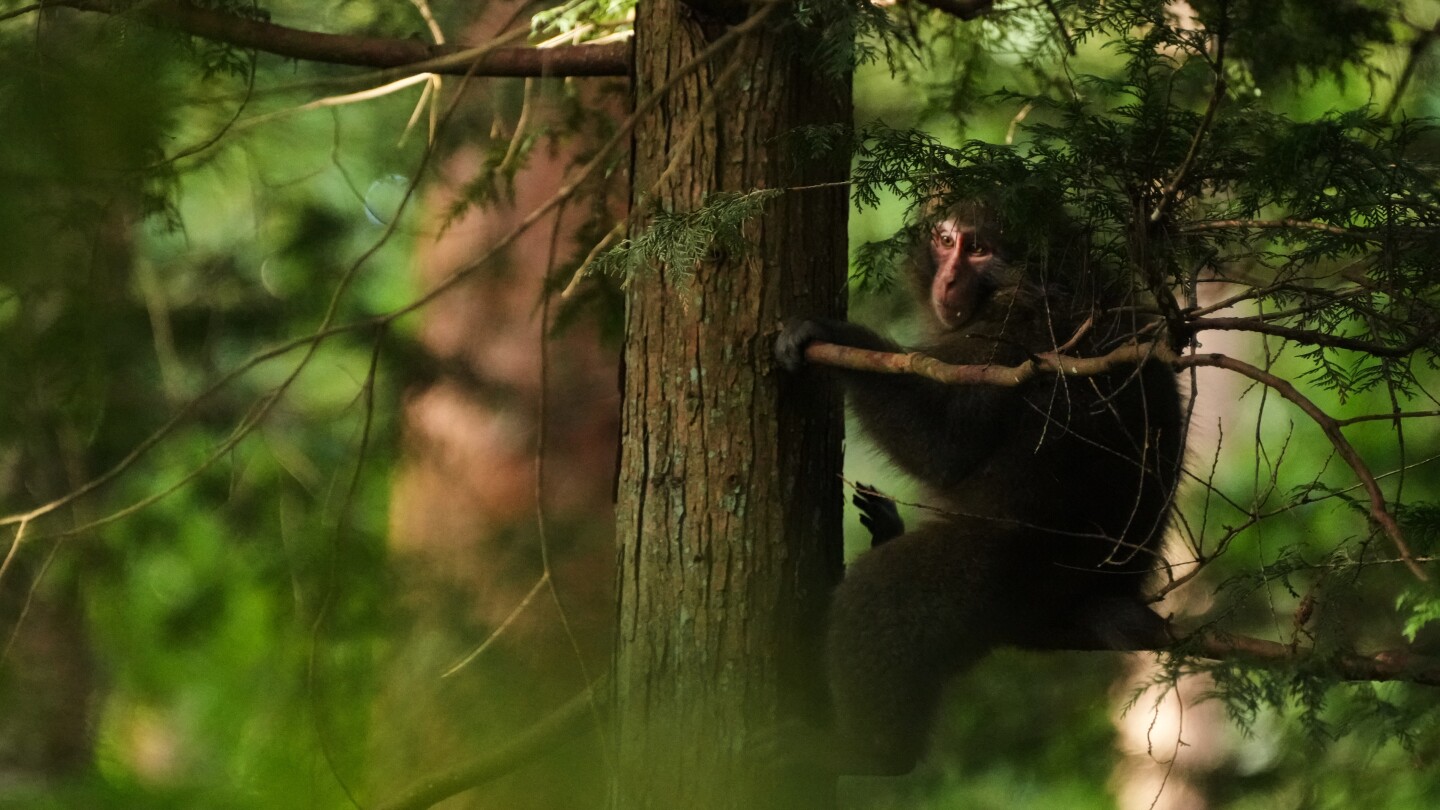
The complexity of the human-wildlife conflict was perfectly illustrated during a recent patrol. After being chased away from a forest shrine, the monkeys quickly returned, perching on the roof to watch their human adversaries below.
“Now it’s almost the opposite – like we’re the squad that doesn’t chase monkeys,” Miyake quipped, highlighting the ongoing challenge of coexistence in Japan’s rapidly changing rural landscape.
Fact Checker
Verify the accuracy of this article using The Disinformation Commission analysis and real-time sources.

8 Comments
This is a really interesting story about the complex relationship between humans and wildlife in Japan. The Monkey Chasing Squad’s efforts to herd the macaques back to the mountains seem like a reasonable approach, though it’s clear that more long-term solutions may be needed to prevent repeated conflicts.
The confrontation between residents and the Japanese macaques is a fascinating example of the challenges of urban-wildlife coexistence. I’m impressed by the Monkey Chasing Squad’s coordinated efforts to herd the primates back to their natural habitat, though it does seem like an ongoing battle.
I wonder if there are any insights from this situation that could be applied to managing human-wildlife conflicts in other parts of the world facing similar issues.
It’s great that Japan is trying to find humane ways to deal with this issue, rather than resorting to more aggressive measures. Coexisting with native wildlife can be challenging, but the Monkey Chasing Squad seems to be taking a balanced approach.
I’m curious to learn more about the park that attracts so many visitors to see the macaques. Do they have a successful model for managing the monkeys in a way that benefits both the animals and the local community?
Fascinating story about the delicate balance between wildlife and human settlements in Japan. The Monkey Chasing Squad sounds like an unusual but necessary job to manage the mischievous macaques and protect local farms and homes.
I wonder if there are any non-lethal deterrents or relocation methods that could help the monkeys stay in their natural mountain habitat while minimizing conflict with nearby residents.
This story highlights the delicate balance that must be struck between preserving wildlife and protecting human settlements. The Monkey Chasing Squad’s efforts to herd the macaques back to their natural habitat seem like a reasonable compromise, though I wonder if there are any long-term solutions to prevent repeated conflicts.