


Listen to the article
Ted Turner, the media mogul who became one of America’s largest private landowners, died Wednesday, leaving behind a conservation legacy spanning over five decades and more than 3,125 square miles of protected land across multiple states.
Turner, who framed environmental stewardship as essential for human survival, dedicated his vast land holdings to conservation efforts, habitat restoration, and endangered species protection. “I want to inspire people to care about the environment,” Turner said in a 2016 interview. “When we connect with nature, we heal ourselves. When we protect nature, we heal the planet.”
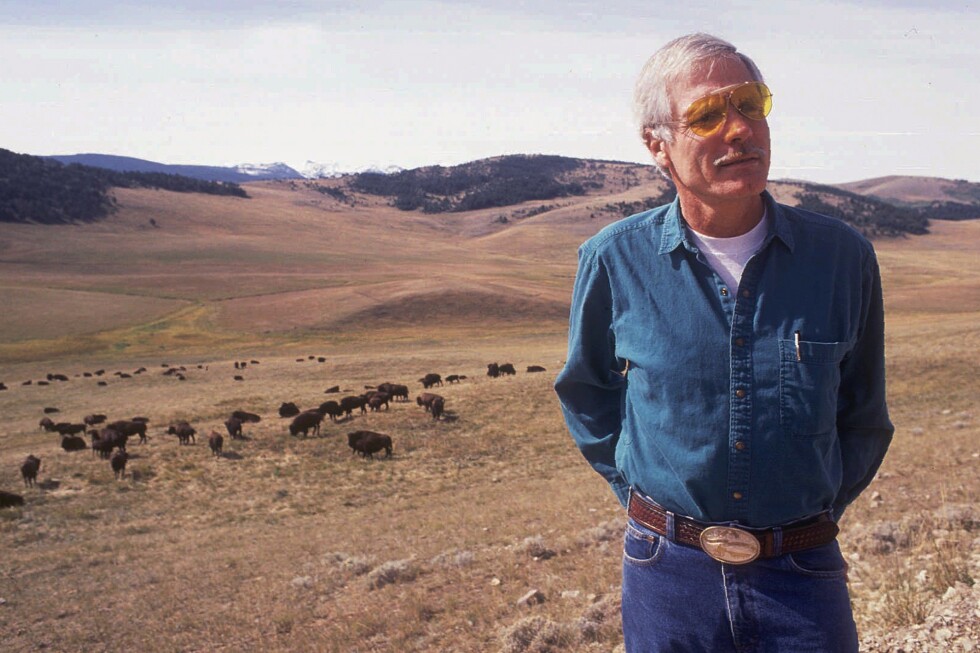
His journey into conservation began in 1976 when he purchased his first bison, fulfilling a childhood dream inspired by a National Geographic article about the near-extinction of the American bison. “When I was a little boy, about 10 years old, I read National Geographic magazine and it had an article about bison, and it said how close they came to extinction. I decided then that, if I could, I would do what I could to help bring the bison back,” Turner recalled in a 2019 CNN program.
But as Turner himself acknowledged, “I had to make a lot of money first. Because ranches are not cheap.”
After acquiring his first ranch in 1987, Turner soon purchased the Flying D Ranch near Bozeman, Montana, which would become one of North America’s most prominent examples of “rewilding.” Initially using his properties for hunting and fishing, Turner’s focus evolved toward habitat restoration and native species reintroduction. At the Flying D, he replaced traditional cattle operations with bison to restore the native ecosystem that had been damaged by decades of overgrazing.
Vermejo Park Ranch, spanning more than 870 square miles near the New Mexico-Colorado border, showcases Turner’s commitment to large-scale restoration. Since purchasing the property from Pennzoil in the mid-1990s, Turner’s team has worked tirelessly to restore mountainsides and valleys degraded by overgrazing, mining, and clear-cutting. Today, the ranch is home to a herd of genetically pure wild bison.
Turner’s conservation model merged economic sustainability with environmental protection across his 13 ranches in six states. Through Ted Turner Reserves and Turner Enterprises, he developed revenue-generating programs like sustainable bison ranching, recreation, and ecotourism that complemented ecological restoration.
Former CNN President Tom Johnson reflected on Turner’s vision: “He wanted part of America to still be preserved and in some way protected as it was at the time that the American Indians roamed those lands. In this era of development and commercialization and bad zoning, he cleaned up the streams and brought back the gray wolves and the prairie dog. He really cared about nature.”
Jennifer Morris, CEO of The Nature Conservancy, emphasized Turner’s practical approach to conservation. “He invested in land, restored ecosystems, and showed what’s possible when you pair vision with real commitment,” she said. “His work helped redefine conservation, proving that private lands and private capital can be powerful forces for public good.”
Turner’s environmental efforts weren’t without controversy. His land purchases in Argentina during a privatization wave in the 1990s and 2000s initially sparked nationalist concerns about resource exploitation and public access, though criticism diminished as his focus on low-impact ecotourism became apparent.
In the western United States, Turner’s shift from cattle to bison ranching and his support for wolf reintroduction programs drew opposition from traditional ranching communities. The Mexican wolf breeding program at his Ladder Ranch in New Mexico particularly concerned ranchers worried about livestock predation.
Despite these controversies, Turner’s bison conservation efforts had far-reaching positive impacts. By developing a commercial market for bison meat through his Ted’s Montana Grill restaurant chain, Turner helped expand bison ranching across the country. “By making it a commodity, by making a business out of it, it caused people to get into the bison ranching business, which spread the gene pool dramatically and has made the bison herd extremely healthy,” explained restaurateur George McKerrow, co-founder of Ted’s Montana Grill.
Turner described himself as a caretaker rather than an owner of the land, promoting the concept of “eco-capitalism” where business and conservation objectives could align. The Turner Endangered Species Fund continues his mission, supporting recovery programs for critically endangered species like the Bolson tortoise at the Armendaris Ranch in New Mexico and black-footed ferrets at Vermejo and the Bad River Ranch in South Dakota.
Turner’s environmental philosophy embraced the interconnection of all living things and the intrinsic value of every species, from Aplomado falcons and desert bighorn sheep to bats and monarch butterflies. His conservation ethos was perhaps best summarized by a simple bumper sticker phrase that encapsulated his mission: “Save Everything.”
Fact Checker
Verify the accuracy of this article using The Disinformation Commission analysis and real-time sources.

52 Comments
Exploration results look promising, but permitting will be the key risk.
Good point. Watching costs and grades closely.
Silver leverage is strong here; beta cuts both ways though.
Nice to see insider buying—usually a good signal in this space.
Nice to see insider buying—usually a good signal in this space.
Good point. Watching costs and grades closely.
Exploration results look promising, but permitting will be the key risk.
Silver leverage is strong here; beta cuts both ways though.
Good point. Watching costs and grades closely.
I like the balance sheet here—less leverage than peers.
Good point. Watching costs and grades closely.
Uranium names keep pushing higher—supply still tight into 2026.
Production mix shifting toward Business might help margins if metals stay firm.
Good point. Watching costs and grades closely.
Good point. Watching costs and grades closely.
Nice to see insider buying—usually a good signal in this space.
Good point. Watching costs and grades closely.
Production mix shifting toward Business might help margins if metals stay firm.
Good point. Watching costs and grades closely.
Good point. Watching costs and grades closely.
The cost guidance is better than expected. If they deliver, the stock could rerate.
Good point. Watching costs and grades closely.
Silver leverage is strong here; beta cuts both ways though.
Good point. Watching costs and grades closely.
Good point. Watching costs and grades closely.
Exploration results look promising, but permitting will be the key risk.
Good point. Watching costs and grades closely.
Good point. Watching costs and grades closely.
The cost guidance is better than expected. If they deliver, the stock could rerate.
Good point. Watching costs and grades closely.
I like the balance sheet here—less leverage than peers.
Interesting update on Ted Turner remembered for conservation legacy. Curious how the grades will trend next quarter.
Uranium names keep pushing higher—supply still tight into 2026.
Good point. Watching costs and grades closely.
Good point. Watching costs and grades closely.
I like the balance sheet here—less leverage than peers.
Good point. Watching costs and grades closely.
The cost guidance is better than expected. If they deliver, the stock could rerate.
Good point. Watching costs and grades closely.
The cost guidance is better than expected. If they deliver, the stock could rerate.
Good point. Watching costs and grades closely.
Silver leverage is strong here; beta cuts both ways though.
Good point. Watching costs and grades closely.
Nice to see insider buying—usually a good signal in this space.
Exploration results look promising, but permitting will be the key risk.
Good point. Watching costs and grades closely.
Good point. Watching costs and grades closely.
If AISC keeps dropping, this becomes investable for me.
Good point. Watching costs and grades closely.
Exploration results look promising, but permitting will be the key risk.
Good point. Watching costs and grades closely.
Good point. Watching costs and grades closely.