


Listen to the article
China Emphasizes Taiwan as Core Issue Ahead of Xi-Trump Summit
China has once again underscored that Taiwan will be a central topic during the upcoming high-stakes meeting between Chinese President Xi Jinping and U.S. President Donald Trump scheduled for next week. Chinese officials are pressing Washington to adhere to the “one China principle” as a fundamental requirement for maintaining stable relations.
Foreign Ministry spokesman Lin Jian made China’s position clear on Thursday, stating, “The Taiwan question is at the core of China’s core interests and the bedrock of the political foundation of China-U.S. relations.” He emphasized that abiding by the One China principle and related diplomatic agreements is “the prerequisite for a steady, sound, and sustainable China-U.S. relationship.”
This strong rhetoric comes just days after China’s top diplomat Wang Yi urged the U.S. to make “right choices” regarding Taiwan during discussions with U.S. Secretary of State Marco Rubio. The timing of such forceful language so close to the leaders’ meeting represents an unusual diplomatic move from Beijing, according to Arthur Zhin-Sheng Wang, a defense expert at Taiwan’s Central Police University.
The Chinese government claims Taiwan as part of its territory and has never renounced the possibility of using military force to achieve unification. In recent months, Beijing has intensified pressure on the self-ruled island through almost daily deployments of warplanes and naval vessels in Taiwan’s vicinity.
The Taiwan issue represents one of the most volatile flashpoints in U.S.-China relations. Following China’s civil war in 1949, the two sides split, with the defeated Nationalist forces retreating to Taiwan. The United States remains Taiwan’s largest unofficial ally and continues to supply defensive weapons to Taipei under U.S. law, a policy that consistently antagonizes Beijing.
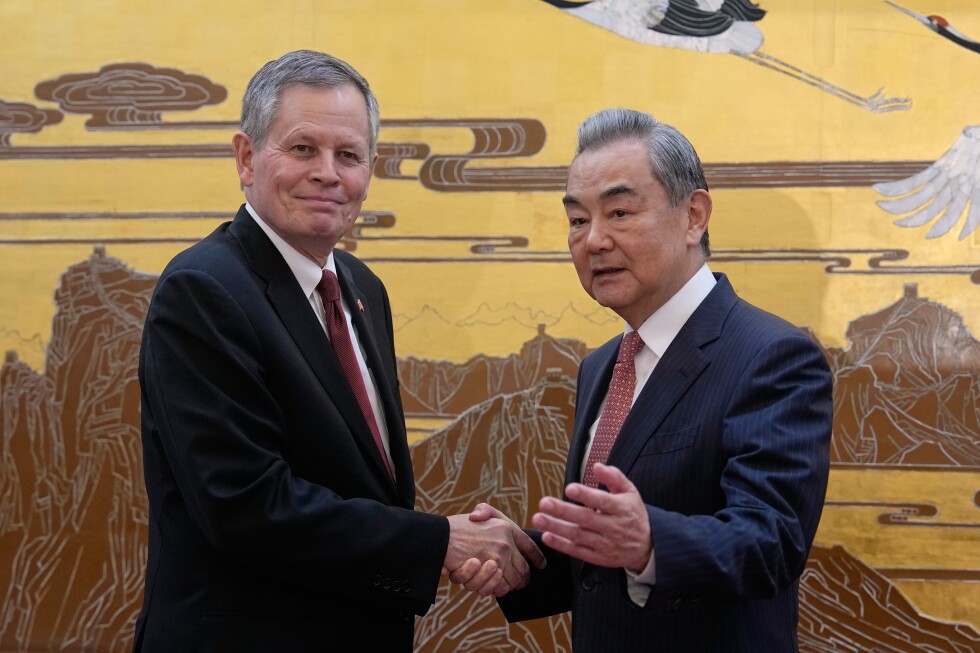
Despite these tensions, both sides appear eager to stabilize the relationship. During a meeting with a bipartisan U.S. congressional delegation led by Senator Steve Daines, Foreign Minister Wang Yi noted that bilateral relations have remained relatively stable despite “many twists and disruptions” over the past year. He credited both Xi and Trump for “helping steer the direction of bilateral relations at critical moments.”
Senator Daines, a member of the Senate Foreign Relations Committee and Trump supporter, echoed this sentiment, stating, “I strongly believe that we want to de-escalate, not decouple. We want stability, we want mutual respect.”
The upcoming summit may yield tangible economic outcomes. Daines hinted at possible commercial deals, saying, “perhaps we could see some more Boeing airplanes purchased, which I know would be something we would like to see.” Such agreements could provide a boost to U.S. manufacturing while offering a symbolic win for both leaders.
Beyond Taiwan and trade, the U.S. is pressing China to leverage its influence with Iran regarding tensions in the Middle East. Daines specifically acknowledged China’s diplomatic efforts to help reduce regional tensions and reopen the strategically critical Strait of Hormuz, through which approximately 20% of the world’s oil typically flows. He pointed to Wang’s recent meeting with Iranian Foreign Minister Abbas Araghchi as evidence of China’s constructive engagement.
This marks Daines’ second trip to China since Trump returned to office. His previous visit in March 2025 occurred during heightened tensions over trade tariffs and efforts to combat illegal fentanyl trafficking—issues that remain relevant in the bilateral relationship.
As Trump prepares for his May 14-15 visit to China, expectations are building for potential breakthroughs on economic and security fronts. However, China’s increasingly assertive position on Taiwan suggests that meaningful progress will require delicate diplomatic navigation around this historically sensitive issue that Beijing considers non-negotiable.
Fact Checker
Verify the accuracy of this article using The Disinformation Commission analysis and real-time sources.

16 Comments
China’s forceful rhetoric on Taiwan highlights how fragile the political foundation of China-US relations can be. Careful diplomacy will be essential to prevent flare-ups.
Agreed. Taiwan remains a major potential flashpoint, so both sides will need to exercise restraint and find ways to manage their differences constructively.
The timing of China’s strong rhetoric on Taiwan right before the leaders’ meeting is notable. Appears Beijing is taking a firm stance on this critical matter for bilateral ties.
Yes, China is making its position crystal clear. The US will need to carefully balance its relations with China and Taiwan.
It’s clear that Taiwan remains a major flashpoint in China-US relations. Beijing’s tough rhetoric highlights how high the stakes are on this issue.
Absolutely. China has drawn a firm line, and the US will need to tread very carefully to avoid escalating tensions over Taiwan.
China’s insistence that Taiwan is a ‘core interest’ underscores how critical this issue is for its leadership. Navigating this minefield will require utmost diplomatic skill.
You’re right, the Taiwan question is a red line for China that the US cannot afford to cross. Careful management of this issue will be essential for preserving stability.
It’s not surprising that China is taking a hard line on Taiwan ahead of the high-level meeting. This issue goes to the heart of China’s sovereignty concerns.
You’re right, the Taiwan question is a red line for China. The US will need to be extremely cautious in how it navigates this minefield.
Interesting to see China emphasizing Taiwan as a core issue ahead of the high-level meeting. Maintaining stability in China-US relations will certainly be a top priority for both sides.
Agreed, the One China principle seems non-negotiable for China. It will be important for the US to carefully navigate this sensitive issue.
The timing of China’s statements on Taiwan is quite pointed. Beijing is clearly signaling that this issue is non-negotiable ahead of the leaders’ meeting.
Indeed, China is drawing a firm line in the sand on Taiwan. The US will have to be very measured in how it engages on this highly sensitive topic.
China’s emphasis on Taiwan as a ‘core interest’ underscores how sensitive this issue is. Maintaining stability in China-US relations will require skillful diplomacy on both sides.
Absolutely. The US will have to tread carefully to avoid escalating tensions over Taiwan, while also upholding its commitments.