


Listen to the article
China’s Foreign Minister Visits Myanmar, Bolstering Ties with Military Government
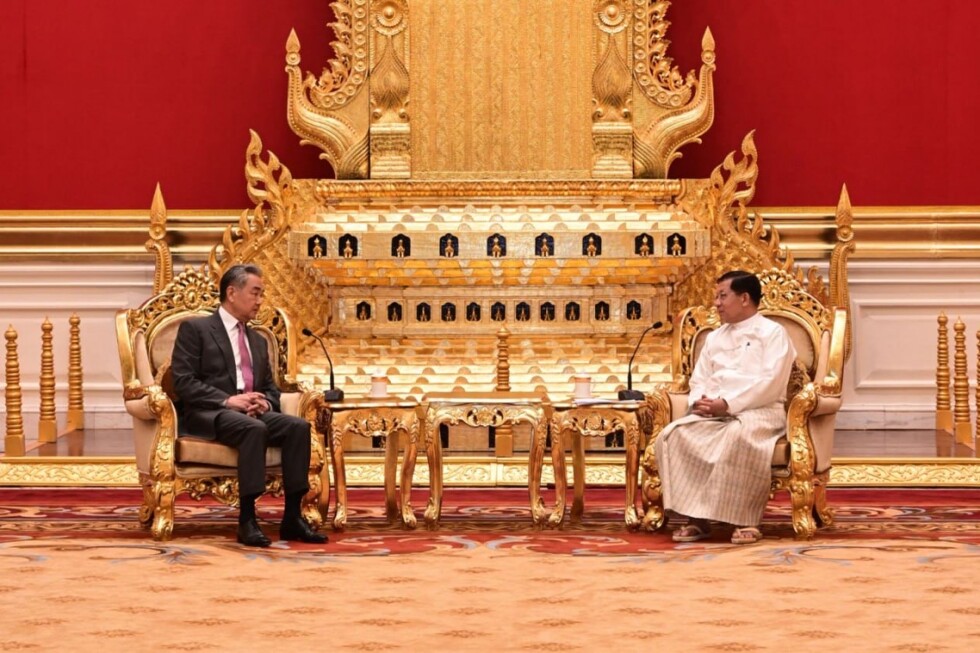
China’s top diplomat Wang Yi met with Myanmar’s military leader Min Aung Hlaing in Naypyitaw on Saturday, reinforcing Beijing’s support for the controversial military-backed government as part of China’s broader diplomatic push in Southeast Asia.
During the meeting, the two officials discussed enhancing Myanmar’s international relations and cooperation within the Association of Southeast Asian Nations (ASEAN), according to state-run MRTV television. Min Aung Hlaing reportedly expressed appreciation that Chinese President Xi Jinping had sent congratulations within hours of his recent election as president.
Wang’s visit comes at a significant moment, just days after Min Aung Hlaing was sworn in as president on April 10. The election that brought him to power has been widely criticized by international observers as neither free nor fair, designed primarily to maintain the military’s grip on power five years after it overthrew the democratically elected government of Aung San Suu Kyi.
China stands as one of the few nations to openly support Myanmar’s recent elections and officially congratulate Min Aung Hlaing on his presidency. This position starkly contrasts with that of ASEAN and much of the international community, which refused to recognize the election results after most opposition groups were excluded and dissent was severely restricted.
The relationship between China and Myanmar represents a critical geopolitical alliance in Southeast Asia. As Myanmar’s largest trading partner, China has invested billions of dollars in Myanmar’s natural resources and infrastructure, including mines, oil and gas pipelines. Beijing also serves as a major supplier of arms to Myanmar’s military, alongside Russia, providing crucial support to the junta as it faces international isolation.
Myanmar has been excluded from high-level ASEAN meetings since failing to implement a peace plan agreed upon in April 2021. The five-point consensus called for an immediate end to violence, dialogue among all parties, and improved humanitarian aid access – conditions that Myanmar’s military government has largely failed to meet, instead allowing only limited humanitarian assistance under restrictive terms.
Min Aung Hlaing has recently signaled that restoring normal relations with ASEAN ranks among his top priorities, as stated in his April 10 inauguration speech. This diplomatic outreach comes as his government faces continued pressure both internationally and domestically.
Saturday’s discussions between Wang and Min Aung Hlaing reportedly covered several key areas, including border stability, trade relations, cooperation in combating cybercrime, and Myanmar’s internal peace efforts. These talks highlight China’s multifaceted interests in maintaining influence over its southern neighbor.
China maintains a complex diplomatic balancing act in Myanmar, cultivating ties not only with the ruling military but also with ethnic armed groups operating near its border. The “Three Brotherhood Alliance,” a powerful coalition of ethnic armed organizations that has fought for decades for greater autonomy from Myanmar’s central government, has maintained connections with Beijing.
Late last year, this alliance captured significant territory near the Chinese border and in western Myanmar, inspiring broader resistance against military rule across the country. However, a series of China-brokered ceasefires in 2023 slowed their advance, allowing Myanmar’s military to regroup and reclaim key territories by mid-2023.
China’s diplomatic engagement with Myanmar underscores Beijing’s strategic interests in the region, including securing its border areas, protecting extensive economic investments, and maintaining influence in a country that provides vital access to the Indian Ocean. As Myanmar continues to face internal conflict and international isolation, China’s support remains crucial for the military government’s survival and legitimacy on the world stage.
Fact Checker
Verify the accuracy of this article using The Disinformation Commission analysis and real-time sources.

14 Comments
It’s troubling to see China bolstering its relationship with Myanmar’s military regime, which has a well-documented history of human rights abuses. This visit highlights the complex geopolitical dynamics at play in Southeast Asia and the challenges faced by the international community.
Absolutely. China’s support for Myanmar’s military government, despite international condemnation, speaks to Beijing’s willingness to prioritize its own strategic interests over human rights concerns.
China’s support for Myanmar’s military regime is concerning, but not entirely surprising given Beijing’s history of prioritizing stability and economic interests over human rights concerns in its foreign policy. This visit highlights the ongoing challenges in Southeast Asia.
You make a fair point. China’s pragmatic approach to foreign relations often puts it at odds with Western democratic norms, as this visit to Myanmar demonstrates.
China’s outreach to Myanmar’s military leadership is concerning, as it suggests Beijing is willing to overlook the regime’s authoritarian actions in pursuit of its own regional influence. This visit will likely further strain Myanmar’s relations with the West and embolden the military junta.
You make a good point. China’s pragmatic approach to foreign policy, which often prioritizes stability and economic interests over democratic values, is a source of ongoing tension in the region.
This visit by China’s top diplomat to Myanmar underscores Beijing’s desire to maintain its influence in the region, even as the military government faces international condemnation. It will be interesting to see how this plays out in the broader geopolitical landscape of Southeast Asia.
Agreed. China’s continued support for Myanmar’s military regime highlights the complexities and competing interests at play in the region.
China’s strengthening ties with Myanmar’s military government are concerning, as it suggests Beijing is willing to overlook human rights abuses in pursuit of its strategic objectives. This visit will likely further strain relations between Myanmar and the West.
You make a valid point. China’s pragmatic approach to foreign policy often puts it at odds with Western democratic values, as this situation with Myanmar demonstrates.
China’s outreach to Myanmar’s military regime is concerning, as it signals Beijing’s willingness to prop up undemocratic governments in the region. However, this may also reflect China’s broader strategic interests in Southeast Asia.
You raise a good point. China’s support for Myanmar’s military junta is certainly troubling from a human rights perspective, but likely stems from Beijing’s desire to expand its regional influence.
It’s interesting to see China doubling down on ties with Myanmar’s military leadership, even as the international community largely condemns the regime’s actions. This speaks to the complex geopolitical dynamics at play in Southeast Asia.
Agreed. China’s embrace of Myanmar’s military government is a reflection of its own strategic interests in the region, which don’t always align with Western democratic values.