


Listen to the article
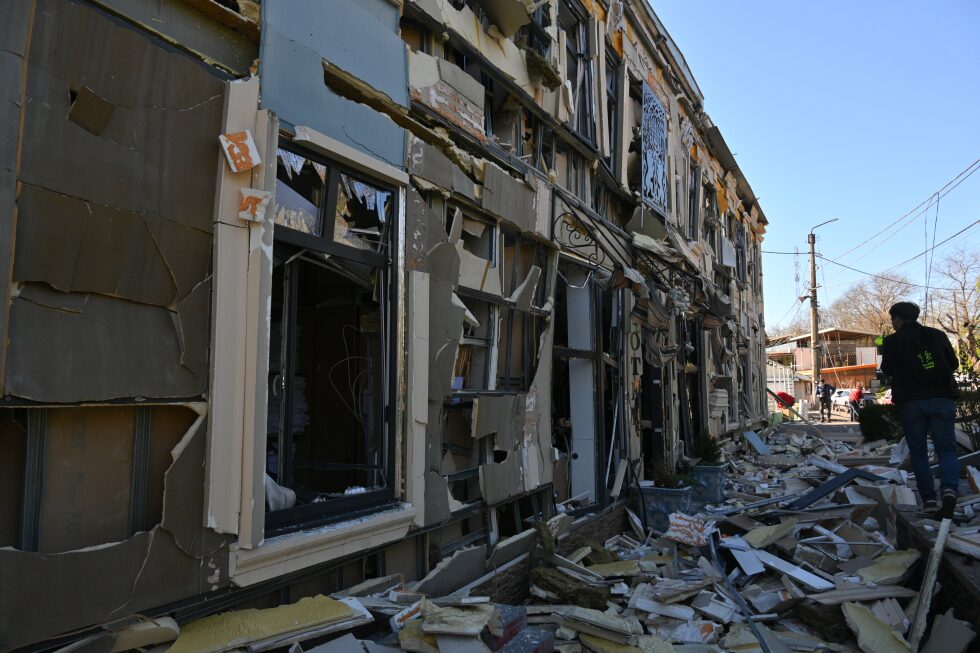
Russian drone strikes on the Ukrainian port city of Odesa wounded 14 people, including two children, early Monday morning as Moscow continues its unrelenting aerial bombardment of civilian areas across Ukraine.
The pre-dawn attack targeted residential neighborhoods and civilian infrastructure, according to Serhii Lysak, head of Odesa’s city administration. Five victims with shrapnel wounds required hospitalization, regional military administrator Oleh Kiper confirmed.
Odesa, a strategic Black Sea port essential to Ukraine’s maritime economy, has endured repeated Russian attacks since the full-scale invasion began in February 2022. These strikes have systematically targeted the city’s port facilities, residential areas, and critical infrastructure.
In a corresponding development, Moscow-installed Governor Vladimir Saldo reported that a Ukrainian drone strike killed two elderly civilians in their 70s in the Russian-occupied village of Dnipriany in Ukraine’s southern Kherson region.
The escalating drone war has reached unprecedented levels. Ukrainian President Volodymyr Zelenskyy revealed that in just the past week, Russia launched approximately 1,900 attack drones, nearly 1,400 guided aerial bombs, and around 60 missiles of various types at Ukrainian territory. Despite this onslaught, Zelenskyy noted that Ukraine’s increasingly sophisticated air defenses now intercept over 90% of incoming Russian drones.
Ukraine’s growing expertise in drone warfare has attracted international attention. The country has begun sharing its technical knowledge with Middle Eastern and Gulf nations facing similar threats from Iranian-made drones. Norway recently became the latest European country to establish a joint drone manufacturing agreement with Kyiv, according to Ukraine’s Defense Ministry.
Neighboring Poland is also leveraging Ukrainian expertise. Prime Minister Donald Tusk announced plans to build a “drone armada” with Ukraine’s assistance to bolster the defensive capabilities of both Poland and broader Europe against potential threats.
The battlefield innovation extends beyond aerial platforms. Zelenskyy announced a major production increase of ground robots capable of delivering supplies, evacuating wounded soldiers, and providing automated firepower along the 1,250-kilometer (770-mile) front line. Ukraine has ordered 25,000 of these unmanned ground vehicles for this year alone—double the number planned for 2025—with production expected to continue scaling up.
Meanwhile, Ukraine has intensified its own long-range strikes on Russian economic infrastructure, particularly targeting oil terminals and refineries deep within Russian territory. The Institute for the Study of War, a Washington-based think tank, confirmed geolocated evidence of at least 10 Ukrainian strikes against Russian oil and gas facilities in the past two weeks alone. These operations appear designed to disrupt Russia’s petroleum industry, a crucial revenue source funding Moscow’s war machine.
Despite the ongoing violence, Zelenskyy highlighted recent diplomatic and financial victories. NATO partners, excluding the United States, have created a mechanism to purchase American weapons for Ukraine. Additionally, the European Union approved a €90 billion ($106 billion) loan package to support Ukraine’s economy and defense needs, while also preparing new sanctions against Moscow.
The intensifying drone warfare represents a significant evolution in the conflict’s technological dimension. Both sides are rapidly adapting their capabilities, with Ukraine demonstrating remarkable innovation despite resource limitations. The country’s ability to counter Russian aerial threats has improved dramatically over the course of the war, though Zelenskyy continues to emphasize the critical need for additional American-made Patriot air defense missiles to intercept Russia’s ballistic missiles.
As the war approaches its third year, the civilian population continues bearing a heavy burden, with residential areas regularly targeted despite international humanitarian law prohibiting such attacks. The situation in Odesa illustrates the ongoing pattern of Russian strikes against non-military targets in major Ukrainian cities, resulting in civilian casualties and infrastructure damage.
Fact Checker
Verify the accuracy of this article using The Disinformation Commission analysis and real-time sources.

11 Comments
The drone attacks on Odesa’s port facilities and infrastructure are particularly alarming, as they threaten Ukraine’s vital maritime economy. I hope the international community can pressure both sides to avoid civilian casualties and focus military efforts on legitimate military targets.
Agreed, the attacks on Odesa’s port are extremely concerning. Ukraine’s economy and food exports rely heavily on these maritime operations, so disrupting them could have devastating humanitarian consequences.
This drone war is rapidly spiraling out of control, with devastating consequences for the people of Ukraine. I urge both sides to exercise restraint and refocus their military efforts on legitimate military targets, not civilian population centers. The loss of innocent life is heartbreaking.
The escalating drone war between Russia and Ukraine is deeply troubling. I hope the international community can pressure both sides to de-escalate and find a diplomatic solution to end the conflict. Continuing to target civilians is a grave violation of human rights.
I agree, the targeting of civilians is unacceptable. The international community must hold both Russia and Ukraine accountable for any war crimes committed during this conflict.
This escalating drone war is deeply concerning. Both sides seem to be targeting civilian areas, which is a grave violation of international law. I hope they can find a diplomatic solution to end the conflict and protect innocent lives.
You’re right, the targeting of civilians is completely unacceptable. These drone strikes are only escalating the suffering of the Ukrainian people.
The revelation that Russia launched nearly 1,900 attack drones in just the past week is staggering. This relentless aerial bombardment appears to be a deliberate strategy to terrorize and demoralize the Ukrainian population. The international community must hold both sides accountable for war crimes.
You’re absolutely right, the sheer volume of drone strikes is overwhelming. The impact on civilians is unacceptable, and Russia must be held to account for these indiscriminate attacks.
It’s distressing to see the civilian toll mounting from these drone strikes on both sides. I hope the leaders can find a way to de-escalate the conflict and return to meaningful peace negotiations, rather than continuing this cycle of retaliation.
While I understand the strategic importance of Odesa’s port, attacking residential neighborhoods and civilian infrastructure is a clear war crime. Both Russia and Ukraine need to strictly adhere to the laws of war and prioritize protecting innocent lives.