


Listen to the article
Argentine President Escalates Media Crackdown, Banning Journalists from Government Headquarters
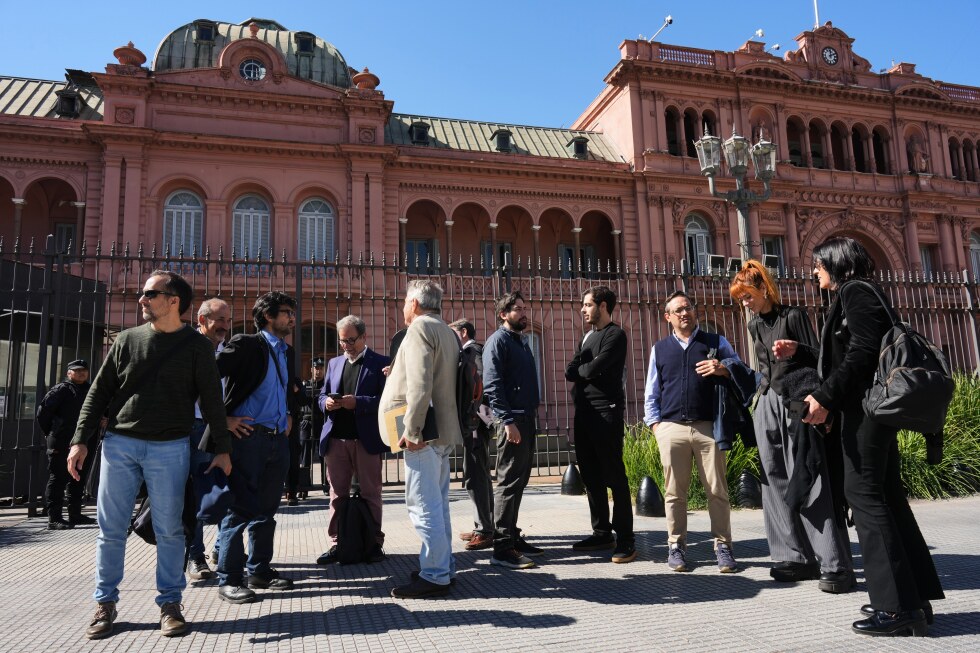
In an unprecedented move that has sparked outcry across Argentina’s political spectrum, President Javier Milei last week expelled the entire press corps from the Casa Rosada—Argentina’s presidential palace—marking a significant escalation in his increasingly hostile campaign against the media.
The radical libertarian president blocked approximately 60 accredited reporters from entering the government headquarters and took to social media to denounce journalists as “filthy scum” and “corrupt junkies hooked on advertising bucks and bribes.”
“It’s the culmination of the government’s contempt for journalism and its value in a democracy,” said Fernando Stanich, president of the Argentine Journalism Forum, a professional group representing journalists across the country.
Rights watchdogs have condemned the move as the most severe attack on press freedom since Argentina’s return to democracy in 1983. “Argentina is still a democracy, but these are the actions of an autocrat,” said Cristina Zahar, Latin America coordinator for the Committee to Protect Journalists. “An autocrat who tries to curtail press freedoms, who tries to prevent journalists from reporting and keeping society informed about public interest matters.”
Government spokesperson Javier Lanari defended the decision, claiming authorities implemented the ban “as a preventative measure” after Todo Noticias, a local television channel, aired footage filmed inside the Casa Rosada with smart glasses, allegedly without authorization. The government has filed legal action against the network, accusing it of “illegal espionage.”
Journalist Luciana Geuna from Todo Noticias has refuted these claims, stating that her team had notified press officers of their filming plans in advance and that the footage showed only publicly accessible areas of the presidential palace that had been televised before.
Milei’s antagonistic relationship with the media has been a defining feature of his presidency, drawing comparisons to former U.S. President Donald Trump and Brazil’s Jair Bolsonaro. Since taking office, the former television commentator has intensified his attacks rather than moderating his rhetoric.
An analysis by La Nación newspaper revealed that over just four days in early April, Milei posted 86 messages attacking journalists and reshared 874 similar posts on the social media platform X. His signature slogan, “We don’t hate journalists enough,” frequently accompanies these posts, along with claims that “95% of journalists are criminals.”
Milei has systematically targeted specific reporters critical of his administration with personal insults, while filing defamation lawsuits against at least eight journalists in the past year. His administration has also encouraged allies to pursue similar legal action against media critics.
“Milei’s followers are extremely fanatical. They’ve harassed me, doxxed me, dragged me into mediation,” said Alejandro Alfie, a media reporter for Argentina’s largest newspaper, Clarín. Alfie now faces four defamation lawsuits from Milei’s close allies seeking millions in damages. “People say, ‘Oh, it’s not real. It’s just social media.’ But when you have someone telling you on Instagram every day that they will kill your children, it is something else entirely.”
The president has shunned traditional press conferences, preferring instead to communicate through social media memes—some AI-generated—and appearances on right-wing influencer programs. He has appointed social media provocateurs to government positions and mobilized digital activists to undermine traditional news outlets.
His administration has also modified Argentina’s open-records law to restrict access to public information and shut down Telam, the state news agency, accusing it of being a propaganda tool for the left-leaning opposition. The agency has since been repurposed as an advertising outlet.
Journalists expelled from the Casa Rosada say they saw the ban coming. Over the past year, the government had already restricted media movement within the building, declared certain areas off-limits, and capped attendance at news briefings. Earlier this month, authorities barred six accredited media outlets from accessing both the Casa Rosada and the lower house of Congress, accusing them of involvement in Kremlin-backed disinformation—allegations the journalists denied.
The backlash to Milei’s latest move has been swift and broad. Opposition lawmakers have filed legal challenges, with a dozen legislators requesting urgent meetings with officials over what they described as an “institutional undermining of freedom of expression.” Even the Argentine Catholic Church intervened, noting that the press “had operated virtually uninterrupted in the Casa Rosada since 1940.”
The media crackdown comes at a particularly challenging time for Milei, whose popularity has reached its lowest point since taking office, according to polling firm AtlasIntel. His efforts to combat Argentina’s chronic inflation have stalled, unemployment has risen, and the economy has contracted. Adding to his troubles, corruption allegations involving his chief of staff, Manuel Adorni, have emerged—reminiscent of the scandals plaguing the political establishment that Milei vowed to overthrow.
“It’s a very bad moment for the president,” said Jaime Rosemberg, a political correspondent for La Nación who remains barred from the Casa Rosada. “And often the easiest thing to do in that moment, what you have closest at hand, is to blame the press for everything.”
Fact Checker
Verify the accuracy of this article using The Disinformation Commission analysis and real-time sources.

6 Comments
This move by the Argentine president is extremely concerning and a serious threat to press freedom. Journalists must have unfettered access to government institutions in order to hold leaders accountable. I hope the international community takes strong action to condemn this attack on democracy.
This is a very concerning development. Banning journalists from government headquarters is a blatant attack on the freedom of the press, which is a cornerstone of any democratic society. I hope the Argentine people stand up against this unacceptable authoritarianism.
I agree completely. Restricting media access is a clear sign of an administration that fears scrutiny and accountability. This sets a dangerous precedent that must be reversed.
Restricting media access to government buildings is a classic authoritarian tactic. President Milei’s actions undermine the public’s right to information and threaten the foundations of Argentine democracy. This is a worrying development that merits widespread condemnation.
Disturbing to see this crackdown on press freedom in Argentina. Free and independent media is crucial for a healthy democracy. I hope the international community condemns this move and pushes for the restoration of press access.
As an observer of Latin American politics, I’m deeply troubled by President Milei’s actions. Cracking down on the press is a common tactic of would-be autocrats. I hope the people of Argentina remain vigilant in defending their democratic institutions.