


Listen to the article
Tehran’s Visual Battleground: How Propaganda Has Reshaped Iran’s Capital
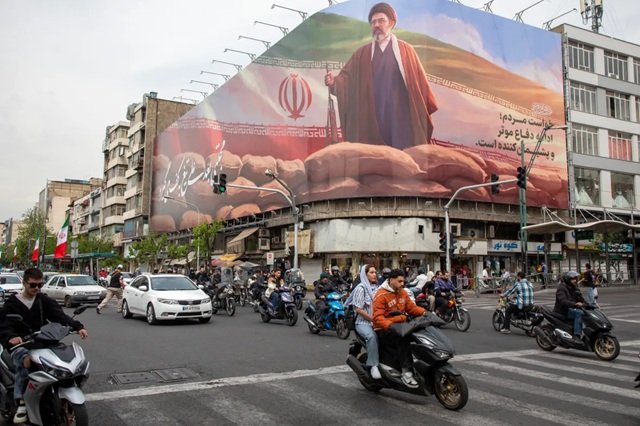
In Tehran, the landscape of war has spilled from distant frontlines into everyday life, transforming the city into a visual battleground of state messaging. Across highways, public squares, and residential districts, an unprecedented propaganda campaign blends traditional political imagery with new artificial intelligence-generated visuals that saturate public spaces.
Residents describe a capital overtaken by ideological imagery, where portraits of Mojtaba Khamenei, widely portrayed as the successor to Iran’s supreme leadership, dominate the visual environment. These images appear alongside depictions of the late Ayatollah Ali Khamenei, often presented in stylized or digitally enhanced forms that many locals perceive as increasingly artificial.
“The city has been made ugly,” says Sohrab, a 35-year-old restaurant manager in Tehran, describing what he sees as an assault on everyday life. For him and many others, the omnipresent propaganda evokes anger and resentment, highlighting a growing emotional divide between official narratives and public sentiment.
This visual transformation has accelerated dramatically in recent weeks, with new billboards and displays appearing almost overnight. Many residents suspect artificial intelligence plays a significant role in generating or enhancing these images, creating a more sophisticated and responsive propaganda ecosystem.
The content ranges from explicitly militaristic scenes to emotionally charged imagery of civilian suffering. One widely discussed display shows children reportedly killed in a strike on a school in southern Iran, framed within a narrative of martyrdom and national sacrifice. Critics within Iran argue such imagery exploits grief for political purposes.
“They’re using the deaths of children,” says Afsaan, a 38-year-old content editor in Tehran, describing public reaction as a mixture of collective sorrow and anger at what many see as the instrumentalization of tragedy.
Beyond mourning, the state’s visual language projects military dominance and defiance. Massive banners in central Tehran depict strategic waterways like the Strait of Hormuz, accompanied by slogans asserting Iranian control over key maritime routes. Other installations show Revolutionary Guard figures symbolically trapping American aircraft and naval vessels, reinforcing messages of deterrence and resistance.
According to reporting cited by The Sunday Times, these campaigns are coordinated through semi-official cultural organizations connected to the Islamic Revolutionary Guard Corps, including groups operating under the umbrella of the “House of Islamic Revolution Designers.” These bodies integrate artists, designers, and increasingly, professionals trained in digital production and artificial intelligence.
This propaganda system reflects a broader shift in Iran’s approach to information warfare. Experts describe decades of investment in cultural infrastructure designed to reinforce ideological narratives through multiple channels. Omid Memarian, an Iran analyst at a Washington-based think tank, notes that the IRGC has systematically expanded its influence across cultural sectors over the past twenty years, with artificial intelligence representing their newest frontier.
The messaging extends far beyond static images. Throughout Tehran, state-aligned groups organize public gatherings, distribute food and tea in temporary hospitality tents, and stage symbolic displays of unity involving flags, chants, and choreographed participation. These activities are particularly visible near checkpoints and central squares, creating an atmosphere of constant mobilization.
“Even the smallest details are calculated,” observes Somayeh, a public relations specialist in Tehran, noting that elements like the presence of women without headscarves at certain staged events appear carefully managed to project an image of social cohesion and broad support.
Yet beneath this carefully constructed surface, human rights organizations report a parallel reality of intensified repression. Kurdish rights monitors have documented multiple executions of political prisoners since the escalation of conflict, with further death sentences issued to individuals accused of collaboration with foreign powers.
The nightly soundscape of Tehran further reflects this propaganda environment. Rallies feature chants against ceasefire proposals and calls for continued resistance, while loudspeakers mounted on vehicles broadcast patriotic songs and anti-American slogans through residential neighborhoods late into the night.
For some residents, these sounds evoke painful historical memories. Afsaan describes hearing wartime music from the Iran-Iraq conflict echoing through her neighborhood—sounds she associates with mobilization and loss. Yet she acknowledges a stark hierarchy of fear, noting that “the noise of propaganda is still better than the sound of airstrikes or fighter jets.”
The cumulative effect is a capital saturated with meaning, where walls, screens, and public spaces function as instruments of political narrative. For residents of Tehran, the boundaries between reality and representation have become increasingly blurred, as what was once occasional political messaging has evolved into a continuous visual presence defining not just how the state sees itself, but how it demands to be seen.
Fact Checker
Verify the accuracy of this article using The Disinformation Commission analysis and real-time sources.

8 Comments
The use of digitally enhanced imagery of political leaders is a troubling tactic. It speaks to a desire to create an aura of power and authority, rather than represent reality. I worry this could set a dangerous precedent for other regimes to follow.
This propaganda campaign seems quite concerning. I wonder how it is impacting the daily lives and perspectives of Tehran’s residents. It must be unsettling to be surrounded by such heavy-handed messaging in public spaces.
Yes, the visuals described sound quite oppressive and artificial. It’s troubling to hear the propaganda is eroding the connection between the government and public sentiment.
The use of AI-generated imagery in this propaganda effort is particularly alarming. It blurs the line between reality and fabrication, making it harder for people to discern truth from fiction. I hope this doesn’t spread to other contexts.
Agreed, the integration of AI into propaganda campaigns is a worrying development. It amplifies the ability to spread disinformation and manipulate public perception on a large scale.
This report highlights how control over public spaces and visuals is a key battleground in modern information warfare. The Iranian government seems intent on saturating the environment with ideological messaging to shape perceptions and suppress dissent.
It’s disturbing to hear how the city of Tehran has been transformed into a visual propaganda machine. The emotional divide this is creating between the government and the public is deeply concerning. I wonder what the long-term impacts will be on social cohesion.
Yes, the psychological toll of being constantly bombarded with these artificial, ideological images must be immense. It’s a tactic to erode independent thought and normalize the government’s narrative.