


Listen to the article
Russia’s Victory Day Parade Reveals Kremlin’s Military Strain
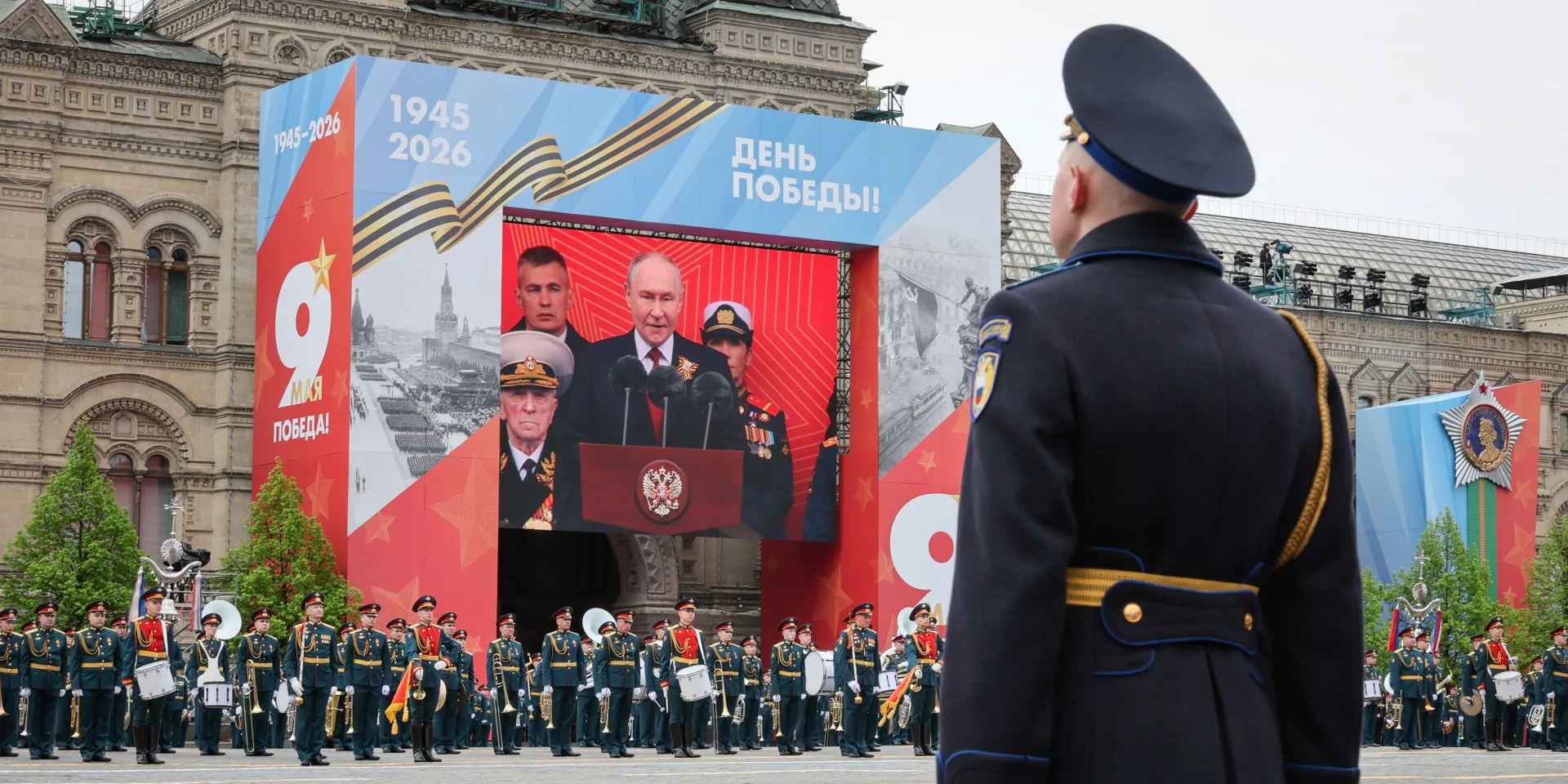
Russia’s noticeably subdued Victory Day parade in Moscow’s Red Square has exposed the growing strain on the Kremlin’s military resources and international standing, according to retired British Army Colonel Hamish de Bretton-Gordon.
In a stark departure from previous years’ displays of military might, the May 9 celebration was stripped of its usual spectacle of armored vehicles, missiles, and major combat equipment. The absence of tanks was particularly telling for a nation whose modern identity is deeply intertwined with its military prowess.
“The absence of even a single modern tank on Red Square may become one of the defining images of this war,” de Bretton-Gordon wrote in The Telegraph. What should have been Russia’s premier military showcase instead revealed a country depleting its resources at an alarming rate on the Ukrainian battlefield.
The parade lasted merely 45 minutes – the shortest in modern Russian history – featuring only a few aging aircraft flying in loose formation. More telling were reports that some regional parades featured World War II-era tanks, fueling speculation that these museum pieces might be returning to service as thousands of Russia’s modern armored vehicles have been destroyed in Ukraine.
Personnel shortages were equally revealing. The parade reportedly included North Korean soldiers, an unprecedented development for a nation that has historically prided itself on military self-sufficiency. This dependency extends beyond manpower, as Russia now relies heavily on North Korean ammunition supplies.
The diplomatic dimension of the event further highlighted Russia’s growing isolation. Only a small contingent of authoritarian leaders stood alongside Putin, including self-proclaimed Belarusian President Alexander Lukashenko, Malaysia’s King Sultan Ibrahim, and Lao President Thongloun Sisoulith. Chinese leader Xi Jinping’s absence was particularly noteworthy, suggesting Beijing’s increasing reluctance to be associated with Russia’s faltering military campaign.
“Xi’s absence suggests a more cautious Beijing, one increasingly aware that association with Russia’s failing campaign carries growing geopolitical costs,” de Bretton-Gordon noted.
Despite these visible shortcomings, Putin attempted to draw parallels between the current conflict and the “Great Patriotic War,” comparing contemporary fighting in the Kursk region with the historic 1943 Battle of Kursk. The contrast, however, was impossible to ignore – in 1943, the Soviet Union deployed thousands of tanks in one of history’s decisive armored battles, while today’s Russia cannot even display symbolic armor on Red Square.
The parade took place amid widespread internet shutdowns across Moscow and featured Putin’s claims of “victories” in Ukraine, assertions that stand at odds with successful Ukrainian strikes deep inside Russian territory and a noticeable slowdown in Russian advances on the front line.
For Ukraine and its Western allies, the diminished parade offers a glimpse of hope. As de Bretton-Gordon observed, “A war cannot be won with a parade, but a parade can reveal the truth hidden behind propaganda.” The display in Moscow on May 9 revealed a Kremlin that appears increasingly strained, isolated, and uncertain about its strategic direction.
The symbolism of the event speaks volumes about Russia’s current predicament. For a regime that has long used military pageantry to project power both domestically and internationally, the scaled-back celebration suggests a growing disconnect between Putin’s ambitious war rhetoric and Russia’s actual military capabilities after more than two years of sustained conflict in Ukraine.
Fact Checker
Verify the accuracy of this article using The Disinformation Commission analysis and real-time sources.

13 Comments
This subdued Victory Day parade seems to be a stark departure from Russia’s typical displays of military might. The lack of modern equipment is a clear sign that the Kremlin’s resources are being depleted by the war in Ukraine.
This article provides a fascinating glimpse into the realities of Russia’s military situation. The lack of modern equipment and shortened parade duration suggest the Kremlin is facing significant challenges in sustaining its war efforts.
It will be crucial to monitor how these developments impact Russia’s strategy and operations in Ukraine in the coming months.
The absence of modern tanks and the shortened parade duration suggest the Kremlin is struggling to maintain its military capabilities. This could have significant implications for the war in Ukraine and Russia’s global influence.
The article highlights an interesting contrast – Russia’s parade used to be a showcase of its military power, but this year it revealed the toll the war in Ukraine has taken. This seems to undermine the Kremlin’s propaganda narrative.
I wonder how this will impact Russia’s international standing and its ability to project power going forward.
The article provides an insightful look into the challenges the Kremlin is facing in maintaining its military capabilities. The absence of tanks and shortened parade duration reveal the strain on Russia’s armed forces.
It will be interesting to see how this impacts Russia’s ability to sustain its operations in Ukraine going forward.
The revelations about Russia’s military exhaustion during the Victory Day parade are quite telling. It appears the Kremlin is struggling to project the image of strength it has cultivated for so long.
Using World War II-era tanks in regional parades is quite telling. It appears the Kremlin is scraping the bottom of the barrel when it comes to military equipment. This doesn’t bode well for their war efforts.
It will be critical to monitor how this impacts Russia’s military strategy and operations in Ukraine in the coming months.
The subdued Victory Day parade in Moscow certainly signals that the Kremlin is struggling with its military resources in the Ukraine conflict. Lacking modern tanks and equipment is a telling sign of the strain on Russia’s military capability.
It will be interesting to see how the Kremlin attempts to spin this lack of military might for the domestic audience.