


Listen to the article
In a controversial series of reports, BBC correspondent Nawal Al-Maghafi has come under scrutiny for her coverage of Israeli airstrikes in Lebanon, with critics claiming her reporting lacks crucial context and promotes narratives that align with Hezbollah’s position.
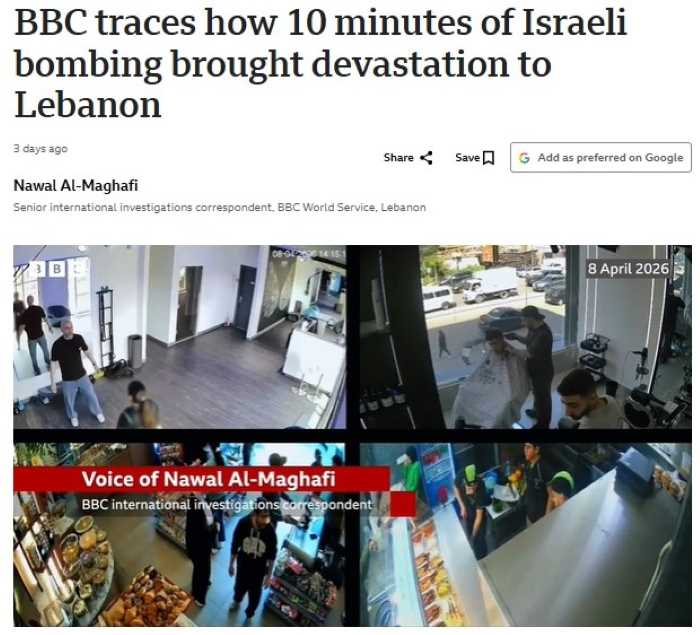
Al-Maghafi, described as the BBC’s “senior international investigations correspondent,” produced multiple reports in May 2026 examining the aftermath of Israeli bombing raids in Lebanon that occurred on April 8th. Her coverage, titled “How 10 minutes of Israeli bombing brought devastation to Lebanon” and alternatively “Lebanon’s Black Wednesday,” focused on three locations struck during the Israeli operation.
The reports have drawn criticism for allegedly omitting key information that would provide viewers and readers with a more complete understanding of the situation. In one segment, Al-Maghafi interviews a man identified only as Mohammed in the Hay el Sellom neighborhood of Dahiya, a known Hezbollah stronghold in Beirut. Mohammed, whose son Abbas died in the strike, insists that only residents lived in the targeted building.
“If I thought there was even a 1% chance that someone from Hezbollah lived here, I wouldn’t have stayed,” Mohammed tells Al-Maghafi. “I would never risk my son’s life.”
Critics point out that Al-Maghafi’s reporting does not inform audiences that Dahiya is a Hezbollah-controlled district where the terrorist organization has long embedded its operations within civilian infrastructure. Independent researcher David Collier reportedly found evidence that Abbas, the deceased son, had Hezbollah affiliations visible on his grave marker, a detail absent from the BBC’s investigation.
Similarly, the report states that the BBC “searched for evidence of a Hezbollah target and could not find one” in another bombed location, Corniche al Mazraa. However, security analysts from The Long War Journal and the Alma Center have identified the area as containing “safe apartments and command centers used by mid- and senior-ranking commanders” of Hezbollah.
In Sidon, Al-Maghafi acknowledges that a Hezbollah-affiliated religious complex was struck, killing Sheikh Sadiq Naboulsi, who had “deep ideological and family ties to Hezbollah,” and Mohammed Ma’ani, described as “a senior Hezbollah official.” However, critics argue that additional context is missing, including reports that the strike also eliminated Maher Qassem Hamdan, commander of the Hezbollah-allied Lebanese Resistance Companies, along with multiple operatives.
The BBC report uncritically presents Hezbollah’s denial of using civilian areas for military purposes, stating the group “never wanted war and is acting in self-defense” without noting that Hezbollah initiated attacks against Israel on October 8, 2023, and again on March 2, 2026.
Security experts have long documented Hezbollah’s strategy of embedding military assets within civilian areas, a tactic that complicates Israel’s targeting and increases civilian casualties. The Israeli military stated that most targets were “within the heart of the civilian population, as part of Hezbollah’s cynical exploitation of Lebanese civilians as human shields.”
Al-Maghafi’s report cites Lebanon’s health ministry claiming “the vast majority” of those killed were civilians, but fails to mention that the ministry is headed by a minister from the same organization as the “senior Hezbollah political figure” she interviewed previously.
Media watchdogs contend that this pattern of reporting mirrors BBC coverage of Gaza, where critics say Palestinian militant claims are sometimes presented without sufficient scrutiny or context, potentially creating an incomplete picture for audiences about the complexities of urban warfare and the challenges of targeting armed groups that operate among civilian populations.
The BBC has not publicly responded to these specific criticisms of Al-Maghafi’s reporting on the Lebanon airstrikes.
Fact Checker
Verify the accuracy of this article using The Disinformation Commission analysis and real-time sources.

5 Comments
Hmm, the claims of lacking crucial information are concerning. Responsible journalism should strive for impartiality and provide the public with a comprehensive understanding of complex conflicts. I hope further reporting can shed more light on the facts.
I’d like to see more balanced coverage that examines all perspectives objectively, rather than potentially amplifying Hezbollah’s position. Thorough investigation and accurate reporting are crucial, especially on sensitive geopolitical issues.
This seems like a complex and politically charged issue. I’d encourage readers to seek out analysis from a range of trusted sources to develop a more nuanced understanding, rather than relying on a single report that may have biases.
While civilian casualties are always tragic, it’s important to understand the full context around military operations. I wonder if the BBC reporter had access to intelligence or other information that wasn’t included in the published reports.
This reporting seems to lack important context and could be promoting a biased narrative. It would be helpful to have more details on the targeted locations and potential Hezbollah presence to better understand the full situation.