


Listen to the article
President Trump Ends Record 75-Day DHS Funding Lapse, Signs Bipartisan Bill
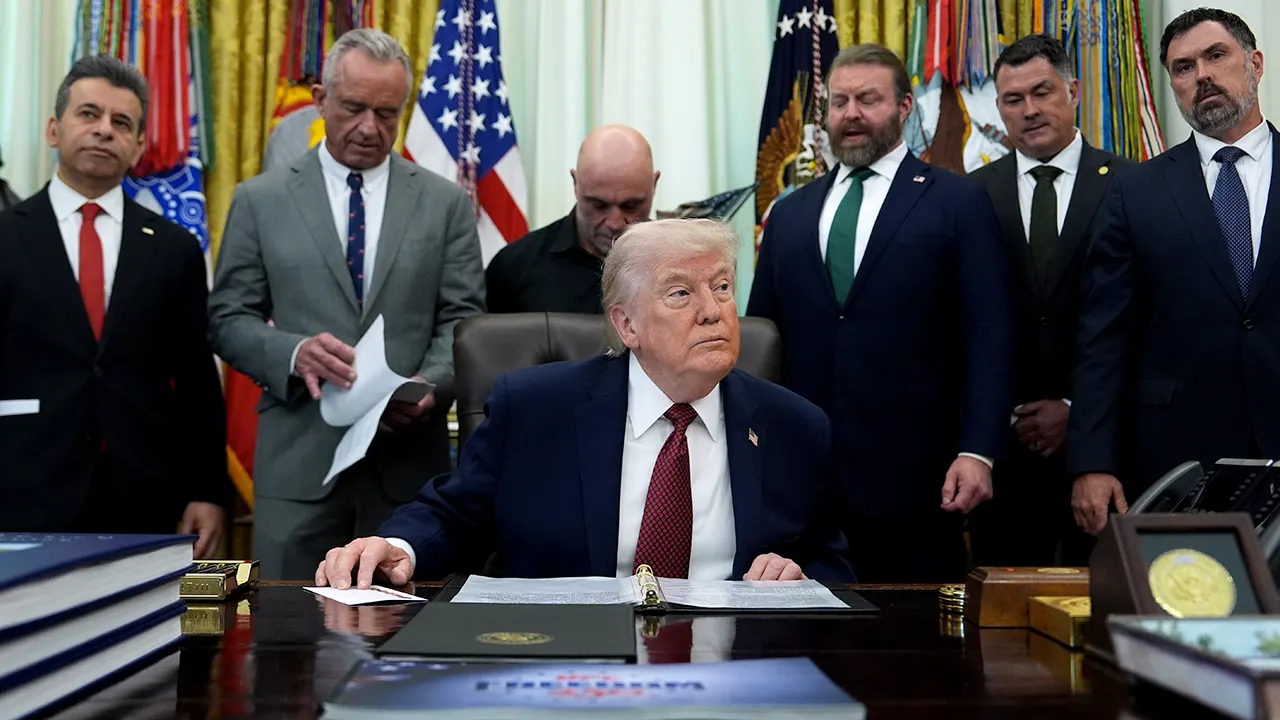
President Donald Trump has signed legislation restoring funding to the Department of Homeland Security, bringing an end to a partial government shutdown that lasted 75 days—the longest such lapse in U.S. history.
The bill, which passed the House of Representatives by voice vote after earlier Senate approval, will fund most DHS operations through September. The signing on Thursday marked the conclusion of a politically contentious battle over one of the nation’s most critical security agencies.
Notably, the legislation leaves two key border security components—U.S. Immigration and Customs Enforcement (ICE) and U.S. Customs and Border Protection (CBP)—unfunded, setting up another potential political showdown in the coming months.
House Speaker Mike Johnson (R-La.), who had previously blocked the Senate-passed measure for more than a month, reversed course this week after the White House intervened. Johnson had initially refused to bring the bill to the floor, citing concerns that it would defund law enforcement operations, a position widely shared among House Republicans.
The political standoff finally broke when the White House issued a stark warning to congressional offices that without immediate action, the administration would be unable to pay DHS employees beginning in May.
“If this funding is exhausted, the Administration will be unable to pay DHS personnel beginning in May, which will once again unleash havoc on air travel, leave critical law enforcement officers—including our brave Secret Service agents—and the Coast Guard without paychecks, and jeopardize national security,” stated a White House memo obtained by Fox News Digital.
The Department of Homeland Security, established in the aftermath of the September 11 attacks, represents one of the federal government’s largest agencies with approximately 200,000 personnel. Beyond ICE and CBP, DHS encompasses several critical security operations including the U.S. Secret Service, Transportation Security Administration (TSA), U.S. Coast Guard, and the Federal Emergency Management Agency (FEMA).
Throughout the funding lapse, the administration had been relying on existing funds to cover six weeks of back pay and ongoing payroll obligations for DHS employees. Officials warned lawmakers that these reserve funds were rapidly depleting, creating an urgent situation that ultimately forced congressional action.
The political resolution comes at a critical moment for national security operations. Homeland Security functions have taken on increasing importance amid ongoing immigration challenges at the southern border, heightened global security concerns, and domestic threats.
Republicans in the House have begun drafting a separate funding package specifically targeting ICE and CBP operations, though that legislation isn’t expected to advance before lawmakers depart Washington for their upcoming recess. This separate approach highlights the ongoing partisan divide over border security and immigration enforcement policies.
The conclusion of this partial shutdown brings temporary relief to thousands of federal workers who had been working without pay during the extended funding lapse. However, the unresolved status of ICE and CBP funding ensures that border security will remain a contentious political issue as both parties prepare for upcoming election battles.
National security experts have expressed concern about the operational impacts of the extended funding uncertainty on DHS agencies, particularly those involved in counterterrorism, cybersecurity, and critical infrastructure protection. The resolution provides needed stability for most department operations while leaving border security funding as an ongoing challenge.
The bipartisan agreement represents a rare moment of cooperation in an otherwise deeply divided Congress, though the compromises involved have left neither side fully satisfied. The funding restoration comes amid continued debate over broader government funding priorities and approaches to immigration policy.
Fact Checker
Verify the accuracy of this article using The Disinformation Commission analysis and real-time sources.

12 Comments
It will be interesting to see how the unfunded status of ICE and CBP plays out. Those agencies play a crucial role, so their funding needs to be addressed.
Agreed, this seems like a significant loose end that will likely need to be tied up sooner rather than later.
Interesting to see how this funding crisis has played out. Curious to hear more about the potential impact on border security agencies like ICE and CBP in the coming months.
Yes, the ongoing political dynamics around immigration enforcement will be worth following. A lot at stake for national security.
Ending the longest government shutdown in US history is certainly an important milestone, though the work is far from over on immigration enforcement. Curious to see what happens next.
Absolutely, this is likely just the first step in an ongoing debate. Immigration policy will surely remain a hot-button issue.
Given the importance of border security, I hope lawmakers can find a sustainable long-term solution that addresses everyone’s concerns. This temporary fix is a start.
Absolutely, kicking the can down the road on issues like this is rarely a good strategy. Hoping for a more durable resolution.
This seems like a complex issue with a lot of moving parts. I appreciate the bipartisan effort to restore DHS funding, even if some key components remain unfunded for now.
Agreed, it’s good to see some compromise, even if more work remains. Immigration policy is always a hot-button topic.
This is a politically sensitive topic, but I’m glad to see the two parties were able to come together to end the funding lapse, even if some issues remain unresolved.
Yes, compromise is often necessary on complex, polarizing topics like this. Hopefully they can build on this progress.