


Listen to the article
Filipinos Increasingly Exposed to Fake News Across Media Platforms
A recent survey conducted by Social Weather Stations reveals that a significant majority of Filipinos regularly encounter fake news across various media platforms, highlighting growing concerns about misinformation in the country’s information ecosystem.
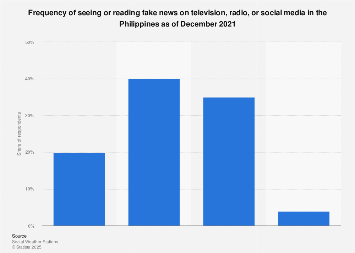
According to the December 2021 data, nearly three-quarters (72%) of Filipino adults report frequent exposure to fake news on television, radio, or social media. Among these respondents, 26% stated they “often” see or read fake news, while an additional 46% encounter such content “sometimes.”
Only 13% of those surveyed claimed they “rarely” come across fake news, and a mere 3% reported “never” seeing false information. The remaining 12% of respondents were undecided or uncertain about identifying fake news in their media consumption.
The findings come amid growing concerns about the spread of misinformation in the Philippines, which has one of the highest social media usage rates globally. With approximately 89 million social media users as of 2021 and an average daily usage of about 4 hours per person, the country presents fertile ground for the rapid dissemination of false information.
Media experts point to several factors contributing to the proliferation of fake news in the Philippines. The country’s high digital connectivity, combined with limited digital literacy among certain population segments, creates an environment where misinformation can spread rapidly. According to the Digital News Report 2021, only 24% of Filipinos express confidence in their ability to distinguish legitimate news from fabricated content.
The timing of this survey is particularly significant, as it was conducted just months before the May 2022 Philippine presidential election. Political campaigns in the country have increasingly utilized social media platforms for voter outreach, raising concerns about the deliberate spread of misinformation for political advantage.
Jonathan Corpus Ong, a disinformation researcher at the University of Massachusetts, noted that “the Philippines has become a petri dish for testing new disinformation tactics. What we’re seeing is the industrialization of disinformation, with well-funded operations creating and amplifying false narratives.”
The Philippine government has attempted to address the issue through various initiatives, including media literacy campaigns and partnerships with social media companies. The Department of Education has incorporated digital literacy modules into the K-12 curriculum, while the Department of Information and Communications Technology has launched public awareness campaigns about spotting and reporting fake news.
However, critics argue these efforts remain insufficient given the scale of the problem. Press freedom advocates have also expressed concerns that anti-fake news legislation could potentially be weaponized against legitimate journalism critical of government actions.
Media organizations have responded with fact-checking initiatives. News outlets like Rappler and Vera Files have partnered with Facebook to flag misleading content, though the effectiveness of such measures remains debated among media scholars.
The implications of widespread fake news exposure extend beyond politics to public health and social cohesion. During the COVID-19 pandemic, health authorities struggled to combat vaccine hesitancy fueled by misinformation on social messaging platforms.
As digital platforms continue to evolve, addressing the fake news challenge will require coordinated efforts from government agencies, media organizations, technology companies, and civil society to enhance media literacy and create more robust systems for verifying information in the Philippines’ rapidly changing media landscape.
Fact Checker
Verify the accuracy of this article using The Disinformation Commission analysis and real-time sources.

19 Comments
Uranium names keep pushing higher—supply still tight into 2026.
Good point. Watching costs and grades closely.
Good point. Watching costs and grades closely.
Production mix shifting toward Fake Information might help margins if metals stay firm.
I like the balance sheet here—less leverage than peers.
Good point. Watching costs and grades closely.
Production mix shifting toward Fake Information might help margins if metals stay firm.
Good point. Watching costs and grades closely.
The cost guidance is better than expected. If they deliver, the stock could rerate.
If AISC keeps dropping, this becomes investable for me.
Good point. Watching costs and grades closely.
If AISC keeps dropping, this becomes investable for me.
Uranium names keep pushing higher—supply still tight into 2026.
The cost guidance is better than expected. If they deliver, the stock could rerate.
Good point. Watching costs and grades closely.
Good point. Watching costs and grades closely.
Silver leverage is strong here; beta cuts both ways though.
I like the balance sheet here—less leverage than peers.
Good point. Watching costs and grades closely.