


Listen to the article
The Gambia and ECOWAS Launch West Africa’s First Disinformation Response Center
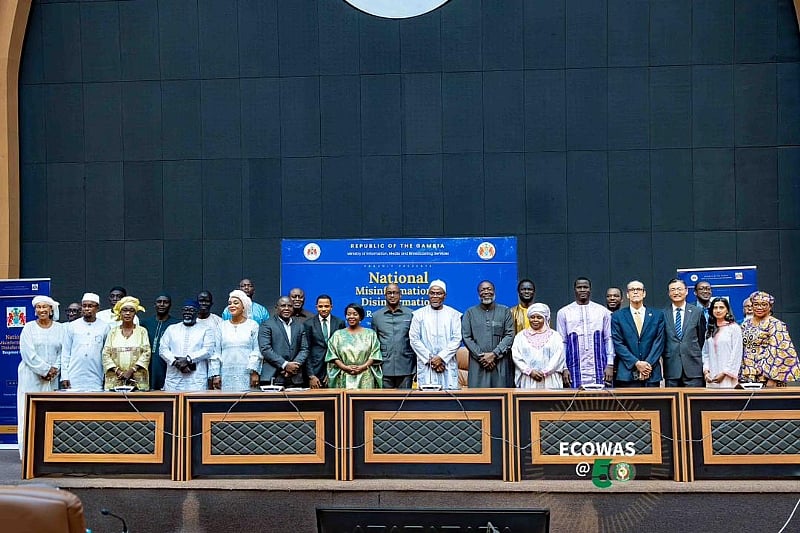
The Government of The Gambia, working alongside the Economic Community of West African States (ECOWAS) Commission, has established the region’s first National Misinformation and Disinformation Response Centre. The groundbreaking facility, which opened its doors on April 25 in Banjul, represents a significant step forward in the battle against false information across West Africa.
Amid rising concern over the proliferation of misleading content on digital platforms throughout the subregion, the initiative aims to protect information integrity, restore public confidence in media, and shield democratic processes from manipulation.
During the launch ceremony, The Gambia’s Vice President Muhammad Jallow joined ECOWAS Commission President Dr. Omar Alieu Touray to highlight the center’s regional significance. Both leaders emphasized how the facility would strengthen early warning capabilities, enable fact-checking in real time, and foster cross-border cooperation in combating disinformation.
According to a statement released by ECOWAS on Tuesday, April 28, officials were careful to clarify that the center’s purpose is not to censor content but rather to ensure citizens have access to verified, accurate information. This distinction comes at a crucial time when concerns about government overreach in information regulation have emerged in various parts of the world.
The center’s establishment reflects growing recognition across West Africa that misinformation poses a serious threat to regional stability. In recent years, false information spread through social media has contributed to election tensions, public health crises, and communal conflicts throughout the region. The Gambia, having emerged from decades of authoritarian rule under former President Yahya Jammeh in 2017, has firsthand experience with how controlled information environments can undermine democracy.
Media experts familiar with the West African information landscape suggest the center could serve as a model for other regions grappling with similar challenges. Dr. Ibrahim Souley, a communications researcher at the University of Dakar, notes that “West Africa faces unique challenges with misinformation, including language diversity and varying levels of media literacy across populations. A regional approach is essential.”
The center is expected to employ a combination of technological tools and human expertise to monitor, identify and respond to false information. Sources close to the project indicate it will include a public-facing component where citizens can verify information and report suspected misinformation.
The timing of this initiative coincides with several upcoming elections across the ECOWAS region, where misinformation has historically played a disruptive role. Political analysts suggest that the center could help provide a more stable information environment during these critical democratic exercises.
For The Gambia, hosting the region’s first such institution represents a significant commitment to information integrity and regional cooperation. The country continues to rebuild its democratic institutions following the end of the Jammeh regime, making the fight against misinformation particularly meaningful in its national context.
ECOWAS, representing 15 West African nations with a combined population of over 400 million people, has increasingly prioritized information integrity as a component of regional security and stability. This center represents one of the bloc’s most concrete steps toward addressing digital disinformation threats.
As digital penetration continues to grow rapidly across West Africa, with millions of new internet users joining online platforms each year, the challenge of managing information integrity will only increase in importance. The Banjul-based center stands as an acknowledgment that in today’s interconnected world, protecting information spaces has become as crucial to national and regional security as traditional defense measures.
Fact Checker
Verify the accuracy of this article using The Disinformation Commission analysis and real-time sources.

10 Comments
I’m curious to learn more about the specific capabilities and mandate of this new disinformation response center. What types of digital platforms and content will it focus on, and how will it coordinate with national authorities across the region?
Those are good questions. Effective cross-border collaboration will be key to the center’s success in addressing disinformation that doesn’t respect national boundaries.
As someone who closely follows developments in the mining and commodities space, I’m particularly interested in how this center might address disinformation related to those industries. Accurate, fact-based information is so important in those sectors.
That’s a good point. Combating misleading narratives around extractive industries and energy resources will be an important part of the center’s mandate.
It’s great to see ECOWAS taking such a proactive approach to this challenge. Equipping the region with the tools and expertise to quickly identify and debunk false narratives is a crucial investment in public trust and resilience.
I agree. This center could play a vital role in empowering citizens across West Africa to become more discerning consumers of online information.
The timing of this launch is quite timely, given the growing global concern over the influence of misleading online content. I hope this initiative can serve as a model for other regions to follow in strengthening their defenses against information manipulation.
Absolutely. Establishing dedicated structures to monitor and counter disinformation is an essential part of safeguarding democratic discourse in the digital age.
This is an important step forward in combating disinformation in West Africa. Establishing a dedicated regional center to monitor, fact-check, and respond to false information is crucial for protecting democratic processes and public trust.
Agreed. Proactive measures like this can help build resilience against the spread of misleading content that undermines informed decision-making.