


Listen to the article
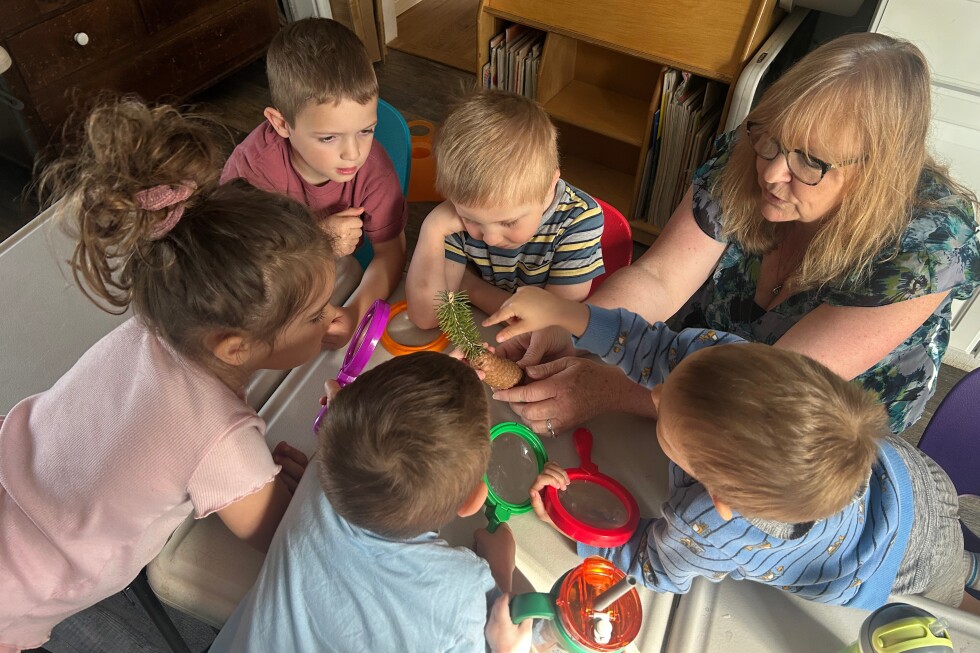
In a quiet corner of Fowlerville, Michigan, children gather around small tables with colorful magnifying glasses as Lori Leggert teaches them about living and nonliving things. While her child-care center incorporates traditional school elements like the Pledge of Allegiance and plenty of books, it also features unique touches – including hens and roosters in the yard and students as young as 18 months old.
Leggert, owner of The Sky’s the Limit Family Childcare, is part of Michigan’s groundbreaking pilot program that brings no-cost pre-K education into home-based childcare settings. The initiative represents a significant expansion of the state’s efforts to make quality early childhood education accessible to all families.
“It benefits all the children in my care, not just the 4-year-olds,” Leggert explained.
Michigan’s ‘Pre-K for all’ initiative already allows any 4-year-old in the state to attend pre-K at no cost. However, until this pilot launched, home-based care providers were excluded from participation. The $1.5 million program, funded through a federal grant, will serve approximately 75-80 children aged 3 or 4 this spring and summer, with potential continuation into the next academic year.
Participating providers receive support for coaching, curriculum development, materials, and assessment tools – resources typically available only to larger institutional settings.
Early childhood advocates see tremendous potential in this approach. “Home-based providers are an untapped resource,” notes a state policy document outlining opportunities for pre-K expansion. The inclusion makes practical sense given Michigan’s network of 3,344 group homes and family childcare sites operating across the state in fiscal year 2024.
Deb Dupras, executive director of Community Coordinated Child Care Association of the Upper Peninsula (4C of the UP), emphasizes the importance of including home providers in the conversation. Her organization connects parents with childcare options and trains early childhood workers throughout the region. Dupras hopes assessment results will demonstrate that children in home-based pre-K settings perform at least as well as those in traditional center or school-based programs.
The home-based model offers distinct advantages, according to Joan Blough, vice president at the Early Childhood Investment Corporation. “It’s smaller, more intimate, you can have more individualized attention,” she said, highlighting the importance of providing families with diverse options for their children’s early education.
Michigan’s broader pre-K expansion has already seen significant progress. The Great Start Readiness Program now serves almost 55,000 students statewide, with classes offered in schools, childcare centers, and churches. Initially available only to low-income families, Governor Gretchen Whitmer’s “pre-K for all” initiative has opened the program to all 4-year-olds regardless of family income.
These efforts have earned Michigan recognition as 17th in the nation for access to pre-K for 4-year-olds, according to research from the National Institute for Early Education Research. The state is among a select few that meet all ten benchmarks for quality early childhood education.
The state is also addressing workforce challenges through initiatives like the MiEarly Apprentice program, which creates pathways for paraprofessionals to earn college degrees and teaching certificates, allowing them to lead early childhood classrooms.
Leggert, who holds a child development associate credential rather than a college degree, challenges perceptions of home-based providers. “I think sometimes hands-on experience outweighs a degree,” she said, noting that people often mistakenly view home providers as mere “babysitters” rather than the “edu carers” they truly are.
For parents like Taylor Provost, whose 4-year-old son attends Leggert’s program, the pilot offers the best of both worlds. Provost’s older son previously attended a Great Start Readiness Program at a public school, but she preferred the comfort and quality of Leggert’s home-based care for her younger child – even when it meant paying out-of-pocket.
“All that free stuff, it sounds great, right,” Provost said. “But then when you think about quality childcare, and you’re just comfortable, too, with where your kids are at, you kind of make that decision.” Now that she can keep her son in Leggert’s program at no cost, saving approximately $2,600, the choice became what Provost calls a “no-brainer.”
Advocates highlight additional benefits of home-based pre-K, including more flexible hours and the ability for siblings to remain together – advantages for both families and the state’s educational objectives.
Katie Sloan, assistant professor at Oakland University, commends the inclusion of home providers in Michigan’s pre-K strategy, particularly as the state implements other changes like allowing higher student-teacher ratios and expanding programs from four to five days weekly.
“For some children, they benefit from being in a home-based setting where they’re not in a crowd of children and might have a lower ratio,” Sloan noted.
For Leggert, the pilot program will fund additional materials for outdoor play, enhancing her ability to create developmentally appropriate learning experiences. The opportunity to focus on children’s interests while building strong relationships with families remains central to her educational approach.
“We are doing exactly what the school systems are,” she said. “We’re teaching the young kids… They’re getting their education 0 to 5, and I’m excited to be part of that.”
Fact Checker
Verify the accuracy of this article using The Disinformation Commission analysis and real-time sources.

9 Comments
Interesting move by Michigan to expand pre-K access to home-based childcare providers. Seems like a good way to reach more families and promote early education.
Agreed, home-based providers can offer a more personalized setting for young kids. Getting pre-K into these smaller facilities is an innovative approach.
I’m skeptical about the long-term sustainability of this initiative. Home-based providers may struggle to meet the same standards as traditional pre-K programs. But it’s worth trying to reach more families.
That’s a fair concern. Proper oversight and support will be crucial to ensure consistent quality across home-based pre-K offerings. Scaling this pilot successfully will be the real challenge.
Incorporating elements like hens and roosters sounds like a unique way to engage young kids in home-based pre-K. Curious to see what other innovative approaches these providers come up with.
I wonder how the curriculum and teaching standards in this home-based pre-K program compare to traditional pre-K classrooms. Ensuring educational quality will be key to the program’s success.
Bringing no-cost pre-K to home-based daycares is a smart way to boost early childhood education in underserved areas. Curious to see if this pilot program leads to wider adoption.
Yes, the $1.5 million investment to serve 75-80 kids initially sounds like a good start. Expanding this model could really improve access to quality pre-K.
Making pre-K education accessible to all families, regardless of their childcare setting, is an admirable goal. This pilot could serve as a model for other states looking to expand early childhood programs.