


Listen to the article
Minister Warns Against Misinformation in Dietary Advice, Advocates for Personalized Nutrition
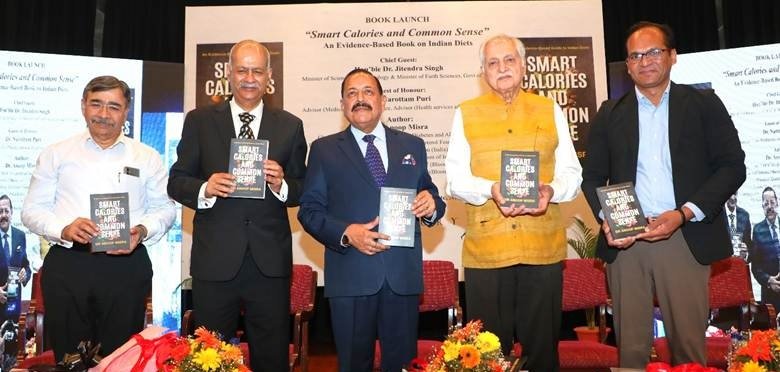
Union Minister Dr. Jitendra Singh emphasized the dangers of misinformation in nutrition science while releasing a new book on evidence-based Indian diets at an event in New Delhi yesterday. The minister stressed that dietary recommendations should be individualized rather than generalized, as each person’s metabolic needs differ significantly.
“Diet cannot be reduced to generalised prescriptions or uniform charts,” said Dr. Singh, who serves as Minister of State for Science & Technology, Earth Sciences, and several other portfolios. “Each individual must understand and adapt according to their own body, lifestyle, and metabolic needs.”
The minister was speaking at the launch of “Smart Calories and Common Sense: An Evidence-Based Guide to Indian Diets,” authored by Dr. Anoop Misra. The event at India International Centre brought together prominent medical professionals, including Dr. Narottam Puri, Advisor for Fortis Healthcare and FICCI’s health services division.
Dr. Singh highlighted how nutrition science has evolved over the decades, noting significant shifts in recommendations regarding cooking oils, sweeteners, and other dietary components. These changing perspectives, he explained, demonstrate that nutritional guidance continues to develop as research advances.
“Scientific understanding in nutrition continues to evolve,” the minister noted, adding that population-level studies often yield conclusions that may not apply universally to every individual.
Drawing on his background in medicine, Dr. Singh emphasized the value of clinical judgment and personalized patient interaction. He recalled earlier medical practices that relied heavily on detailed history-taking and observation before diagnostic technologies became widespread, suggesting that modern healthcare sometimes overlooks individual variations in favor of standardized approaches.
The minister expressed concern about the commercialization of dietary advice, where marketing often trumps science. He cautioned against flashy but impractical diet plans that gain popularity despite lacking scientific foundation or practical relevance.
“Diet is too important a subject to be left to any one group alone,” Dr. Singh remarked, encouraging individuals to take personal responsibility by monitoring their own dietary responses over time.
The timing and distribution of meals throughout the day also received attention during the minister’s address. He pointed out that when people eat can be as important as what they consume—an aspect of nutrition that receives insufficient emphasis in common dietary guidance.
India faces significant public health challenges related to diet, with rapidly increasing rates of diabetes and obesity across urban and increasingly rural populations. According to the International Diabetes Federation, India has approximately 77 million people with diabetes, second only to China globally, with numbers projected to reach 134 million by 2045 if current trends continue.
These statistics make evidence-based nutritional guidance particularly crucial in the Indian context, where traditional diets are rapidly giving way to processed foods and Western-style eating patterns, especially in urban areas.
Dr. Singh concluded his remarks by emphasizing that no single “ideal diet” exists for everyone. Instead, he advocated for a personalized approach based on observation, moderation, and informed choices while maintaining skepticism toward unverified claims and trending diets.
The book launch comes at a time when social media platforms are flooded with often contradictory nutritional advice, highlighting the importance of reliable, science-based resources tailored to Indian dietary patterns and nutritional needs.
Fact Checker
Verify the accuracy of this article using The Disinformation Commission analysis and real-time sources.

10 Comments
The emphasis on personalized nutrition is encouraging. Each individual has unique metabolic needs, so a one-size-fits-all approach to diet is inherently flawed. I look forward to seeing more innovations in this space that empower people to optimize their health.
Personalized nutrition seems like the way forward. Each person’s metabolic needs are unique, so generic dietary advice is often unhelpful. I’m glad the Health Minister is advocating for more evidence-based, individualized approaches to diet and health.
I agree. One-size-fits-all diets don’t work well. Tailored nutrition plans based on individual factors are crucial for optimal health outcomes.
Glad to see the Health Minister taking a strong stance against dietary misinformation. In an age of endless online health advice, it’s crucial to rely on authoritative, evidence-based sources. This book launch is an important step in the right direction.
Absolutely. Cutting through the noise of online health fads and pseudoscience is a major challenge. Resources like this book can help provide trustworthy, science-backed information.
Individualized diets based on metabolic needs – that makes a lot of sense. Generic diet plans often fail to account for the unique differences between people. This new book sounds like a valuable resource for personalized nutrition guidance.
It’s concerning to see the spread of misinformation around diet and nutrition. I hope this new book can help provide reliable, science-backed guidance on healthy Indian diets. Combating dietary falsehoods is an important public health issue.
Absolutely. Misinformation can have serious consequences when it comes to people’s health and well-being. Fact-based resources are essential.
I’m curious to learn more about the evolution of nutrition science and the shifts in dietary recommendations over time. It sounds like this is a complex and nuanced field that requires careful, evidence-based analysis.
Yes, the field of nutrition has seen a lot of changes as our understanding has progressed. It’s important to stay up-to-date on the latest research to make informed choices.