


Listen to the article
Greenpeace Faces Existential Crisis After $345 Million Judgment in Pipeline Case
Greenpeace is engaged in a high-stakes legal battle for its survival in North Dakota’s court system following a judge’s decision to order the environmental organization to pay an expected $345 million to Energy Transfer, the company whose Dakota Access oil pipeline construction sparked widespread protests nearly a decade ago.
Judge James Gion announced Tuesday he would cut in half the more than $660 million in damages that a jury awarded to Energy Transfer last year after finding three Greenpeace entities liable for numerous claims. Once the order is formally entered, both sides are expected to appeal to the North Dakota Supreme Court.
The Dallas-based Energy Transfer, valued at $64 billion and operating thousands of miles of pipelines across 44 states, has objected to the reduction in damages. Meanwhile, Greenpeace USA has reported cash and assets nowhere near sufficient to cover such a hefty financial penalty.
“We will be requesting a new trial and, failing that, will appeal the judgment to the Supreme Court of North Dakota, where Greenpeace International and the US Greenpeace entities have solid arguments for the dismissal of all legal claims against us,” said Kristin Casper, Greenpeace International General Counsel, in a statement Thursday.
The lawsuit centers on protests that erupted in 2016 and 2017 against the Dakota Access Pipeline, which now transports oil through four Midwestern states. The Standing Rock Sioux Tribe, whose reservation lies downstream from the pipeline’s Missouri River crossing, raised concerns that the infrastructure threatened their water supply. The tribe’s objections drew thousands of supporters who camped in the area for months in an attempt to block construction, resulting in hundreds of arrests.
During the trial, Energy Transfer’s attorney Trey Cox characterized Greenpeace as “master manipulators” who were “deceptive to the core.” He accused the organization of exploiting a small, local issue to advance its broader environmental agenda, alleging Greenpeace paid professional protesters, organized training sessions, shared intelligence about the pipeline route, and even supplied lockboxes for demonstrators to attach themselves to equipment.
Greenpeace strongly denied these allegations, maintaining they had little or no involvement in the protests and describing the litigation as “lawfare” intended to silence activists and critics. Despite these denials, the jury found Greenpeace USA liable on all counts, including defamation, conspiracy, trespass, nuisance, and tortious interference, while the other two Greenpeace entities were found liable for some of the claims.
Founded in 1971 in Canada by environmental activists seeking to halt nuclear weapons testing in Alaska’s Aleutian Islands, Greenpeace has grown into an influential global network operating in more than 55 countries. The organization describes itself as using “peaceful protest and creative confrontation to expose global environmental problems and promote solutions.”
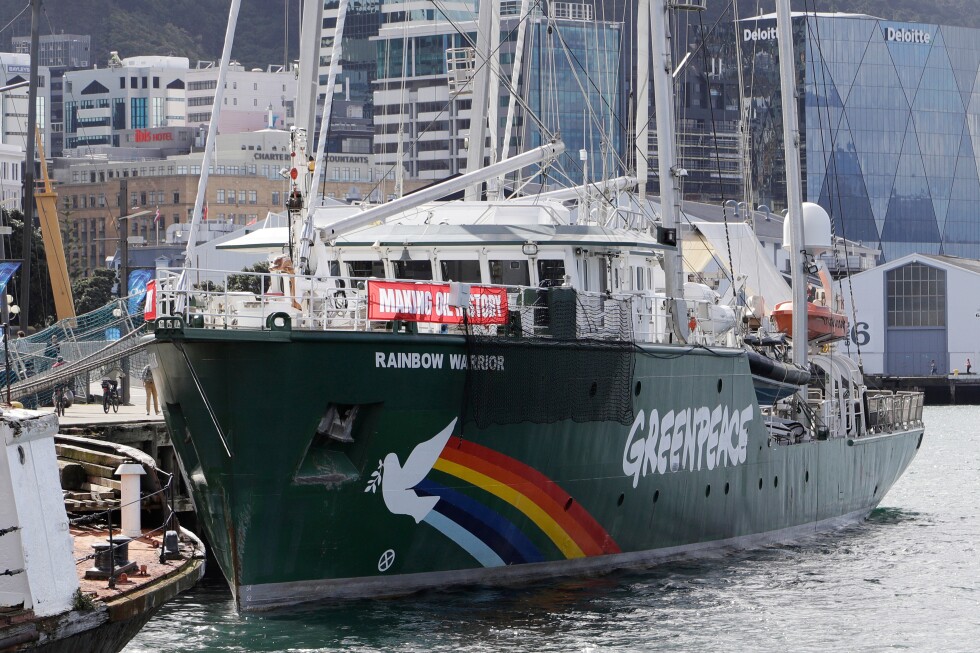
Throughout its five-decade history, Greenpeace has employed dramatic, attention-grabbing tactics to advance environmental causes. Its activists have climbed bridges and buildings to hang protest banners, confronted whaling boats at sea, scaled chemical plant smokestacks to protest toxic pollution, and occupied oil platforms. The organization maintains three ships that sail globally to support its campaigns.
In 2017, Greenpeace members unfurled a “Resist” banner from a crane near the White House shortly after President Donald Trump took action to restart Dakota Access Pipeline construction. More recently, in 2023, activists covered then-British Prime Minister Rishi Sunak’s country estate in black fabric to protest new oil and gas drilling initiatives.
The massive financial judgment against Greenpeace raises serious questions about the organization’s future operations and ability to continue its environmental advocacy work. While Greenpeace has vowed to fight the ruling through all available legal channels, the case highlights the increasing financial risks that activist organizations face when challenging powerful corporate interests.
If upheld, the judgment could set a precedent that might discourage environmental groups from engaging in certain forms of protest or criticism of industrial projects, potentially reshaping the landscape of environmental activism in the United States and beyond.
Fact Checker
Verify the accuracy of this article using The Disinformation Commission analysis and real-time sources.

10 Comments
This case underscores the growing tension between energy companies and environmental groups over major infrastructure projects. It will be interesting to see how the North Dakota Supreme Court rules on appeal.
Greenpeace has a history of high-profile protests, but this lawsuit suggests they may have crossed a line. The outcome could set an important precedent.
This is a high-stakes lawsuit with major implications for Greenpeace. The environmental group is facing a massive financial penalty that could potentially cripple its operations. It will be interesting to see how this plays out on appeal.
Greenpeace has long been a thorn in the side of major energy companies. This case highlights the legal risks they face in their activism.
This is a complex case with significant implications for the balance of power between energy companies and environmental groups. I’m curious to see how the North Dakota Supreme Court will rule on appeal.
Greenpeace has a track record of high-profile actions, but this lawsuit suggests they may have gone too far. The outcome could set an important precedent for future environmental activism.
A $345 million judgment is a staggering amount that could cripple Greenpeace’s operations. This highlights the legal risks that come with environmental activism, even for well-established groups.
It’s concerning to see such a large penalty imposed on Greenpeace. This case could have a chilling effect on environmental advocacy if the judgment is upheld.
The $345 million judgment is an eye-watering amount that Greenpeace will struggle to pay. It raises questions about the balance between corporate interests and environmental advocacy.
I’m curious to see if Greenpeace can successfully appeal this ruling. The legal ramifications could have far-reaching consequences for the environmental movement.