


Listen to the article
Venezuela’s acting President Delcy Rodríguez arrived in the Netherlands on Sunday to defend her country’s territorial claim to the resource-rich Essequibo region before the International Court of Justice (ICJ), marking a crucial moment in a border dispute with Guyana that has spanned decades.
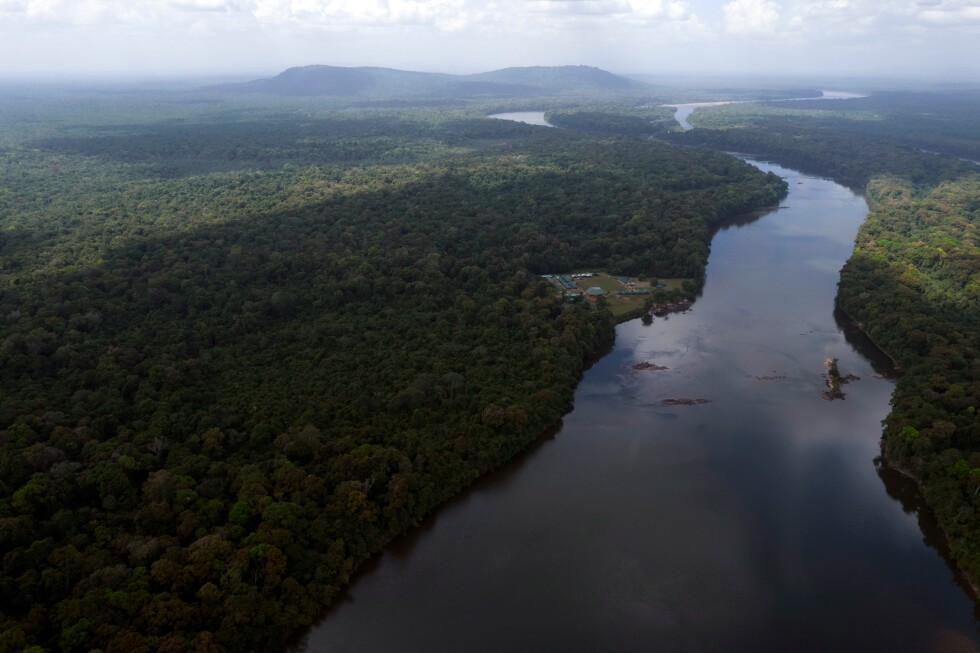
The ICJ in The Hague is hosting a series of hearings between the South American neighbors over Essequibo, a territory covering nearly 62,000 square miles. The contested region contains significant deposits of gold, diamonds, and timber, as well as proximity to massive offshore oil reserves that have become increasingly valuable in recent years.
Venezuela has maintained its claim to Essequibo since the Spanish colonial period, when the jungle territory fell within its historical boundaries. However, an 1899 arbitration decision by representatives from Britain, Russia, and the United States drew the border along the Essequibo River, largely favoring what would later become Guyana.
The Venezuelan government argues that a 1966 agreement signed in Geneva effectively nullified the earlier arbitration, reopening the question of territorial ownership. This “Geneva Agreement” was meant to resolve the dispute but has instead become central to Venezuela’s legal position.
After landing at Amsterdam’s Schiphol Airport, Rodríguez, who assumed power in January following the departure of Nicolás Maduro, emphasized the historical importance of the territory. “Venezuela has demonstrated at every historical stage what our territory has meant since we were born as a Republic,” she told reporters.
The final court hearing, featuring Rodríguez’s arguments, is scheduled for Monday. Legal experts anticipate the ICJ will take several months to issue its final and legally binding ruling in the case.
The dispute has taken on greater significance in recent years following major offshore oil discoveries by ExxonMobil and its partners in Guyanese waters near the contested region. Since 2015, these discoveries have transformed Guyana’s economic prospects, with production beginning in 2019 and rapidly turning the formerly poor nation into one of the world’s fastest-growing economies.
For Guyana, a former British colony that gained independence in 1966, the stakes could hardly be higher. At the opening of the hearings, Guyanese Foreign Minister Hugh Hilton Todd told the international judges that the dispute “has been a blight on our existence as a sovereign state from the beginning,” noting that approximately 70% of Guyana’s territory is at stake in the case.
The legal proceedings began in 2018 when Guyana brought the case to the ICJ seeking confirmation that the 1899 ruling—not the 1966 Geneva Agreement—should determine the official border between the two nations. Venezuela has participated in the hearings while maintaining that its involvement does not constitute consent to or recognition of the ICJ’s jurisdiction in the matter.
Regional analysts note that tensions over Essequibo have fluctuated over decades but intensified in recent years as the economic value of the region has grown. In December 2023, Venezuela held a referendum on claiming sovereignty over the territory, further escalating the dispute.
The case has drawn attention from international energy companies with interests in the region, as well as from neighboring countries concerned about regional stability. Brazil, which borders both nations, has previously expressed concern about the potential for escalation and has encouraged a peaceful resolution.
The ICJ, also known as the World Court, is the United Nations’ highest judicial body for settling disputes between states. While its rulings are legally binding, the court lacks enforcement mechanisms, leaving implementation dependent on international pressure and the willingness of nations to comply.
Fact Checker
Verify the accuracy of this article using The Disinformation Commission analysis and real-time sources.

9 Comments
The Venezuelan government’s claim that the 1966 Geneva Agreement nullified the earlier 1899 arbitration decision is an interesting legal argument. It will be important to see how the ICJ evaluates the validity and implications of these competing agreements.
Agreed. The ICJ’s interpretation of these historical agreements and their impact on the current territorial dispute will be crucial. Their ruling could have far-reaching consequences for the resource extraction and energy industries in the region.
The competing claims over the Essequibo region highlight the complex interplay between historical territorial disputes and modern resource extraction interests. I’ll be following this case closely to see how the ICJ navigates these complex issues.
This case at the ICJ is certainly high-stakes, with significant mineral and energy resources at stake in the Essequibo region. I’m curious to see how the court will weigh the historical territorial claims versus the modern economic and geopolitical factors.
This border dispute over the Essequibo region has been going on for decades, but the recent offshore oil and gas discoveries have heightened the tensions. I wonder if the ICJ will prioritize the historical territorial claims or the modern economic realities in their ruling.
Interesting dispute over the mineral-rich Essequibo region between Venezuela and Guyana. I wonder how the ICJ will rule on the validity of the 1899 and 1966 agreements. This could have major implications for the energy and mining sectors in the region.
You’re right, the outcome of this case could reshape the geopolitical and economic landscape in northern South America. The competing claims over the resource-rich territory are certainly complex.
The potential for valuable mineral and energy resources in the Essequibo region is clearly a key factor driving this dispute between Venezuela and Guyana. I’m curious to see how the ICJ will balance the historical territorial claims with the economic interests at stake.
Absolutely. Given the high-stakes nature of this case, I imagine both sides will make a strong legal argument to sway the court’s decision in their favor. Whichever way it goes, the ramifications could be significant.