


Listen to the article
Sioux Falls city leaders secured a crucial commitment from Smithfield Foods that will reshape the city’s landscape and economic future. The meatpacking giant announced plans to relocate its century-old downtown facility to a new $1.3 billion campus in northwestern Sioux Falls, preserving thousands of jobs while opening prime real estate for redevelopment.
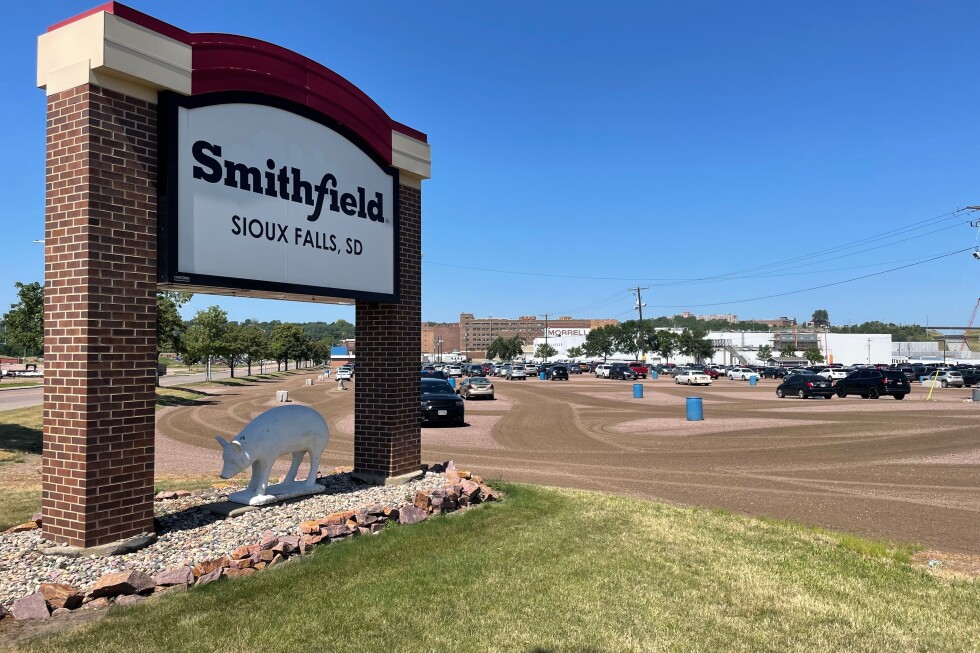
On February 16, South Dakota Governor Larry Rhoden, Sioux Falls Mayor Paul TenHaken, and Smithfield Foods CEO Shane Smith unveiled the ambitious relocation plan. The new facility will be constructed on 200 acres in an industrial park, replacing the 120-acre downtown site that has operated since 1909, when it opened as John Morrell & Co. before Smithfield’s acquisition in 1995.
With approximately 3,200 employees, the Sioux Falls operation ranks as the city’s third-largest private employer. It serves as Smithfield’s second-largest processing facility nationwide and stands as the country’s largest producer of packaged meats. The plant processes around 20,000 hogs daily, sourced primarily from over 500 independent farmers across South Dakota, Minnesota, and Iowa.
The relocation project received a significant boost from billionaire Denny Sanford, who donated $50 million to help the Sioux Falls Development Foundation purchase the downtown property. City officials are also planning a $90 million tax increment financing (TIF) district for the new campus, which will help fund a new wastewater treatment facility.
Mayor TenHaken emphasized the economic significance of retaining Smithfield, noting that similar plant closures elsewhere have resulted in massive economic losses. He cited the University of Nebraska’s assessment that a Tyson beef processing plant closure cost that state $3.3 billion. “I don’t want to just take for granted that it was assumed Smithfield would stay here, because it wasn’t,” TenHaken said.
The move addresses long-standing environmental concerns associated with the aging downtown facility. Residents have long contended with the plant’s distinctive odor that often permeates downtown when wind conditions are unfavorable. Smithfield representatives assured the city council that the new facility will incorporate advanced air-scrubbing technology to significantly reduce odor emissions.
Environmental impact has been a persistent issue for the operation. The current site sits directly on the Big Sioux River, South Dakota’s most populated river basin, with over 40% of the state’s population residing within its watershed. By contrast, the new location will be positioned about three miles from the river and one mile from its nearest tributary, Willow Creek.
The plant currently consumes approximately 3 million gallons of water daily, according to Friends of the Big Sioux River. Under federal Clean Water and Clean Air Acts, Smithfield must maintain permits for wastewater discharges and emissions, overseen by the South Dakota Department of Agriculture and Natural Resources (DANR). The company has faced compliance issues in the past, including a $55,382 fine in 2018 for discharge permit violations and a $44,000 fine in 2011 for multiple permit violations, including ammonia releases.
However, Smithfield has reported substantial environmental improvements in recent years. Ray Atkinson, senior director of external communications, noted that a $45 million investment in a wastewater treatment facility at the current site three years ago resulted in a 47% decrease in nitrate discharge to the Big Sioux River.
Travis Entenman, executive director of Friends of the Big Sioux River, told South Dakota News Watch that while the plant has historically been linked to river quality concerns due to its high wastewater discharge levels, the facility’s relocation will likely have limited impact on overall river quality. He emphasized that agricultural runoff from upstream farms contributes the majority of harmful elements to the river.
“This won’t solve all of our river issues in terms of quality,” Entenman said. “It’s just a small drop in the bucket compared to everything that’s going into it.” Nevertheless, he described the move as a “wonderful surprise” that creates opportunities for increased river access and recreational activities.
The economic impact of Smithfield extends well beyond Sioux Falls. The company generates $4.4 million in taxes annually and pays approximately $200 million in yearly wages. Though pork production trails behind cattle, corn, and soybeans in the state’s agricultural economy (which represents nearly 14% of South Dakota’s GDP), the plant provides critical market access for regional hog producers.
The neighboring town of Crooks, population 1,679, will soon find itself adjacent to the new Smithfield operation, with the town’s city limits bordering the planned site. The Crooks City Council has scheduled a March 9 public meeting to discuss the implications of this major development.
City officials estimate the redevelopment of the vacated downtown site will take “several decades” to complete. The process will begin with demolition and environmental assessment before transitioning to new development, potentially doubling Sioux Falls’ current downtown footprint.
Fact Checker
Verify the accuracy of this article using The Disinformation Commission analysis and real-time sources.

27 Comments
Production mix shifting toward Business might help margins if metals stay firm.
Good point. Watching costs and grades closely.
Good point. Watching costs and grades closely.
If AISC keeps dropping, this becomes investable for me.
Interesting update on What Smithfield’s move could mean for environment, economy. Curious how the grades will trend next quarter.
Good point. Watching costs and grades closely.
If AISC keeps dropping, this becomes investable for me.
Good point. Watching costs and grades closely.
Good point. Watching costs and grades closely.
If AISC keeps dropping, this becomes investable for me.
Good point. Watching costs and grades closely.
Good point. Watching costs and grades closely.
If AISC keeps dropping, this becomes investable for me.
Good point. Watching costs and grades closely.
Silver leverage is strong here; beta cuts both ways though.
Good point. Watching costs and grades closely.
Good point. Watching costs and grades closely.
Silver leverage is strong here; beta cuts both ways though.
Good point. Watching costs and grades closely.
I like the balance sheet here—less leverage than peers.
Silver leverage is strong here; beta cuts both ways though.
The cost guidance is better than expected. If they deliver, the stock could rerate.
Silver leverage is strong here; beta cuts both ways though.
Interesting update on What Smithfield’s move could mean for environment, economy. Curious how the grades will trend next quarter.
Silver leverage is strong here; beta cuts both ways though.
Good point. Watching costs and grades closely.
Uranium names keep pushing higher—supply still tight into 2026.