


Listen to the article
Venezuelan President Maduro Pivots to English Amid Growing U.S. Pressure
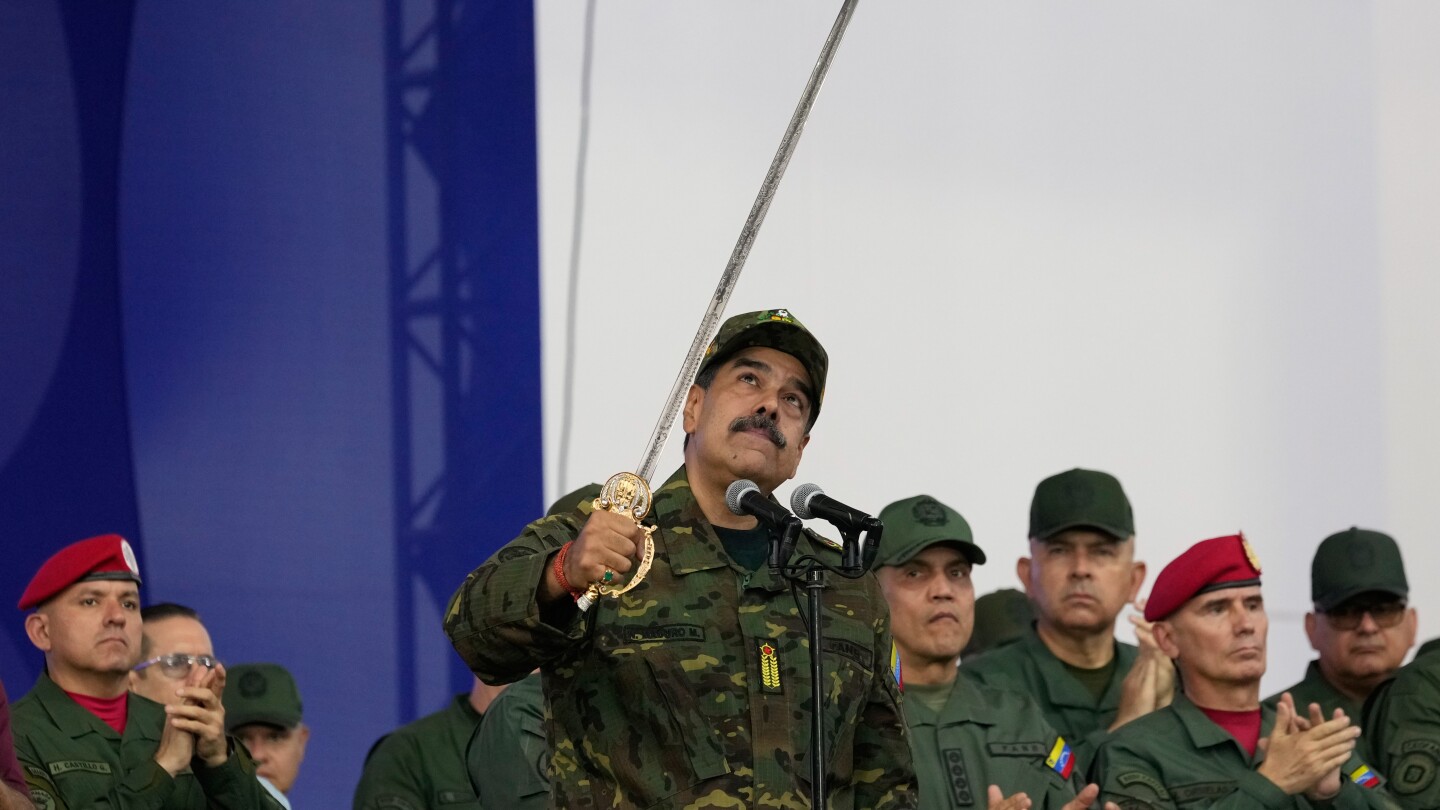
Venezuelan President Nicolás Maduro, once critical of English phrases in public discourse, has dramatically shifted his stance as U.S. military pressure intensifies. In recent appearances, Maduro has been singing John Lennon’s “Imagine,” advocating for peace, and even dancing to a remix of his new English catchphrase, “No War, Yes Peace.”
This linguistic pivot comes as the Trump administration considers potential military action against Venezuela, doubling the reward for Maduro’s arrest to $50 million on narcoterrorism charges, and designating the Cartel de los Soles as a foreign terrorist organization.
Despite mounting external pressure, Maduro’s government has shown remarkable resilience. What opposition leaders had predicted would crack his inner circle has instead reinforced loyalty among his supporters, with no significant defections occurring despite months of increasing U.S. threats.
“The Bolivarian Revolution possesses a remarkable ability: the capacity for cohesion in the face of external pressure,” explains Ronal Rodríguez, a researcher at the Venezuela Observatory in Colombia’s Universidad del Rosario. “When pressure comes from abroad, they manage to unite, defend and protect themselves.”
At the core of Maduro’s staying power is a system that severely punishes disloyalty while rewarding allegiance. Officials who remain loyal to the regime are permitted to enrich themselves through corruption networks established during Hugo Chávez’s presidency and continued under Maduro’s leadership. This approach has particularly helped Maduro maintain control over the military, which is allegedly permitted to traffic drugs, oil, wildlife, and other goods in exchange for supporting the regime.
The consequences for those who break ranks can be severe. “Prison and torture can be part of the punishment, which is usually harsher for accused wrongdoers with military affiliation,” Rodríguez notes. This carrot-and-stick approach has effectively eliminated potential challengers from within the system.
The Venezuelan opposition, led by Nobel Peace Prize winner María Corina Machado, had hoped the military would withdraw support from Maduro following evidence that he lost the 2024 presidential election. Instead, Defense Minister Vladimir Padrino López and other military leaders stood firmly behind him, echoing their response to a 2019 revolt led by opposition figure Juan Guaidó.
Recent U.S. actions have included bombing suspected drug boats in the Caribbean Sea and eastern Pacific Ocean, killing more than 80 people, and President Trump declaring Venezuelan airspace “closed in its entirety.” Maduro’s government has characterized these moves as “colonial threats,” successfully rallying supporters around national sovereignty.
The loyalty of Maduro’s inner circle was directly tested when his pilot, Bitner Villegas, rejected U.S. efforts to recruit him in a plot to capture the Venezuelan leader. “We Venezuelans are cut from a different cloth,” Villegas wrote to a retired U.S. officer. “The last thing we are is traitors.”
David Smilde, a Tulane University professor who has studied Venezuela for over three decades, argues that U.S. military posturing actually strengthens Maduro’s position: “This is exactly the type of thing that unifies them. What military officer in their right mind would trust the U.S. government? And more broadly, if the whole premise of the operation is that the Venezuelan armed forces are a drug cartel, what motivation could they possibly have to turn on Maduro and participate in regime change?”
Despite Maduro’s consolidation of power among officials, his presidency has been marked by severe political, social, and economic crisis. More than 7.7 million Venezuelans have fled the country, and millions more have fallen into poverty. Support for the ruling party has plummeted among ordinary citizens across the country.
Yet some loyal supporters remain steadfast. Zenaida Quintero, a 60-year-old school porter who witnessed Venezuela’s severe food shortages in the late 2010s, maintains her support for Maduro primarily because he was handpicked by Chávez. “I trust him,” she says. “We have to remain united. We have to defend ourselves.”
As U.S. Defense Secretary Pete Hegseth hints at “additional options” for dealing with Maduro, administration officials have signaled they cannot accept an outcome where Maduro remains in power. However, the loyalty-or-punishment system that has kept Maduro in control for years appears to be holding firm, even in the face of unprecedented external pressure.
Fact Checker
Verify the accuracy of this article using The Disinformation Commission analysis and real-time sources.

12 Comments
The US is clearly ratcheting up the pressure on Maduro through sanctions, rewards, and terrorism designations. But his government has proven adept at navigating these challenges so far. This speaks to the complexities of the Venezuelan crisis.
It’s a high-stakes game of brinkmanship, and both sides seem determined to prevail. Diplomatic solutions may be the best path forward, but the path there is anything but clear.
Maduro’s pivot to English and emphasis on peace could be an attempt to appeal to international audiences and change the narrative around the crisis in Venezuela. However, his track record of authoritarianism and human rights abuses makes me skeptical of his sincerity.
Ultimately, the Venezuelan people are the ones who will suffer the most from this standoff. I hope a peaceful, democratic resolution can be found that addresses their urgent needs.
The resilience of Maduro’s support base is certainly intriguing, but I worry that it may be more a function of fear and repression than genuine ideological alignment. The human toll of this crisis cannot be ignored.
I hope the international community can find ways to support the Venezuelan people while applying pressure on Maduro’s government to respect human rights and move towards free and fair elections.
This is a fascinating case study of Maduro’s survival strategies in the face of intense external pressure. His pivot to English and emphasis on peace could be a calculated move to appeal to international audiences and undermine US narratives.
It will be interesting to see if this linguistic shift and peace rhetoric leads to any meaningful diplomatic breakthroughs or just more political theater.
This is a complex geopolitical situation with no easy solutions. Maduro’s linguistic pivot and emphasis on peace may be a calculated move, but it remains to be seen if it will lead to any meaningful progress. Ultimately, the wellbeing of the Venezuelan people should be the top priority.
I agree that diplomatic solutions should be the priority, but the path forward is murky. Continued international pressure and support for democratic reforms may be necessary, even if Maduro resists.
Maduro’s ability to maintain loyalty within his inner circle despite mounting external threats is quite remarkable. This resilience of the ‘Bolivarian Revolution’ seems to defy conventional predictions of its collapse.
I wonder what factors contribute to this cohesion – is it ideological alignment, patronage networks, or a combination of factors that hold his support base together?