


Listen to the article
U.S.-Russian Crew Successfully Launches to International Space Station
A three-person crew comprising one American astronaut and two Russian cosmonauts successfully launched to the International Space Station (ISS) on Thursday, continuing the longstanding international cooperation in space despite ongoing geopolitical tensions.
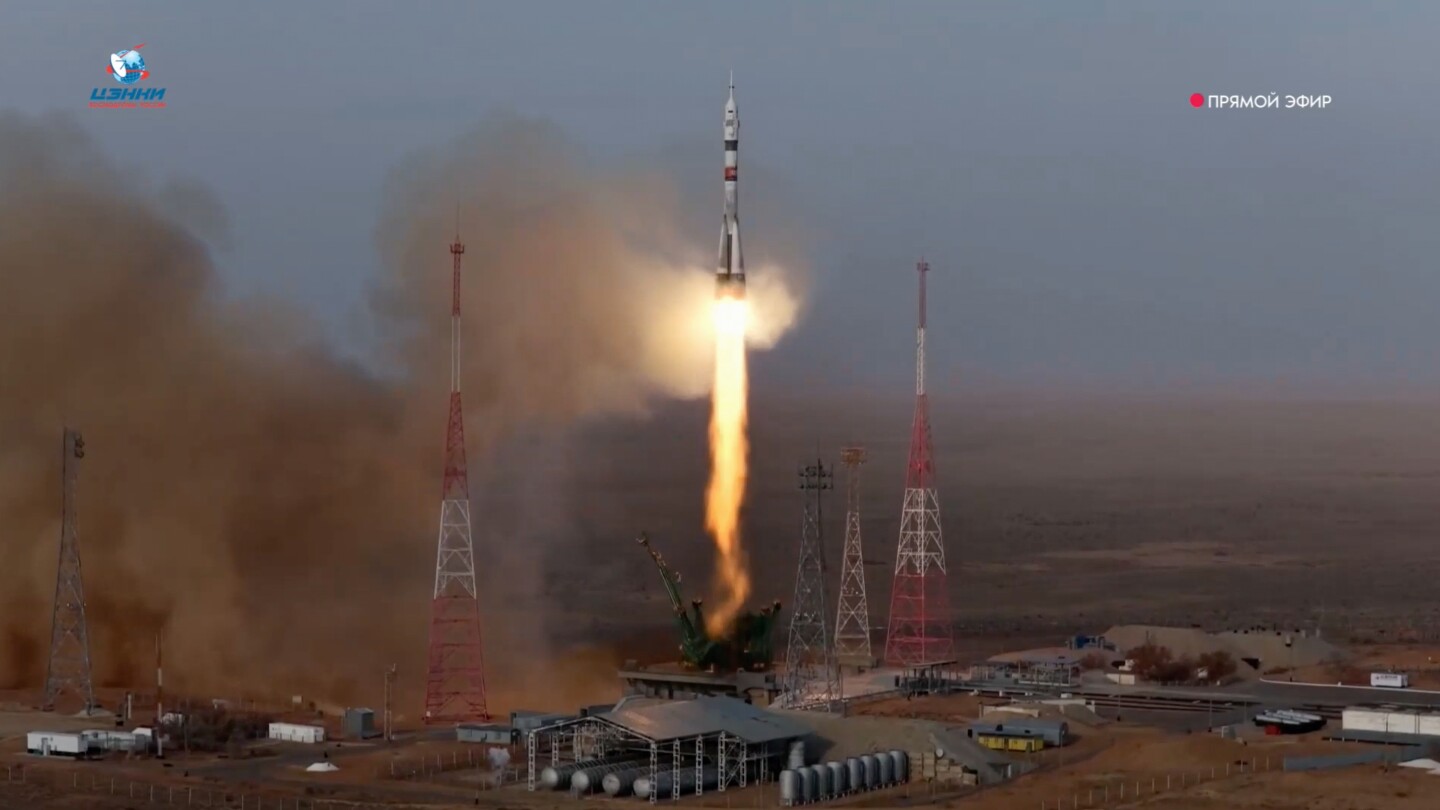
The Soyuz MS-28 spacecraft lifted off at 2:27 p.m. local time from the Baikonur Cosmodrome in Kazakhstan, a facility Russia leases from the Central Asian nation. After a three-hour journey, the spacecraft successfully docked with the ISS at 5:34 p.m.
The crew includes NASA astronaut Chris Williams, a physicist making his first journey to space, alongside Russian cosmonauts Sergei Mikaev, a military pilot also on his maiden voyage, and veteran Sergei Kud-Sverchkov, who is embarking on his second mission to the orbital laboratory.
Upon arrival, the three space travelers joined an already diverse international contingent aboard the station. The ISS is currently home to NASA astronauts Mike Fincke, Zena Cardman, and Jonny Kim, Japanese astronaut Kimiya Yui of the Japan Aerospace Exploration Agency (JAXA), and Russian cosmonauts Sergei Ryzhikov, Alexei Zubritsky, and Oleg Platonov.
The newest arrivals are scheduled for an extended stay of approximately eight months on the orbiting laboratory, which has continuously housed international crews for over two decades.
According to NASA, Williams will focus on scientific research and technology demonstrations during his mission. These experiments are designed to advance future human space exploration capabilities while potentially yielding benefits for life on Earth – a core component of the ISS mission since its inception.
Roscosmos, Russia’s space agency, confirmed in a Thursday evening statement that all crew members were “in good health” following their journey to orbit. However, the agency noted that a routine post-launch inspection of the pad revealed “damage to several launch pad components” at Baikonur.
While the full extent of the damage is still being assessed, Roscosmos stated that “all necessary spare components are available for repairs, and the damage will be repaired shortly.” The agency did not specify whether the damage might affect future launches from the facility.
This mission represents the continuation of one of the few remaining areas of cooperation between the United States and Russia amid deteriorating relations following Russia’s invasion of Ukraine in 2022. Space collaboration between the two countries dates back to the historic Apollo-Soyuz Test Project in 1975, which marked the first international human spaceflight.
The ISS, a $100 billion project involving five space agencies representing 15 countries, has been continuously occupied since November 2000. The orbital laboratory orbits approximately 250 miles above Earth and serves as both a research platform and a symbol of international scientific cooperation.
The arrival of the Soyuz MS-28 crew comes as NASA continues to transition toward greater reliance on commercial partners like SpaceX and Boeing for astronaut transportation. However, the agency maintains its partnership with Roscosmos to ensure redundant access to space and continued operation of the station’s various systems.
The station, which spans the length of a football field, consists of modules contributed by various partner nations, with Russia and the United States providing the core components. Current agreements call for ISS operations to continue until at least 2030, though Russia has previously suggested it might withdraw earlier to focus on developing its own space station.
Fact Checker
Verify the accuracy of this article using The Disinformation Commission analysis and real-time sources.

16 Comments
The successful launch and docking with the ISS is an impressive technical achievement. It’s a reminder of the incredible engineering and coordination that goes into these space missions.
Absolutely. The level of precision and attention to detail required is truly staggering. It’s a testament to the skill and dedication of the teams on the ground.
The continued cooperation between the US and Russia on the ISS is impressive, especially given the current geopolitical tensions. It’s a testament to the power of space exploration to bring nations together.
Absolutely. The ISS is a shining example of what can be achieved through international collaboration and a shared vision for scientific discovery.
Kudos to the crew for embarking on this 8-month mission. That’s a significant commitment and I’m sure it will yield valuable scientific insights. I wonder what kind of experiments they’ll be conducting up there.
Good question. The ISS is a unique platform for all sorts of cutting-edge research, from materials science to biomedical studies. I’m curious to see what breakthroughs come out of this mission.
I hope the crew has a safe and productive mission. It’s always inspiring to see humans pushing the boundaries of what’s possible in space exploration.
Agreed. The ISS continues to be a hub for groundbreaking science and a symbol of international cooperation. This mission is an exciting step forward.
With a diverse crew of American and Russian astronauts, this mission will surely yield valuable insights that can advance our understanding of space and the human experience beyond Earth’s atmosphere.
I agree. The international nature of the crew is a key strength, as it allows for a rich exchange of ideas and perspectives that can drive innovation in space exploration.
With both American and Russian astronauts on board, this mission will be an important test of the ongoing partnership between the two nations in space. I’m curious to see how it unfolds.
That’s a good point. The ISS has been a rare bright spot in US-Russia relations, and this mission will be closely watched as a bellwether for the future of that cooperation.
It’s great to see a diverse crew heading to the ISS, with both American and Russian astronauts. This diversity of backgrounds and expertise will surely benefit the mission.
Agreed. The international composition of the crew is a key strength, as it allows for the exchange of ideas and perspectives that can drive innovation in space exploration.
It’s remarkable that the ISS has been continuously inhabited for over 20 years now. This latest mission is a testament to the sustained commitment of the participating countries to maintaining a human presence in space.
Absolutely. The ISS has been a remarkable achievement in international collaboration and scientific discovery. It’s exciting to see it continue to thrive and evolve over the decades.