


Listen to the article
U.S. futures remained flat Wednesday following President Donald Trump’s State of the Union address, while global markets showed largely positive momentum, particularly in Asia where technology stocks continued their upward trajectory.
European markets opened with modest gains as France’s CAC 40 rose 0.3% to 8,542.30, Germany’s DAX added 0.2% to 25,024.38, and Britain’s FTSE 100 posted a stronger 0.8% increase to 10,763.15. Meanwhile, U.S. futures showed minimal movement with both S&P 500 and Dow Jones Industrial Average futures up just 0.1%.
The Japanese market delivered standout performance as the Nikkei 225 surged 2.2% to close at 58,583.12, briefly touching a record high during the session. The robust gains reflected investor optimism surrounding the artificial intelligence sector that has been driving global tech markets in recent months.
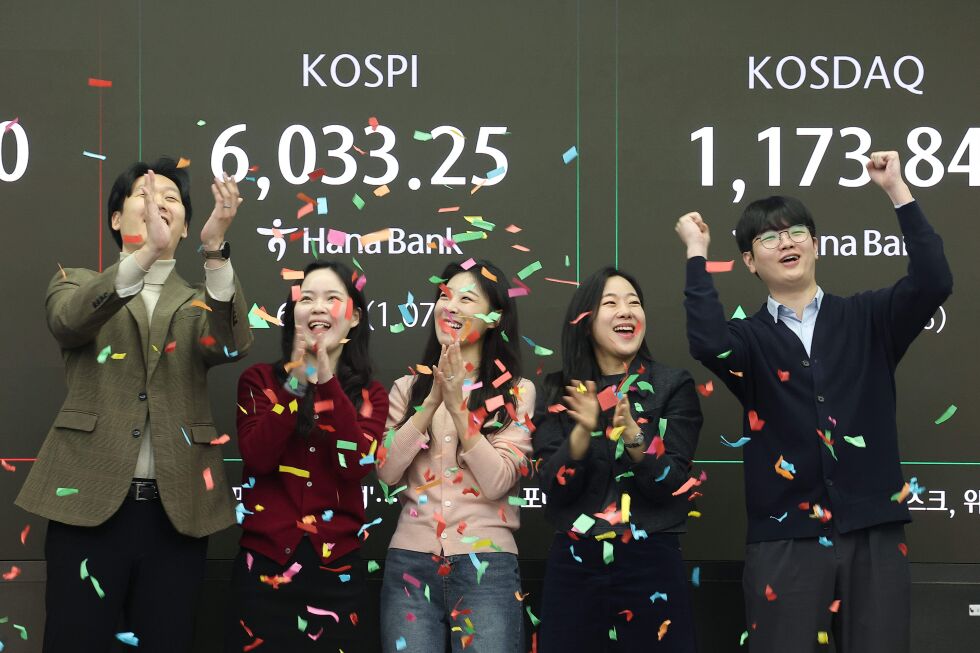
Chinese markets also moved higher, with Hong Kong’s Hang Seng gaining 0.7% to 26,765.72 and the Shanghai Composite adding 0.7% to close at 4,147.23. South Korea’s Kospi jumped 1.9% to 6,083.86, continuing to benefit from strong global demand for semiconductor chips.
Taiwan’s Taiex index posted an impressive 2.1% gain, largely propelled by a 2.5% surge in shares of Taiwan Semiconductor Manufacturing Company (TSMC), the world’s largest contract manufacturer of computer chips. Australia’s S&P/ASX 200 also performed well, rising 1.2% to 9,128.30.
In his State of the Union address, President Trump emphasized job creation, manufacturing growth, and overall economic strength, arguing that the economy is performing better than many Americans perceive. Notably, he devoted less attention to cost-of-living concerns despite polling data suggesting that his handling of economic and household financial issues has become a potential political vulnerability.
Prior to the speech, U.S. markets had already shown positive momentum on Tuesday, with the S&P 500 climbing 0.8%, the Dow Jones Industrial Average adding 0.8%, and the Nasdaq composite rising 1%.
Market participants are now turning their attention to semiconductor giant Nvidia’s upcoming earnings report, expected later Wednesday. The quarterly results could significantly impact market sentiment as investors assess whether the substantial investments in artificial intelligence technology will deliver the anticipated returns.
Expectations for Nvidia remain exceptionally high, continuing a trend that began when the company’s chipsets emerged as the preferred hardware for building AI systems. The report will cover Nvidia’s fiscal quarter from November through January, a period during which AI development continued to accelerate across multiple industries.
In commodities, energy markets showed modest gains with benchmark U.S. crude oil adding 40 cents to reach $66.03 per barrel. Brent crude, the international standard, rose 42 cents to $71.00 per barrel. The modest uptick in oil prices comes amid ongoing concerns about global demand and production levels.
Currency markets saw the U.S. dollar strengthen against the Japanese yen, rising to 156.42 yen from 155.91 yen. The euro gained slightly against the dollar, trading at $1.1792 compared to $1.1774.
The global market rally, particularly in tech stocks, reflects continued investor confidence in the transformative potential of artificial intelligence technologies. As companies across various sectors increase their investments in AI capabilities, semiconductor manufacturers and technology firms developing AI applications have seen sustained investor interest despite concerns about valuations and the pace of practical implementation.
The focus on Nvidia’s earnings highlights how a single company’s performance can now influence broader market sentiment, underscoring the concentrated nature of recent tech-driven market gains.
Fact Checker
Verify the accuracy of this article using The Disinformation Commission analysis and real-time sources.

12 Comments
The strong performance of the Nikkei 225 and other Asian markets is a positive sign, especially given the ongoing global economic uncertainty. I wonder what factors are contributing to this outperformance.
The surge in Taiwanese and South Korean tech stocks is quite notable. The global demand for semiconductors appears to be a key driver behind these gains.
The AI optimism is certainly shaping the investment landscape, but it will be crucial to keep an eye on broader economic factors as well. The flat US futures could be an indication of more cautious sentiment in certain sectors.
The global tech rally, led by the Asian markets, is an interesting development. It will be worth investigating what specific drivers are fueling this trend and how it might impact other industries.
While the US futures may be flat, the overall global picture seems quite bullish, particularly in the tech and AI-related sectors. This could be an interesting opportunity for investors to diversify their portfolios.
The resilience of the global markets, despite the flat US futures, is a testament to the strength of the tech and AI-driven industries. It will be crucial to monitor how this trend develops in the coming months.
The optimism surrounding AI is clearly a major factor in the recent market gains. It will be intriguing to see how this technology continues to shape the investment landscape going forward.
The surge in Nikkei 225 and the broader Asian markets is quite impressive. The global tech sector seems to be the driving force behind these robust performances.
The AI optimism seems to be fueling a global tech rally. Interesting to see how the semiconductor and AI sectors are driving markets higher, even as US futures remain flat.
It will be fascinating to watch how the AI narrative continues to evolve and impact investor sentiment across various markets.
The mixed performance, with US futures flat but global markets gaining, highlights the complexity of the current investment climate. The AI-driven tech sector appears to be a key differentiator in this scenario.
The strong demand for semiconductor chips, particularly from Asian markets, is an intriguing aspect of this story. It will be important to monitor how this dynamic evolves in the coming months.