


Listen to the article
U.S. Energy Secretary Visits Venezuela to Assess Oil Industry Revitalization
U.S. Energy Secretary Chris Wright arrived in Caracas on Wednesday for a three-day visit to evaluate Venezuela’s struggling oil sector, signaling the United States’ expanding role in rehabilitating the South American nation’s most vital industry.
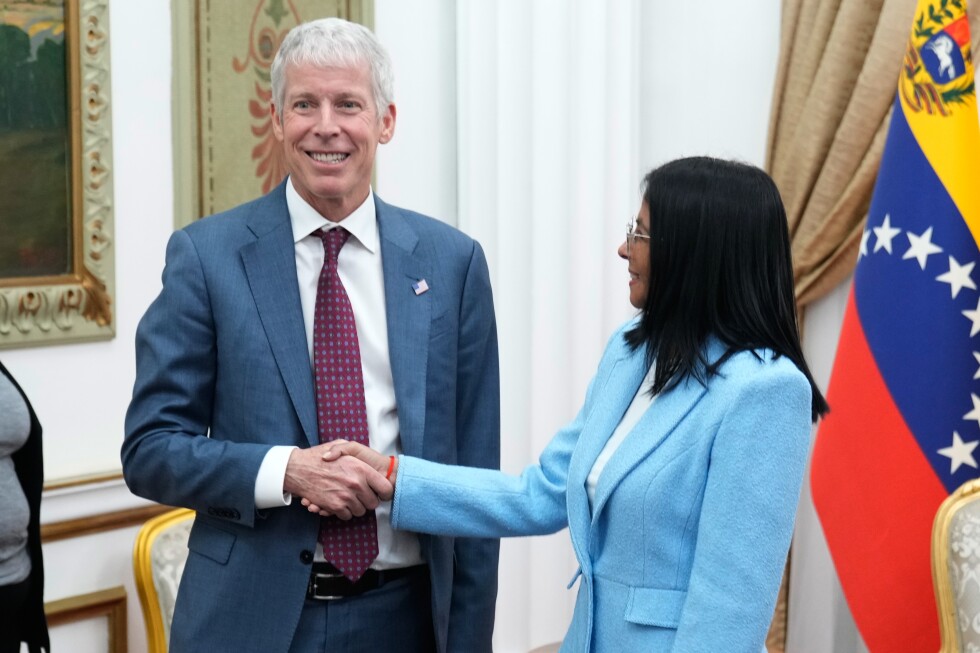
Wright met with Venezuela’s acting President Delcy Rodríguez at the Miraflores presidential palace, where he delivered a message from President Donald Trump. “He is passionately committed to absolutely transforming the relationship between the United States and Venezuela, part of a broader agenda to make the Americas great again,” Wright told reporters, standing alongside Rodríguez with both countries’ flags as a backdrop.
The visit follows significant political upheaval in Venezuela. Rodríguez assumed the presidency after the January 3 U.S. military operation that removed former President Nicolás Maduro from power. Under her leadership, Venezuela recently enacted legislation opening its oil sector to private investment—reversing a cornerstone policy of the country’s two-decade-old socialist government.
Rodríguez acknowledged that Venezuela-U.S. relations have experienced “highs and lows” but emphasized that both nations are now working toward a mutually beneficial “energy agenda.” She called for “diplomatic dialogue and energy dialogue” as the appropriate channels for determining how to move forward.
The newly implemented oil law represents a dramatic shift in Venezuelan policy, granting private companies control over oil production and sales—ending the monopoly previously held by state-run oil company PDVSA. Crucially for potential investors, the legislation allows for independent arbitration of disputes rather than requiring resolution through Venezuelan courts, which are widely considered to be controlled by the ruling party.
Foreign investors view independent arbitration as essential protection against potential future expropriations—a significant concern given Venezuela’s political history. Wright described the reform as “a meaningful step in the right direction” but cautioned it was “probably not far and clear enough to encourage the kind of large capital flows” the U.S. would like to see in Venezuela.
Venezuela possesses the world’s largest proven oil reserves and currently produces approximately 1 million barrels per day. Oil revenue has traditionally been the lifeblood of the Venezuelan economy, making the sector’s rehabilitation crucial to the country’s economic recovery.
During his first term, President Trump imposed severe sanctions on Venezuela’s oil industry in an attempt to topple the Maduro government. These restrictions forced Venezuela to rely on clandestine methods to sell its oil, using unflagged tankers to smuggle deeply discounted crude into global markets. In December, Trump ordered a blockade of “sanctioned oil tankers” entering or leaving Venezuela and began seizing vessels off the country’s Caribbean coast.
Since Maduro’s removal in January, the Trump administration has taken steps to control Venezuela’s petroleum production, refining, and global distribution while overseeing revenue flows. While beginning to lift broad sanctions, U.S. forces have continued seizing tankers—now with the Venezuelan government’s agreement—including one intercepted this week in the Indian Ocean after being tracked from the Caribbean.
Wright told reporters that the blockade is “essentially over,” explaining that the U.S. is now “flowing Venezuelan crude out, selling it at a much higher price than Venezuela was selling it before.” He claimed that the resulting revenue is being directed toward projects benefiting the Venezuelan people.
The Energy Secretary planned to visit oil fields on Thursday as part of his assessment of Venezuela’s petroleum infrastructure, which has deteriorated significantly over the past decade due to mismanagement, lack of investment, and international sanctions.
Rodríguez’s government hopes the changes to the country’s oil law will reassure major U.S. oil companies that have thus far hesitated to return to Venezuela. Many of these companies suffered substantial losses when their investments were nationalized under previous socialist policies.
Fact Checker
Verify the accuracy of this article using The Disinformation Commission analysis and real-time sources.

7 Comments
The U.S. Energy Secretary’s visit to Venezuela is a notable development, as it indicates a willingness to engage with the new government and support the country’s efforts to revitalize its critical oil industry.
Interesting to see the U.S. Energy Secretary visiting Venezuela to assess the oil industry overhaul. This could signal a shift in relations between the two countries, with potential for increased cooperation and investment in the energy sector.
Given the political upheaval in Venezuela, this assessment of the oil industry overhaul by the U.S. Energy Secretary is an important step. The reversal of socialist policies could attract much-needed foreign investment, but the long-term implications remain to be seen.
Absolutely. The success of these reforms will depend on Venezuela’s ability to create an attractive and stable investment climate for international energy companies.
The visit by the U.S. Energy Secretary seems to signal a thawing of tensions between the two countries. It will be interesting to see if this leads to a more constructive partnership around energy development and Venezuela’s economic recovery.
The reversal of Venezuela’s socialist policies to open up the oil sector to private investment is a significant development. It will be important to monitor how this impacts production, foreign investment, and the broader economy.
Agreed. This could be a critical juncture for Venezuela’s economy and its relationship with the U.S. and other international players in the energy industry.