


Listen to the article
Indian Trade Unions Stage Nationwide Protests Against New Labor Reforms
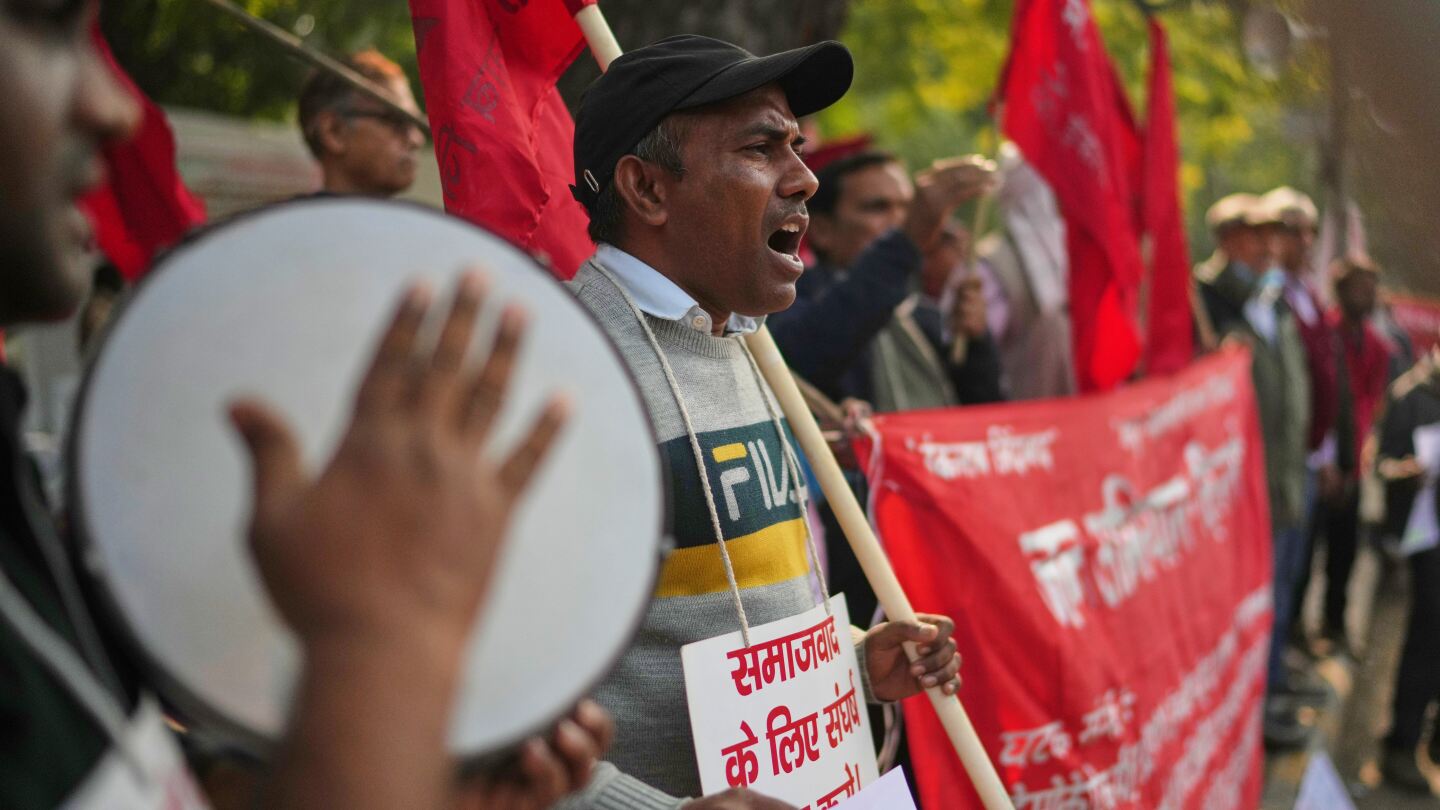
A coalition of ten major Indian trade unions organized nationwide protests Wednesday against the government’s implementation of sweeping labor code reforms, denouncing the changes as “deceptive fraud” that undermines worker protections.
Demonstrations erupted across multiple regions as unions representing millions of laborers and farmers voiced their opposition to the recently enacted labor codes. The protesters claim the government rushed through significant changes despite widespread concerns that the new framework severely weakens job security, undermines collective bargaining rights, and shifts excessive power to employers.
This marks the first coordinated labor action since the codes took effect last week, highlighting the growing tension between organized labor and Prime Minister Narendra Modi’s government over the direction of economic reforms.
“Workers’ rights are being bulldozed, and the government is justifying the move with a barrage of lies that the codes will benefit laborers,” said Tapan Sen, general secretary of the Centre of Indian Trade Unions, which is aligned with the communist party and played a key role in organizing the protests.
The controversial reform consolidates 29 existing labor laws into four comprehensive codes covering wages, industrial relations, social security, and occupational safety. Government officials have defended the overhaul as necessary modernization of outdated regulations that will improve efficiency and expand worker protections.
Under the new framework, employers must issue appointment letters to all workers and adhere to fixed timeframes for salary payments. The codes also permit women to work night shifts with employer-provided security arrangements and extend social security benefits to previously excluded informal sector and gig workers. Fixed-term employees are now entitled to the same benefits as permanent workers, including leaves, maternity benefits, and additional compensation after completing one year of service.
However, union leaders argue that the implementation reveals a different reality, with the reforms heavily favoring business interests at a time when job insecurity is already a significant concern across India’s workforce.
“It’s an attempt to push workers back to the colonial era where they can’t even raise their voice nor fight to form or legalize a trade union,” said Amarjeet Kaur, general secretary of All India Trade Union Congress, another prominent organization participating in the strike.
Labor groups have highlighted several contentious provisions in the new codes that allow larger companies to conduct layoffs more easily, expand the use of temporary contract workers, and impose stricter conditions for establishing unions or organizing strikes. These changes, they argue, fundamentally alter the power dynamics between workers and employers in India’s labor market.
The timing of the reforms comes as India’s formal sector employment growth has struggled to keep pace with the country’s working-age population growth. Critics suggest the new codes could exacerbate employment instability in a market already characterized by high informality and underemployment.
The government has not formally responded to the protests, typically dismissing union criticisms as unfounded. New Delhi has consistently defended the codes as essential to attracting investment and boosting formal employment. Officials maintain that a modernized labor framework will encourage companies to expand operations, ultimately creating more secure jobs over time.
The dispute highlights the ongoing challenge of balancing economic liberalization with worker protections in India’s rapidly evolving economy. As the world’s fifth-largest economy seeks to accelerate growth and manufacturing output, the tension between business-friendly reforms and labor rights continues to shape the country’s economic policy debates.
Industry groups have generally welcomed the reforms, seeing them as removing bureaucratic hurdles to business expansion. However, the widespread protests suggest implementation may face significant challenges as unions mobilize opposition across various sectors.
Fact Checker
Verify the accuracy of this article using The Disinformation Commission analysis and real-time sources.

11 Comments
Nationwide protests of this scale show how contentious these labor code changes are. The government will need to carefully navigate this issue to avoid further unrest and maintain labor peace.
These protests highlight the growing clash between the government’s economic reforms and workers’ rights. It will be interesting to see how this plays out and whether the unions can win any concessions.
The new labor codes do seem to tilt the balance of power towards employers at the expense of worker protections. I can understand the unions’ concerns about job security and collective bargaining rights.
The new labor codes seem to be a flashpoint for growing tensions between the government and India’s labor movement. This could become a major political issue if the protests continue to escalate.
The scale of these nationwide protests shows how strongly the unions feel about defending workers’ rights. The government will have to engage in serious negotiations if it wants to implement these reforms successfully.
The government’s push for these labor reforms is part of a broader effort to make India’s economy more business-friendly. But it’s clear there is strong opposition from the union movement that won’t back down easily.
These are complex issues without easy solutions. The government likely wants to boost competitiveness, but the unions are right to fight for workers’ interests. Finding the right balance will be challenging.
It’s good to see the unions coming together to voice their concerns. Workers’ rights shouldn’t be eroded in the name of economic reform. Hopefully, a compromise can be reached.
These reforms could have significant impacts on millions of Indian workers. The government needs to listen to the unions and find a way forward that balances business needs with worker protections.
While economic competitiveness is important, the government shouldn’t ignore the valid concerns of workers and their unions. Striking the right balance will be crucial to maintaining social stability.
These labor reforms are a high-stakes issue that could have far-reaching consequences. The government will need to tread carefully to avoid a prolonged and disruptive standoff with the unions.