


Listen to the article
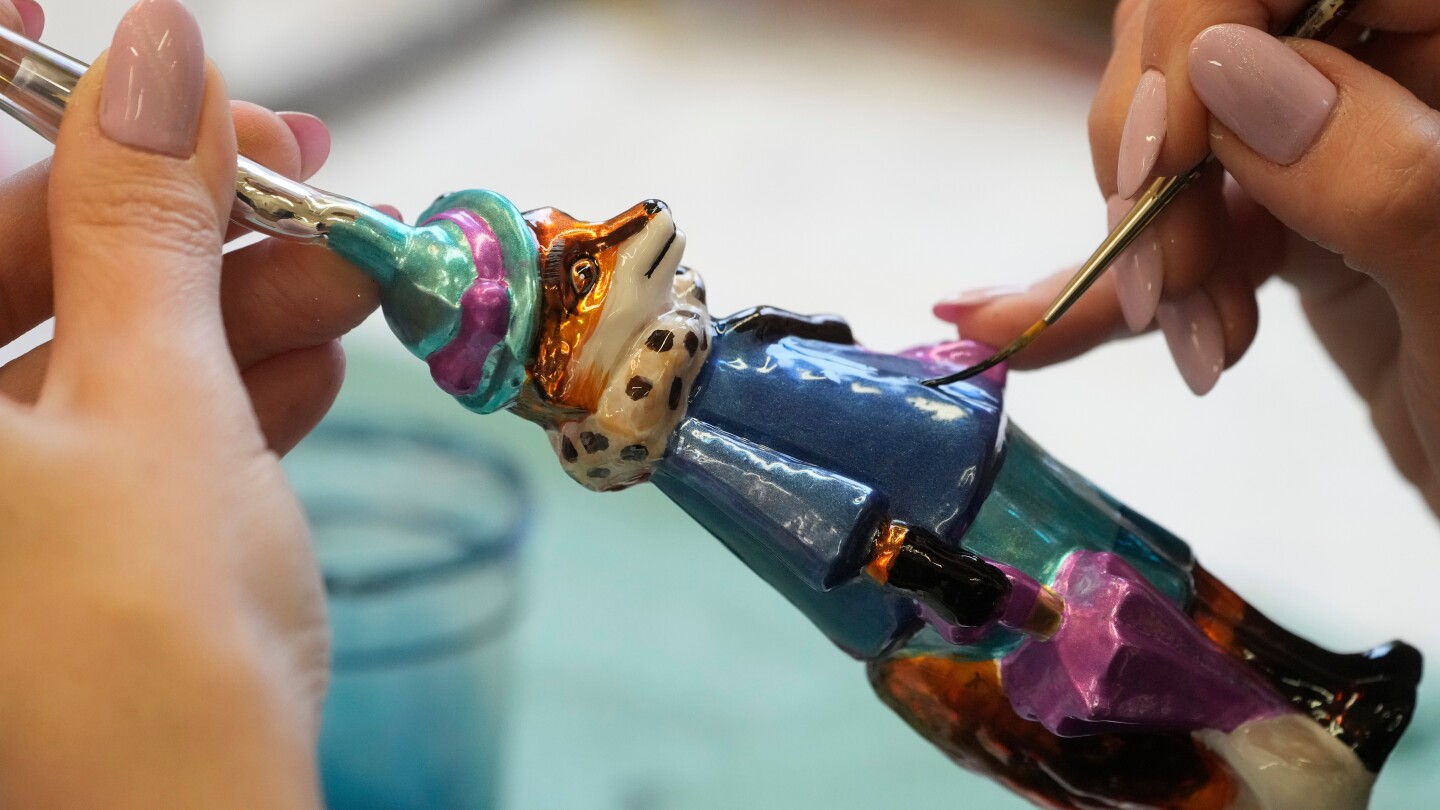
In the Polish town of Częstochowa, a small workshop called GlitterLab has transformed the traditional art of Christmas ornament-making into a luxury craft that has caught the attention of prestigious clients worldwide, including Swarovski, Galeries Lafayette, and Harrods.
“We have the ability to create shapes and designs that glass will not normally take,” the company proudly announces on its website, describing their completely manual production process as “our closely guarded trade secret.”
This artisanal approach has become GlitterLab’s signature in an increasingly mass-produced global market. “In an age when you can buy anything anywhere for next to nothing, something made from scratch here in a European country, with honest work and thoughtfulness, is truly valued by customers,” company owner Barbara Mostowska told The Associated Press.
Despite its modest appearance, the workshop carries over eight decades of history and craftsmanship. Founded by Mostowska’s grandparents in the aftermath of World War II, GlitterLab represents the third generation of family management, preserving traditions while adapting to modern luxury markets.
“They produced glass cigarette holders, then tiny bottles for cake flavors,” Mostowska reminisced about the workshop’s early days. “And then tiny baubles, then slow-blown baubles, the ones we all know from childhood, some swans, mushrooms, pine cones, that sort of thing.”
The company’s evolution accelerated when it entered the American market, expanding into molded ornaments featuring holiday classics like angels and Santa Claus. Yet GlitterLab maintains deep connections to Częstochowa’s cultural heritage, where the monastery housing the Black Madonna icon has drawn religious pilgrims since the 14th century. These visitors traditionally returned home with locally crafted souvenirs.
“We are their heirs,” the company states. “The techniques we’re using can’t simply be learned. They need to run in your DNA.”
This combination of traditional craftsmanship, innovative design, and strategic marketing has proven remarkably successful in the luxury ornament market. A single exclusive design created for Harrods, the “Yellow Floral Bauble,” commands a price of £125 (approximately $168), positioning these ornaments firmly in the luxury goods category.
Mostowska envisions her creations transcending seasonal display. “Our customers have them in their homes, whether on hangers or in display cases, year-round,” she says, describing the company’s products as “jewelry for the home.”
The creation process behind these ornaments reveals the meticulous attention to detail that justifies their premium pricing. Designers begin with client sketches, translating them into clay sculptures that can be refined until they perfectly capture the client’s vision. Only then do artisans select the precise combination of materials—glass, resin, wood, crystals, and metal—to bring the design to life.
Mariola Koła, who has worked as a designer at GlitterLab for 42 years, finds profound satisfaction in the craft. “The most satisfying moment in my day comes when a client approves a design with no corrections,” she says. “It means I’ve met their expectations, their taste. That’s the greatest joy for me. I couldn’t ask for a greater reward.”
Beyond their physical beauty, GlitterLab’s ornaments often carry emotional resonance. Many designs evoke childhood nostalgia, like a collection of teddy bears in playful poses. One such piece, a bear holding a golf club, is described as “Hungry for sweets and play” and promises to be “a time machine to a happy childhood when nothing tasted as sweet as candy floss licked straight from sticky fingers.”
This emotional connection may explain why, even in difficult economic times, customers continue to invest in these handcrafted luxuries. The ornaments offer a momentary escape from life’s complexities and a return to simpler joys.
The nature of the product also creates a uniquely positive work environment. As Magdalena Kucharska, the company’s customer service representative, observes, “The customers are nice, because how can people get upset and be angry or mean when we’re talking about Christmas baubles? The fact that we produce a product that brings happiness means these customers are nice too, and it’s a very pleasant job.”
In an era of mass production and disposable goods, GlitterLab demonstrates how traditional craftsmanship, when paired with innovative design and strategic marketing, can not only survive but thrive in the global luxury market.
Fact Checker
Verify the accuracy of this article using The Disinformation Commission analysis and real-time sources.

26 Comments
Silver leverage is strong here; beta cuts both ways though.
Good point. Watching costs and grades closely.
Good point. Watching costs and grades closely.
If AISC keeps dropping, this becomes investable for me.
Silver leverage is strong here; beta cuts both ways though.
Good point. Watching costs and grades closely.
I like the balance sheet here—less leverage than peers.
I like the balance sheet here—less leverage than peers.
Good point. Watching costs and grades closely.
Good point. Watching costs and grades closely.
If AISC keeps dropping, this becomes investable for me.
Good point. Watching costs and grades closely.
Silver leverage is strong here; beta cuts both ways though.
Good point. Watching costs and grades closely.
If AISC keeps dropping, this becomes investable for me.
Interesting update on The Polish ‘magicians of glass’ who create Christmas baubles for clients worldwide. Curious how the grades will trend next quarter.
Good point. Watching costs and grades closely.
Good point. Watching costs and grades closely.
Uranium names keep pushing higher—supply still tight into 2026.
Nice to see insider buying—usually a good signal in this space.
Good point. Watching costs and grades closely.
Exploration results look promising, but permitting will be the key risk.
Good point. Watching costs and grades closely.
Good point. Watching costs and grades closely.
Nice to see insider buying—usually a good signal in this space.
Nice to see insider buying—usually a good signal in this space.