


Listen to the article
Montana Companies Revive Domestic Hemp Clothing Production After Century-Long Hiatus
In 2020, a northcentral Montana hemp crop marked the beginning of a pioneering experiment by two local companies attempting something that hadn’t been done in nearly a century: producing clothing from American-grown hemp without the material ever leaving the United States.
When the finished shirt finally reached consumers last year, it represented more than just a new product—it demonstrated the revival of a domestic manufacturing capability long since offshored.
Hemp, a versatile crop with applications ranging from fabrics and insulation to edible seed oils, was federally prohibited in the United States for nearly 100 years until Congress lifted restrictions in 2018. This legal change opened the door for Fort Benton’s IND Hemp and Great Falls-based apparel company Smith and Rogue to collaborate on creating American-made hemp clothing.
“Honestly, it was just: Can we do it? Because it hadn’t happened in, arguably, 100 years,” said Morgan Tweet, co-founder and CEO of IND Hemp. “No one had grown hemp fiber and been able to process it to a quality that they were able to spin with in the U.S.”
IND Hemp, established in 2018, initially focused on producing hemp seed oils from regionally grown crops. However, the company had textile production on its radar from the beginning and launched its fiber production line in 2022 after two years of planning.
Around that time, Smith and Rogue approached IND with a proposal. As an offshoot of the North 40 Outfitters chain based in Great Falls, Smith and Rogue already sold hemp-based clothing but sourced internationally. Brandon Kishpaugh, the company’s apparel merchandiser, saw an opportunity to create a fully domestic supply chain.
“We saw there was a demand for a more durable, more sustainable, higher quality fiber,” Kishpaugh explained. “And now it’s how do we get it sourced in the U.S.?”
The geographic proximity of the two companies—less than an hour apart—was fortunate, but represented only the first step in a complex manufacturing process that had to be rebuilt from the ground up.
Despite being outlawed for most of the 20th century, hemp has deep roots in American history. Founding fathers like Thomas Jefferson cultivated the crop, which became a symbol of domestic self-reliance during the American Revolution. However, hemp and marijuana were legally conflated when Congress passed prohibitive legislation in 1937, effectively banning both plants despite their different properties.
Apart from a brief government-sponsored cultivation period during World War II to produce essential materials like rope and parachutes, industrial hemp production in America remained dormant until recent years. Montana legalized industrial hemp cultivation in 2001, but federal prohibition created numerous obstacles, including complications with water access and conflicting jurisdictions.
The 2018 Farm Bill finally removed federal restrictions, allowing Montana to become a mid-tier hemp producer with 2,400 acres harvested in 2024. However, the decades-long prohibition had erased much of the institutional knowledge around hemp production, while American textile manufacturing as a whole had already experienced sharp declines around the turn of the century.
“Over time, that infrastructure has disappeared,” explained Sofi Thanhauser, author of “Worn: A People’s History of Clothing.” “And so it’s really hard for companies who want to do supply chains in the U.S., because a lot of the time the equipment and expertise is not here.”
IND’s primary fiber-processing equipment was imported from France, where a stable European hemp industry has persisted. The Fort Benton facility specializes in decortication, which separates the valuable outer fiber material from the plant’s woody core. These massive machines can process five tons of material per hour.
“We are still always optimizing our line,” Tweet noted. “But there’s not a playbook. You can’t really call up a company and say, ‘We want to make hemp fiber for T-shirts’ and they say, ‘I’ve got you covered.'”
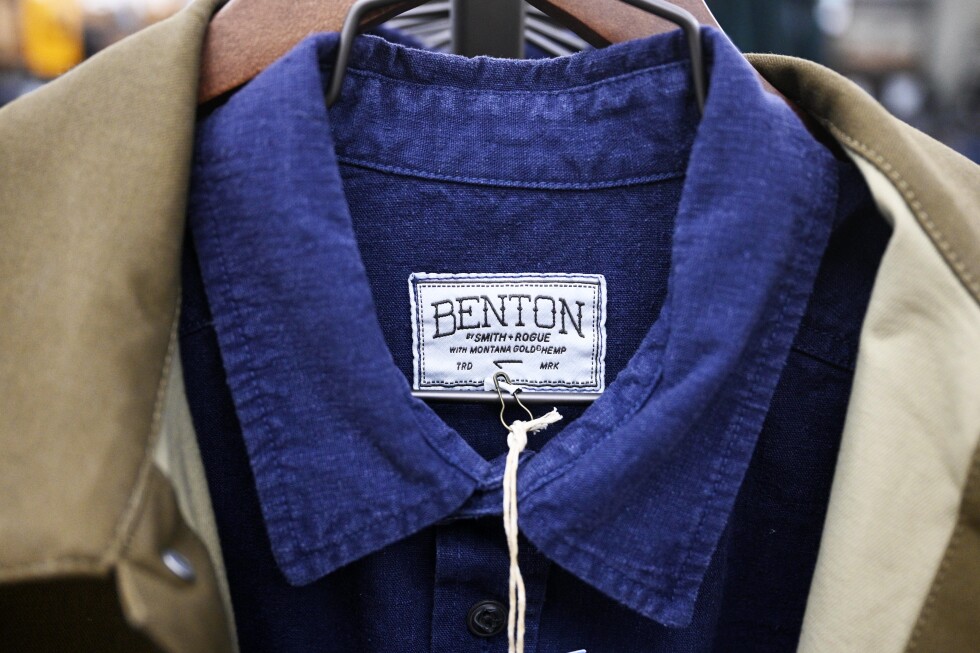
Smith and Rogue’s initial test run produced just 239 men’s work shirts. The resulting “Benton” shirt, priced at $150, blends Montana-grown hemp fibers with Arizona cotton. The manufacturing journey spanned multiple states: raw fibers traveled from Montana and Arizona to North Carolina for refining and blending, then to another North Carolina facility for spinning, South Carolina for weaving, Georgia for finishing, and finally to New York City for cutting and sewing.
“We were able to piece this thing together, which made it very costly,” Tweet said. “The fiber moved probably 10 more times than it had to, and freight is your biggest enemy in all these things.”
The fragmented production process reflects the current reality of American textile manufacturing. With more than 97% of clothing sold in the U.S. made overseas, domestic production faces significant challenges. Certain manufacturing steps require specialized, capital-intensive equipment that small businesses struggle to acquire.
“It’s things like the spinning mill that turns the fiber into thread that is hugely capital-intensive and involves huge, complicated machines,” Thanhauser said. “You can’t, as a small business, just buy a couple of those.”
The project encountered numerous obstacles, including a shipment of finished fabric that went missing en route to New York City. “So there’s 600 yards of this historic fabric that’s warehoused somewhere,” Tweet remarked. Fortunately, enough additional material was available to complete production.
Smith and Rogue finally released the Benton shirt in December 2025, with marketing that emphasized its unique domestic production story. “You can’t just put it on the rack,” Kishpaugh said. “If you don’t know what it is, it’s just going to look like another button-up shirt. And then you look at the price tag.”
While plans for second-generation Benton shirts are underway, with hopes to scale production and expand into outerwear and pants, both companies acknowledge that a hybrid model may be more economically viable for Montana hemp.
“Will there always be these opportunities to promote a full domestic supply chain? Absolutely,” Tweet said. “But they’re never going to be able to serve the larger demand to get it into everyone’s closet.”
The Benton shirt represents not just a product but a proof of concept—demonstrating that American-grown hemp can once again be transformed into high-quality textiles entirely within U.S. borders, even if challenges of scale and cost remain.
Fact Checker
Verify the accuracy of this article using The Disinformation Commission analysis and real-time sources.

10 Comments
The revival of American-made hemp clothing is an intriguing development. While it’s exciting to see domestic production making a comeback, I wonder about the scalability and long-term commercial viability of this industry. What factors will determine whether this remains a niche market or grows into a more mainstream source of textiles and apparel?
That’s a good question. Factors like consumer demand, production costs, supportive government policies, and the ability to build out supply chains and manufacturing capacity will all play a role in determining the long-term prospects of this industry.
Fascinating to see American companies reviving domestic hemp production and clothing manufacturing. This represents an important milestone in reducing our reliance on imported textiles and materials. I’m curious to learn more about the challenges they faced in re-establishing this supply chain and production capability.
Agreed, it’s great to see US companies leading the way in bringing back this industry. I imagine there were significant hurdles around infrastructure, skills, and regulatory changes they had to navigate.
The return of American-made hemp clothing is an exciting development. Hemp is such a versatile and sustainable crop – it will be interesting to see if this can grow into a larger domestic manufacturing industry. What are the long-term economic and environmental benefits this could bring?
Good point. Domestic hemp production could reduce our reliance on imported textiles, create new jobs, and offer more eco-friendly material alternatives. It will be worth monitoring the scalability and long-term viability of this industry.
This is a promising experiment, but I wonder about the economic viability of American-grown hemp clothing compared to mass-produced imports. What steps might be needed to make domestic hemp manufacturing more cost-competitive in the long run?
That’s a valid concern. Economies of scale and supply chain maturity will likely play a big role. Supportive policies, investment in infrastructure, and consumer demand for sustainable US-made products could all help boost the competitiveness of this industry.
It’s great to see American companies taking the initiative to revive domestic hemp production and clothing manufacturing. This helps reduce our reliance on imports and supports the growth of a more sustainable textile industry. I’m curious to learn more about the specific challenges they faced in re-establishing this supply chain.
Absolutely, this is an important step towards greater self-reliance and environmental responsibility in the US textile sector. Overcoming logistical, regulatory, and technical hurdles to rebuild this domestic capability is no small feat.