


Listen to the article
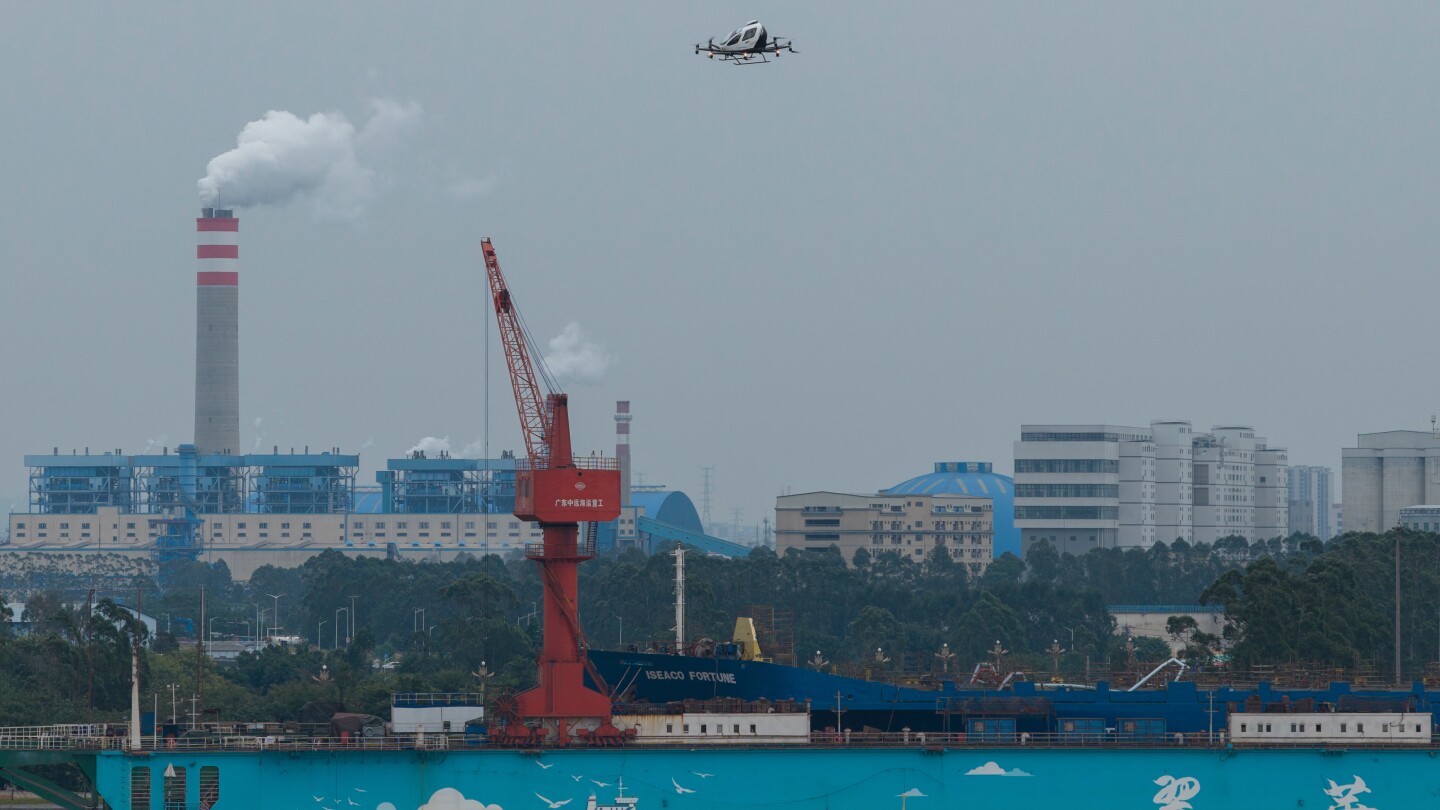
In the skies above Guangzhou, an oval-shaped aircraft from flying taxi manufacturer EHang hovers with a whirring noise reminiscent of a miniature helicopter. This unmanned vehicle, being tested over a riverside innovation zone, represents China’s ambitious push into what officials call the “low-altitude economy” – a sector that once seemed confined to science fiction.
The technology is already making inroads into everyday life. In nearby Shenzhen, food-delivery drones have become both a practical service and tourist attraction. Polish visitor Karolina Trzciańska recently ordered bubble tea via smartphone, which arrived by drone approximately 30 minutes later despite light rain. “This is the first time I’m seeing something like this, so it was super fun,” she said.
China’s low-altitude economy – encompassing activities in airspace below 1,000 meters – generated business worth 506 billion yuan ($70 billion) in 2023, accounting for about 0.4% of China’s overall economy. Zhang Xiaolan, a researcher at the State Information Center, a government-affiliated think tank, projects this figure will surge to 3.5 trillion yuan (approximately $490 billion) by 2035.
Guangdong province, home to global drone giant DJI, is leading China’s aerial revolution. DJI currently commands an estimated 70% of the global commercial drone market. The province also hosts other major players including EHang, logistics company SF Express’s drone division Phoenix Wings, and automaker XPENG’s flying car unit ARIDGE.
Local governments are providing substantial support. Guangdong announced plans in October to accelerate the construction of flight service stations and platforms while backing discount vouchers for low-altitude tourism. Shenzhen has launched a 15-million-yuan ($2.1 million) incentive program for companies that secure passenger eVTOL (electric vertical take-off and landing) vehicle certifications.
EHang has already obtained regulatory approval from China’s Civil Aviation Administration to offer commercial passenger services with its pilotless eVTOL, which can reach speeds of 130 kph (81 mph) with a maximum range of 30 kilometers (19 miles). While commercial routes haven’t launched yet, EHang vice president He Tianxing said the company aims to begin with aerial sightseeing services. Over the past two years, EHang has constructed takeoff and landing sites in 20 Chinese cities.
“It can’t just be a research product, nor an engineer’s toy,” He said, envisioning future citywide networks utilizing rooftops of malls, schools, and parks as terminals.
However, significant technical challenges remain. Guo Liming, co-founder of Shenzhen-based Skyevtol, identified battery limitations as the primary obstacle for eVTOL development. The company’s single-seat manned eVTOL aircraft, priced around $100,000, can only fly 20 to 30 minutes before requiring recharging.
Safety concerns have also emerged. In September, two XPENG eVTOL aircraft collided after a rehearsal for an exhibition, with one catching fire while landing. Though no injuries were reported, a subsequent expo canceled flying demonstrations.
Nevertheless, XPENG continues developing its flying car technology, including a six-wheeled ground vehicle with a detachable eVTOL aircraft. Having invested over $600 million, the company claims more than 7,000 global orders for its “Land Aircraft Carrier” and has begun preparing for mass production. XPENG plans trial sightseeing flights in Dunhuang, a popular Silk Road tourist destination, for July 2025.
The timeline for regular commercial passenger service remains unclear. Some international companies have struggled financially before reaching commercial launch. In Germany, air taxi makers Lilium and Volocopter filed for bankruptcy, though Volocopter was subsequently acquired by Diamond Aircraft Group, a subsidiary of a Chinese firm.
Despite China’s leadership in drone technology and manufacturing, policy constraints—particularly limited airspace access—present significant barriers. Frank Zhou, managing director at GBA Low Altitude Technology Co., suggested that “overseas markets are more promising” for many applications. “Perhaps for some Southeast Asian countries, if I introduce these applications to them, their demand could explode,” he noted.
Less than one-third of China’s low-altitude airspace was accessible for general aviation use in 2023. The number of registered general aviation aerodromes in China, excluding private airports, is approximately one-tenth of those in the United States.
Chinese authorities are gradually addressing these limitations. The military, which controls most Chinese airspace, has pledged to simplify approval procedures in Shenzhen and five other provinces. Proposed revisions to civil aviation law include provisions for low-altitude airspace allocation and supervision.
Gary Ng, senior economist at Natixis Corporate and Investment Banking, expects meaningful commercialization around 2030, with passenger-carrying eVTOLs for tourism and industrial purposes preceding widespread flying taxi services.
“China is a latecomer to the industry but now leads in developing small drones and low-altitude airspace investments,” said Chen Wen-hua, director at the Hong Kong Polytechnic University’s Research Centre for Low Altitude Economy. While optimistic about the sector’s future, Chen cautioned that “the road leading to that bright future might be treacherous.”
Fact Checker
Verify the accuracy of this article using The Disinformation Commission analysis and real-time sources.

10 Comments
The rise of drone-based food delivery in China is a fascinating glimpse into the future. While the convenience and novelty factor are clear, I wonder about the broader economic and environmental implications as this technology scales up.
Fascinating to see China’s push into urban air mobility and the ‘low-altitude economy.’ The regulatory environment and public acceptance will be key factors in determining the pace and scale of adoption for these emerging technologies. It will be interesting to follow the progress and challenges in the years ahead.
The integration of flying taxis and delivery drones into China’s urban landscape raises interesting questions about the future of transportation and logistics. While the convenience and efficiency benefits are clear, the broader societal and environmental impacts warrant close examination.
Intriguing to see China positioning itself as a leader in urban air mobility. The development of flying taxis and delivery drones could have far-reaching implications for transportation, logistics, and city planning. However, safety and public acceptance will be critical hurdles to overcome.
I’m curious to learn more about the technical and operational hurdles that flying taxi companies in China are facing. Achieving widespread adoption and safe integration into urban airspace will require overcoming a range of technical, regulatory, and public acceptance barriers.
Agreed. Issues around noise, airspace management, and public trust in the technology will all need to be addressed. It’s an ambitious vision, but realizing it will take time and careful planning.
China’s ambition to develop a thriving ‘low-altitude economy’ is an exciting vision, but the technical, regulatory, and operational challenges should not be underestimated. Ensuring the safety and public acceptance of technologies like flying taxis and delivery drones will be paramount.
Fascinating to see China’s push into urban air mobility. Flying taxis and delivery drones open up all sorts of possibilities, though the regulatory and safety challenges will be significant. It will be interesting to see how this ‘low-altitude economy’ develops in the years ahead.
China’s projection of the ‘low-altitude economy’ reaching $490 billion by 2035 is eye-catching. I’d be curious to see a breakdown of the different use cases and industries that are expected to drive that growth. The regulatory environment will be key to watch as well.
The rapid growth of China’s ‘low-altitude economy’ highlights the rapid pace of technological change. While the potential benefits are clear, I wonder about the risks and unintended consequences that may emerge as these new modes of transportation and logistics become more widespread.