


Listen to the article
Hawaiian Fishers Battle Rising Shark Depredation, Seek Effective Deterrents
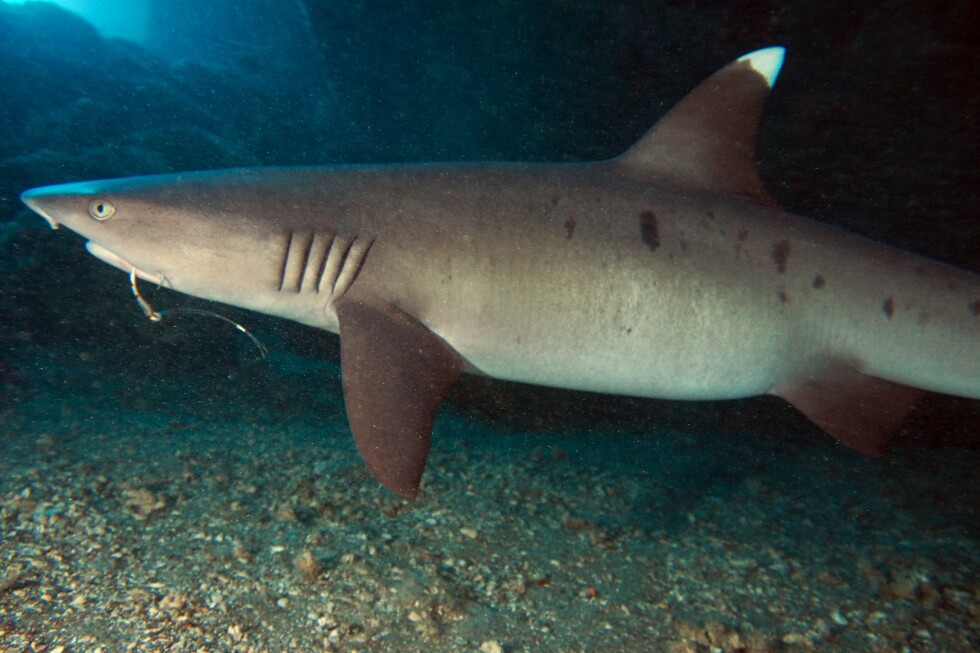
Local small-boat fishers across Hawaii are increasingly losing their valuable catch to sharks, a growing problem that threatens their livelihoods and a cherished island tradition. Reports indicate sharks now snatch fish in at least one of every four licensed fishing trips in Hawaiian waters—the highest rate recorded in two decades of state monitoring.
The phenomenon, known as shark depredation, has become particularly troublesome for fishers targeting prized bottomfish species like ehu, onaga, and the red opakapaka—a staple on New Year’s celebration tables throughout the islands.
“They’re basically losing money because they can’t bring in the fish,” explains Phil Fernandez, president of the Hawaii Fishermen’s Alliance for Conservation and Tradition. “The fish markets won’t buy a fish that has a bite on it.”
Fernandez, who has been troll-fishing off the Kona Coast since the late 1980s, notes that shark depredation wasn’t an issue when he started. The problem emerged over the past 20 years and has intensified significantly in recent years, pushing many fishers to the brink of abandoning their trade altogether.
The Western Pacific Regional Fishery Management Council (Wespac) identified shark depredation as one of the most pressing concerns raised by Pacific fishers during listening sessions last year. The council held a follow-up workshop in February to address the issue and plans to report findings at its Scientific and Statistical Committee meeting on March 17.
Scientists are still investigating the cause of the uptick. Some experts suspect climate change may be a factor, with warming waters driving sharks’ prey into different areas. Many fishers believe local reef, Galapagos, and tiger sharks, as well as visiting oceanic whitetips, have learned to associate fishing boats with an easy meal.
“There’s a lot of speculation,” Fernandez says. “Sharks are very smart.”
Small boats frequenting the Penguin Banks fishing grounds off Molokai now constantly change positions to avoid sharks. Some fishers immediately turn off their engines after catching a fish, believing sharks associate the propeller sound with feeding opportunities.
Researchers at the University of Hawaii Mānoa’s Hawaii Institute of Marine Biology are taking a multi-faceted approach to the problem. They’re providing local fishers with forensic DNA kits to identify which shark species are responsible for the bites, while also tracking shark movements around key fishing grounds.
“We are building the first truly comprehensive effort to understand and mitigate shark depredation in these fisheries,” said institute research professor Carl Meyer.
Various shark repellents already exist, exploiting sharks’ unique sensitivities to certain stimuli. These include devices creating magnetic fields, electric charges, and chemical repellents that mimic the smell of decaying sharks—all designed to deter the predators without affecting the targeted fish species.
Eric Stroud, managing partner with SharkDefense, which produces chemical repellents, expressed interest in expanding testing to Pacific waters, particularly Guam, where depredation rates are especially high.
“Personally, I didn’t really know anything about the Western Pacific, and so I would love to get out there and test,” Stroud said. His company’s repellents, which cost about $1 per hook, use a butter-like material containing chemicals harvested from legally caught sharks in Florida waters. In Hawaii, all shark fishing is prohibited.
Other deterrents include electromagnetic devices that create fields sharks find disorienting—similar to flashing a bright light in their eyes. These typically cost between $150 and $300 each, according to Stroud.
Initial tests of these repellents in Hawaii waters have yielded mixed results. Fernandez reports that some electromagnetic devices tested off the Kona Coast proved impractical for local fishing methods.
“They’re too long and they’re the wrong shape,” he explained. “The hooks tend to wrap around these devices, and now the hooks are all tangled up. So it’s a work in progress.”
Stroud suggests using multiple types of repellents simultaneously, as sharks can temporarily “turn off” certain senses when overstimulated. If a shark becomes desensitized to electromagnetic deterrents, for example, chemical repellents might still be effective.
Mark Fitchett, a pelagic fisheries scientist, notes that local fishers hold varying views on the shark situation. While many feel the animals have too many protections, others recognize sharks’ important ecological role.
“A lot of them also recognize that it’s part of their island culture that these animals are sort of… the gardeners of the water,” Fitchett said. “So there’s that respect for the animal.”
The critical question now, according to Fitchett, is how much depredation fishers can withstand while maintaining their livelihood. Wespac plans to discuss the issue further at its quarterly meeting on March 24-26 at the Ala Moana Hotel, with a detailed report expected several weeks later.
Fact Checker
Verify the accuracy of this article using The Disinformation Commission analysis and real-time sources.
