


Listen to the article
Record Black Friday Spending Despite Economic Uncertainty
Americans opened their wallets wide this Black Friday, spending record amounts both online and in stores despite persistent economic concerns and rising prices. The robust shopping activity signals strong consumer resilience even as many households navigate financial pressures.
According to Adobe Analytics, U.S. consumers spent an unprecedented $11.8 billion online during Black Friday, representing a 9.1% increase from last year. Shopping peaked between 10 a.m. and 2 p.m. local time nationwide, when digital cash registers were ringing up an astonishing $12.5 million per minute.
The spending surge began even earlier, with shoppers spending a record $6.4 billion online on Thanksgiving Day itself. Popular purchases across both days included video game consoles, electronics, and home appliances, with Adobe noting that AI-powered shopping services and social media advertising significantly influenced consumer choices.
Other metrics confirmed the strong performance. E-commerce platform Shopify reported that its merchants generated a record $6.2 billion in worldwide sales on Black Friday, reaching $5.1 million per minute at peak times. Cosmetics and clothing emerged as top-selling categories on the platform.
Software company Salesforce provided an even more impressive estimate, calculating Black Friday online sales at $18 billion in the U.S. and $79 billion globally. Meanwhile, Mastercard SpendingPulse, which tracks both in-person and online spending, reported that overall Black Friday sales (excluding automotive) rose 4.1% from 2023.
“Consumers are navigating an uncertain environment this holiday season by shopping early, leveraging promotions, and investing in wish-list items,” observed Michelle Meyer, chief economist at the Mastercard Economics Institute.
The digital transformation of Black Friday continues to reshape retail traditions. Gone are the days of midnight mall crowds and doorbusters causing shopping mayhem. Instead, more consumers opt for online deals from home or spread their spending across the extended promotional periods now offered by retailers.
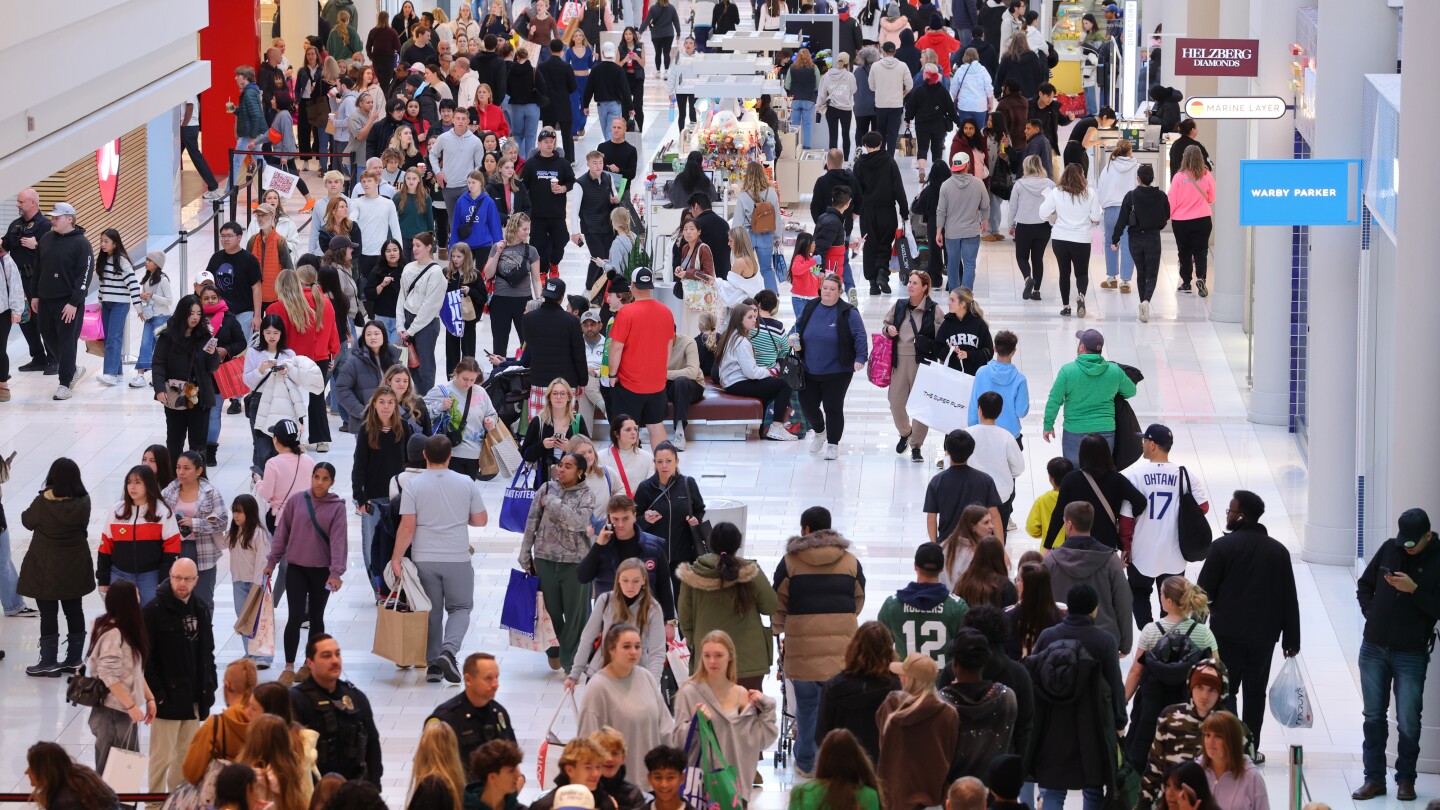
Physical store traffic continued its years-long decline. RetailNext, which measures real-time foot traffic, found that U.S. Black Friday in-store visits fell 3.6% compared to 2023. However, this represented an improvement over the sharper 6.2% decline seen in the days leading up to Thanksgiving. Similarly, Sensormatic Solutions reported a 2.1% dip in store traffic, though it noted that visits during Black Friday week jumped nearly 57% compared to the previous week.
“Black Friday has really turned into like a full week event, or even further,” explained Grant Gustafson, head of retail consulting and analytics at Sensormatic Solutions. “Black Friday is really the start of just a really critical stretch for retailers,” he added, noting that the post-Thanksgiving weekend and days before Christmas will also bring substantial in-store traffic.
The shopping momentum is expected to continue, with Adobe forecasting Americans will spend another $5.5 billion on Saturday and $5.9 billion on Sunday before reaching a projected $14.2 billion peak on Cyber Monday — which would set yet another record.
However, inflation may be artificially inflating some spending figures. President Donald Trump’s extensive tariffs on foreign imports have strained both businesses and consumers over the past year. Despite higher overall spending, Salesforce found that U.S. shoppers actually purchased fewer items at checkout on Black Friday (down 2% from last year), while order volumes slipped 1% as average selling prices climbed 7%.
This holiday spending surge occurs against a backdrop of significant economic uncertainty. Beyond tariffs, workers across sectors face job security concerns amid corporate layoffs and lingering effects from the recent 43-day government shutdown.
Budget consciousness remains evident in shopper behavior. “Consumers are thinking a little bit harder about their purchases this year,” Gustafson noted, “to make sure that they’re getting their very best deals.”
For the entire November-December holiday season, the National Retail Federation projects U.S. shoppers will spend more than $1 trillion for the first time. However, growth is moderating, with an expected increase of 3.7% to 4.2% year-over-year, compared to 4.3% during the 2023 holiday season.
Financial strains are mounting for many households, with rising credit card debt and increasing delinquencies on short-term loans. An increasing number of consumers are turning to “buy now, pay later” services to stretch their holiday budgets for gifts and decorations, potentially creating payment obligations that will extend well into 2025.
Fact Checker
Verify the accuracy of this article using The Disinformation Commission analysis and real-time sources.

14 Comments
The record-breaking online sales figures are impressive, but I wonder how they compare to in-store traffic and purchases. It will be important to monitor the balance between digital and physical retail.
Good point. The shift to e-commerce is undeniable, but brick-and-mortar stores still play a crucial role, especially for certain product categories and consumer experiences.
It’s encouraging to see consumers still willing to spend, but I hope this doesn’t lead to further inflationary pressures. Balancing economic growth and price stability will be crucial.
I wonder if this surge in spending is sustainable or if it’s just a temporary blip. It will be interesting to see how consumer behavior evolves in the coming months.
Interesting to see strong Black Friday sales despite economic concerns. It suggests consumers are still spending, but I wonder how this will impact the broader economy long-term.
Yes, it’s a complex situation. On one hand, the robust spending could indicate resilience, but it also raises questions about inflation and overall financial pressures.
Consumers seem to be finding ways to navigate economic challenges and still indulge in holiday shopping. It will be interesting to see if this trend continues into the new year.
The influence of AI-powered shopping services and social media advertising on consumer choices is fascinating. I wonder how this will shape future retail strategies.
Definitely an interesting development. Retailers will need to stay on top of evolving consumer trends and leverage technology to deliver personalized experiences.
The shift to online shopping is clearly accelerating, with record-breaking digital sales. This could put pressure on brick-and-mortar retailers if the trend continues.
That’s a good point. The rise of e-commerce is a major challenge for traditional retailers, and they’ll need to adapt their strategies to stay competitive.
Strong Black Friday sales are a positive sign, but I’m still concerned about the wider economic uncertainty. Time will tell how this holiday season plays out for both consumers and businesses.
Retailers must be relieved to see this level of consumer activity, especially with the rise of e-commerce and online shopping. I’m curious to see how the holiday season plays out overall.
Definitely. The holiday season is critical for many businesses, so strong Black Friday sales are a positive sign, even if the broader economic picture remains uncertain.