


Listen to the article
Samsung’s New Galaxy Smartphones Feature Enhanced AI and Privacy Tools, Come with Price Increases
Samsung unveiled its latest Galaxy S26 smartphone lineup on Wednesday, introducing a range of advanced features and technologies that include expanded artificial intelligence capabilities and a new privacy feature designed to prevent onlookers from viewing screen content.
The new devices, set to hit stores on March 11, come with price increases for two of the three models. The standard Galaxy S26 will now sell for $899, while the Plus model is priced at $1,099 – both representing increases of $100 (or 10-13%) compared to previous generations. The top-tier Galaxy S26 Ultra will maintain its existing price point of $1,299.
As with most smartphone upgrades, Samsung has improved core features like camera quality and battery life – elements that significantly influence consumers’ decisions to upgrade their devices. However, this year’s release introduces several distinctive features that aim to differentiate the Galaxy line in an increasingly competitive market.
Most notable among these innovations is the “Privacy Display” feature, available exclusively on the Ultra model. When activated, this technology alters the phone’s pixels in a way that makes screen content visible only when viewed directly from the front. From side angles, the screen appears to be turned off, effectively preventing what Samsung calls “shoulder surfing” by nearby onlookers. Users can configure specific applications, particularly those containing sensitive information, to automatically launch in Privacy Display mode.
PP Foresight analyst Paolo Pescatore believes this feature could become “the sleeper hit, a standout feature in a sea of AI noise,” suggesting it may resonate more with consumers than some of the heavily marketed AI capabilities.
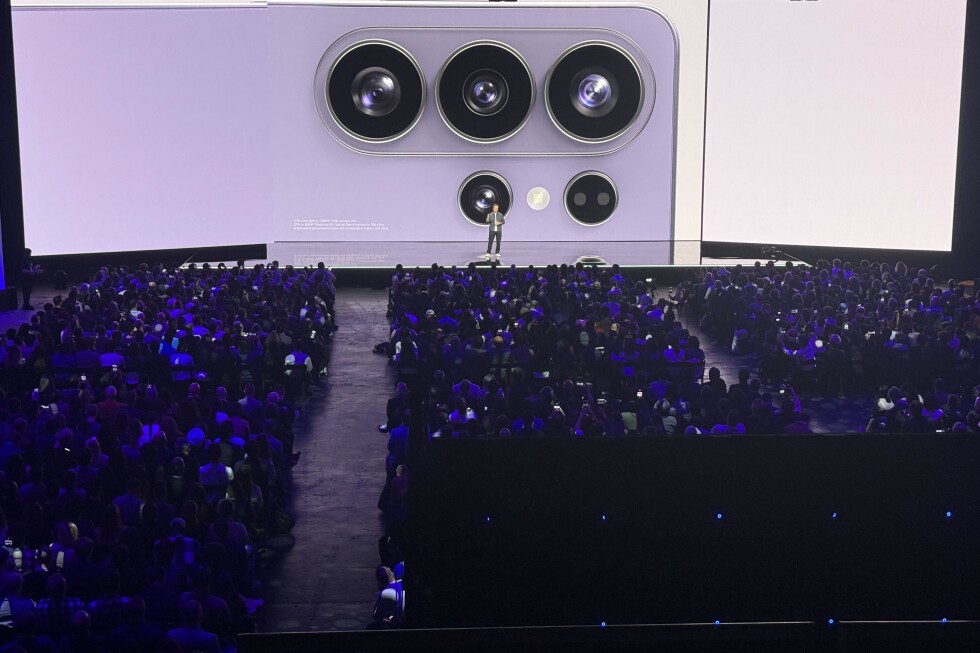
Nevertheless, Samsung continues to emphasize artificial intelligence as a central selling point for its Galaxy devices, building on a strategy it began implementing two years ago. During the San Francisco showcase, Samsung’s CEO of device experience, TM Roh, stressed the importance of integrating AI into everyday technology: “AI must become part of our infrastructure. You should be able to enjoy its benefits through the devices you use every day.”
The company describes the Galaxy S26 as an “agentic AI phone,” promising that its artificial intelligence will serve as a multipurpose assistant capable of retrieving information and content without requiring significant user intervention. Samsung is leveraging Google’s Gemini technology for much of its AI functionality while also introducing an alternative assistant option from Perplexity, an emerging company known for its “answer engine” approach to online information retrieval.
Additional AI features include enhanced photo editing capabilities, such as a tool that automatically softens skin tones in selfies taken with the front-facing camera.
While AI technology is becoming increasingly common across smart devices from various manufacturers including Apple and Google, it remains unclear whether consumers find these features compelling. Apple, despite promoting its own AI suite for nearly two years, has struggled to deliver on all its promised features and has turned to Google to improve its virtual assistant, Siri.
Despite these technological challenges, Apple’s iPhone has maintained its position as the world’s best-selling smartphone for the past three years. Samsung last held this title in 2022, according to data from research firm International Data Corp.
Industry analyst Pescatore notes that AI has yet to become a primary consideration for most consumers. “AI is still not a sought-after feature among users,” he said. “The big opportunity is making AI feel like a daily habit rather than a party trick, with tighter integration across core apps. AI must be boringly useful. Less ‘look what it can do,’ more ‘this saves me time every day.'”
As smartphone manufacturers continue to invest heavily in artificial intelligence capabilities, the challenge remains to translate these technical advancements into tangible benefits that consumers can appreciate in their everyday interactions with their devices.
Fact Checker
Verify the accuracy of this article using The Disinformation Commission analysis and real-time sources.

10 Comments
With increased competition in the premium smartphone space, Samsung will need to really innovate to stand out. The AI and privacy features could be a good start, but the pricing will be a key factor.
I wonder if the Privacy Display will work well in practice or if it will have any limitations.
Enhancing camera quality and battery life are always welcome improvements for smartphone users. The new AI capabilities could be a big selling point as well, if implemented well.
I wonder how Samsung’s AI features compare to what Apple and Google are doing with their latest phones.
The smartphone market is highly competitive, so Samsung will need to ensure their latest Galaxy models offer a compelling value proposition. The new AI and privacy tools are interesting, but the pricing will be crucial.
Interesting to see Samsung adding more AI features and privacy tools to their latest Galaxy lineup. The price increases are noteworthy too – curious to see how consumers respond to the premium pricing.
The Privacy Display feature on the Ultra model sounds like a useful addition for those concerned about prying eyes.
Smartphones are becoming more powerful and feature-rich, but the tradeoffs between cost, performance, and privacy are always a balancing act. Samsung’s approach here seems focused on addressing those concerns.
Smartphones are getting more advanced every year, but the core needs like battery life and camera quality are still critical. Curious to see hands-on reviews of the S26 lineup’s real-world performance.
Price hikes are always a risk, but if Samsung can deliver compelling new features and improvements, they may be able to justify the higher costs. The privacy tools are an interesting differentiator.