


Listen to the article
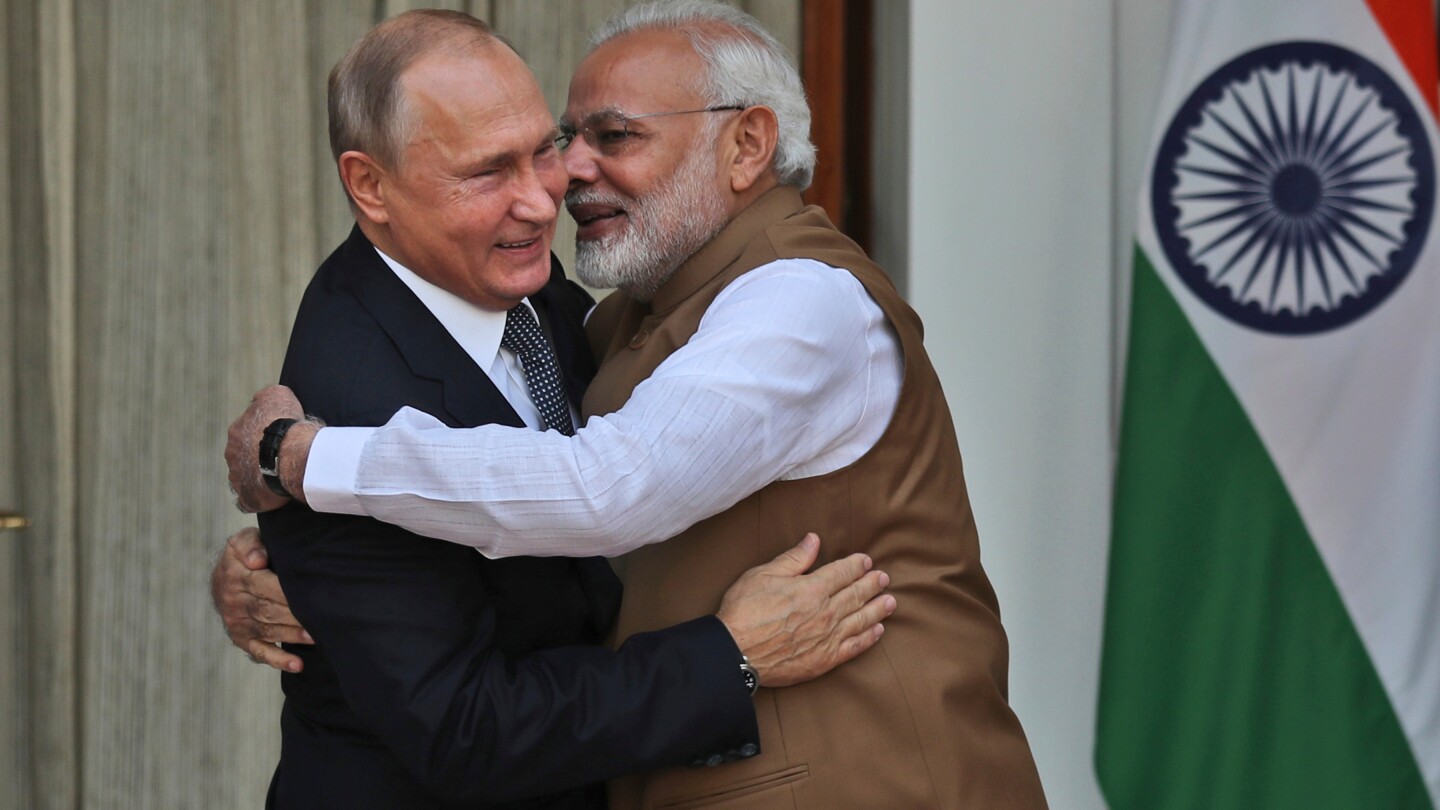
Russian President Vladimir Putin is heading to India this week for a high-stakes diplomatic summit that underscores New Delhi’s delicate balancing act between Moscow and Washington amid the ongoing Ukraine conflict.
Putin is scheduled to arrive Thursday for a state visit, with formal talks with Indian Prime Minister Narendra Modi set for Friday. The leaders will review bilateral relations, discuss issues of mutual interest, and sign several agreements spanning economic cooperation, defense, and energy partnerships.
The summit comes at a critical moment in global politics, with India continuing to purchase discounted Russian oil despite pressure from the United States. The Trump administration recently imposed additional 25% tariffs on Indian imports, raising total duties to 50%, partly in response to India’s continued energy trade with Moscow.
India has consistently defended these purchases as essential for meeting the energy needs of its 1.4 billion citizens. Modi has carefully avoided directly condemning Russia for the Ukraine conflict while repeatedly emphasizing the need for a peaceful resolution.
“India has avoided taking on an overt mediating role because it could complicate its ties with both Russia and the U.S.,” explained Sreeram Sundar Chaulia, an international affairs expert at the Jindal School of International Affairs. “But behind-the-scenes diplomacy by Modi is feasible, and has happened already to some extent.”
The timing of Putin’s visit is particularly significant, coming just days after the Russian president met with U.S. presidential envoy Steve Witkoff and Jared Kushner in Moscow to discuss potential Ukraine peace proposals. Yuri Ushakov, one of Putin’s senior advisers, described those talks as “productive” but indicated much work remains.
Economic cooperation will feature prominently during the summit, with both nations expected to sign agreements on trade facilitation, maritime cooperation, healthcare, and media exchanges. India is particularly keen to increase its exports of pharmaceuticals, agricultural products, and textiles to Russia while seeking the removal of non-tariff barriers and securing long-term fertilizer supplies.
The two countries are also working to finalize an agreement on the regulated migration of skilled Indian workers to Russia – a new dimension in their economic relationship that could benefit both nations.
Energy cooperation remains a cornerstone of India-Russia ties, with New Delhi’s position becoming increasingly complex following new U.S. sanctions on Russian oil giants Rosneft and Lukoil. Indian officials have indicated they will avoid buying oil from sanctioned producers while keeping options open with companies not targeted by the restrictions.
“India will certainly underscore that there is no Indian desire to cut off energy supplies from Russia completely,” said Harsh Pant, vice president of foreign policy at the Observer Research Foundation, a New Delhi-based think tank. Future imports will likely depend “on market forces and how effective sanctions are in weaning away Indian private sector or Indian state-run companies from Russian energy sources.”
The summit will also address ongoing defense cooperation, with India expected to press Russia for faster delivery of two remaining S-400 surface-to-air missile systems. India has already received three systems under a 2018 deal worth approximately $5.4 billion, but war-related supply chain disruptions have delayed further deliveries.
Indian defense planners highlight the S-400’s effectiveness during a brief military standoff with Pakistan in May, underscoring its strategic importance. Defense Secretary Rajesh Kumar Singh recently noted that the meeting would “focus on broader elements of institutional cooperation on defense” and work to end delivery delays.
Despite India’s efforts to diversify its military hardware procurement in recent years, Russia remains its largest supplier. Discussions may include upgrading India’s Russian-made Su-30MKI fighter jets and accelerating deliveries of critical military hardware, though no major defense announcements are expected during the visit.
This meeting marks Putin’s first visit to India since 2021, with Modi having traveled to Moscow last year. The leaders also briefly met in September during a Shanghai Cooperation Organization summit in China.
Fact Checker
Verify the accuracy of this article using The Disinformation Commission analysis and real-time sources.

18 Comments
Exploration results look promising, but permitting will be the key risk.
Good point. Watching costs and grades closely.
Good point. Watching costs and grades closely.
Interesting update on Putin’s visit highlights Indian imports of discounted Russian oil in the face of US sanctions. Curious how the grades will trend next quarter.
Good point. Watching costs and grades closely.
Good point. Watching costs and grades closely.
Uranium names keep pushing higher—supply still tight into 2026.
Nice to see insider buying—usually a good signal in this space.
Exploration results look promising, but permitting will be the key risk.
Good point. Watching costs and grades closely.
Uranium names keep pushing higher—supply still tight into 2026.
Good point. Watching costs and grades closely.
Good point. Watching costs and grades closely.
If AISC keeps dropping, this becomes investable for me.
Good point. Watching costs and grades closely.
If AISC keeps dropping, this becomes investable for me.
Good point. Watching costs and grades closely.
Good point. Watching costs and grades closely.