


Listen to the article
Enraged farmers stormed the apron area of Nikos Kazantzakis International Airport in Heraklion, Crete, on Monday, forcing the suspension of all flights as protests over delayed agricultural subsidies intensified across Greece.
The protesters managed to evade riot police who deployed tear gas and stun grenades in an attempt to block their advance. Local media images showed dozens of farmers occupying the airport’s apron, bringing operations to a standstill.
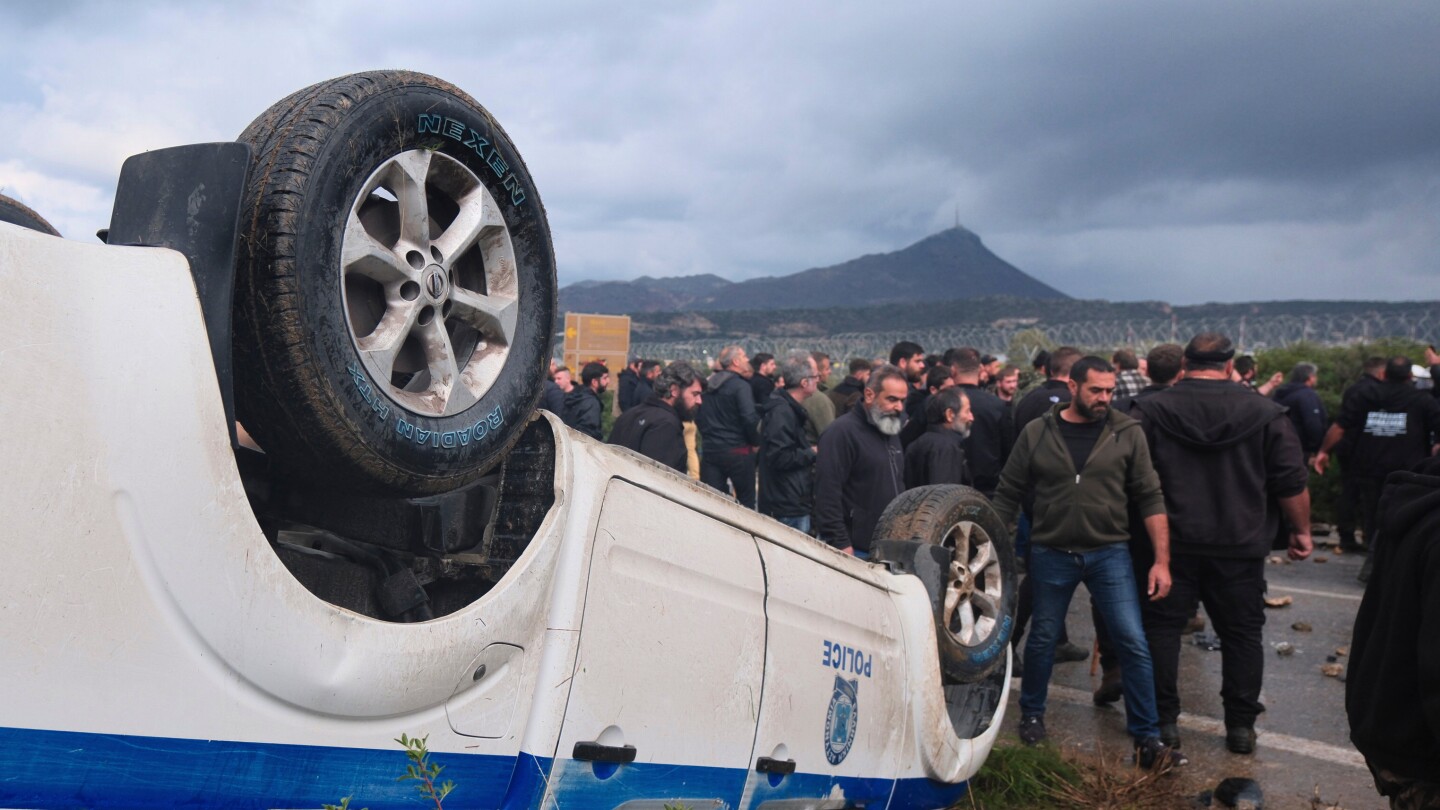
Similar clashes erupted near Chania airport, Crete’s second-largest city, where farmers pelted riot police with rocks and overturned a patrol car. Local reports indicated that two people were injured during the confrontation as police responded with tear gas.
These incidents mark a significant escalation in Greece’s ongoing farmer protests, which have grown increasingly disruptive in recent weeks. The demonstrations stem from delays in European Union-backed agricultural subsidy payments following revelations of widespread fraudulent claims that prompted a comprehensive review of all applications.
Throughout Greece, farmers have deployed thousands of tractors and agricultural vehicles at strategic points including border crossings, highways, ports, and airports. On Friday, riot police fired tear gas at protesters attempting to block the main access road to Thessaloniki’s international airport in northern Greece.
The impact on transportation infrastructure has been substantial. Police have implemented traffic diversions across northern and central Greece to bypass blockades, while farmer roadblocks at the country’s borders with Bulgaria, Turkey, and North Macedonia have created long lines of freight vehicles, severely disrupting commercial transportation.
“The government is essentially punishing all farmers because of the fraudulent actions of a few,” said Dimitris Papadopoulos, a farmer from Thessaly participating in the protests. “We cannot plant our fields for the next season while we wait for money that should have been paid months ago.”
Greece’s agricultural sector faces multiple challenges beyond the subsidy delays. An outbreak of sheep and goat pox earlier this year required a mass livestock cull, further straining farmers’ finances and amplifying frustrations over the delayed payments.
The subsidy scandal that precipitated the current crisis has had far-reaching political implications. In June, five senior government officials resigned, and authorities began phasing out the state agency responsible for handling agricultural subsidies. Law enforcement has arrested dozens of individuals for allegedly filing false claims following an investigation spearheaded by the European Public Prosecutor’s Office.
In late October, the independent EU body responsible for investigating financial crimes described the situation as “a systematic large-scale subsidy fraud scheme and money-laundering activities,” underscoring the severity of the irregularities that led to the current payment freeze.
Public Order Minister Michalis Chrisochoidis has maintained that the government remains open to dialogue with protest leaders but has drawn a line at the shutdown of critical transportation hubs. “We understand farmers’ concerns, but we cannot allow the complete disruption of transportation networks that would affect the entire economy,” Chrisochoidis stated last week.
Agricultural protests have a long history in Greece, with similar actions in the past occasionally severing transportation links between the northern and southern regions of the country for extended periods. The current demonstrations appear poised to follow this pattern, with farmers showing little inclination to back down until their demands are met.
Economic analysts warn that prolonged disruptions could impact Greece’s fragile economic recovery, particularly if the blockades affect tourism—a sector that accounts for approximately 25% of the country’s GDP. The timing is especially sensitive as Greece approaches its peak booking season for summer tourism.
As tensions escalate, both the government and farmer representatives face increasing pressure to find a resolution that addresses legitimate concerns while maintaining public order and economic stability.
Fact Checker
Verify the accuracy of this article using The Disinformation Commission analysis and real-time sources.

7 Comments
The Greek farmers’ protests at the Crete airport highlight the financial pressures facing the agricultural sector. Delays in EU subsidy payments are clearly causing significant disruption and frustration. It will be interesting to see how the government and EU respond to resolve this impasse.
The Greek farmers’ tactics of occupying the airport apron are certainly bold, but I’m not sure that’s the best way to resolve the subsidy payment issues. Hopefully cooler heads can prevail and the government can find a constructive solution.
This is a complex issue with impacts beyond just the agricultural sector. The government will need to balance supporting farmers with ensuring critical infrastructure like airports can operate smoothly. A balanced approach that addresses the root causes is needed.
These protests underscore the importance of reliable and timely agricultural subsidies for farmers in Greece and across the EU. While the alleged fraud is concerning, the government needs to find a fair and efficient way to process payments to avoid such disruptive actions.
Agreed. The government should work quickly to address the farmers’ legitimate concerns and get the subsidy payments flowing again. Keeping the airports operational is crucial for the island’s economy.
Interesting to see the mining/energy angle here, as Greece is a major producer of some critical minerals. I wonder if these farmer protests could have ripple effects on the country’s mining and industrial sectors if the unrest continues.
Good point. Disruptions to transportation hubs like airports could potentially impact the supply chains for mining and other industries in Greece. The government will need to carefully manage this situation to minimize economic fallout.