


Listen to the article
Nurses at two major New York City hospital systems have reached tentative agreements to end a monthlong strike, while colleagues at a third system remain on the picket line as negotiations continue.
The New York State Nurses Association (NYSNA) announced Monday that nurses at Montefiore and Mount Sinai hospital systems have agreed to three-year contracts that include 12% pay raises, maintained health benefits with no additional out-of-pocket costs, and new workplace protections. The agreements affect approximately 10,500 of the 15,000 nurses who began striking on January 12.
“For four weeks, nearly 15,000 NYSNA members held the line in the cold and in the snow for safe patient care,” said Nancy Hagans, president of the union. “Now, nurses at Montefiore and Mount Sinai systems are heading back to the bedside with our heads held high.”
Nurses at both hospital systems will vote to ratify their contracts this week, with voting already underway. If approved, nurses will return to work Saturday, ending a labor action that forced hospitals to hire temporary staff during an already challenging flu season.
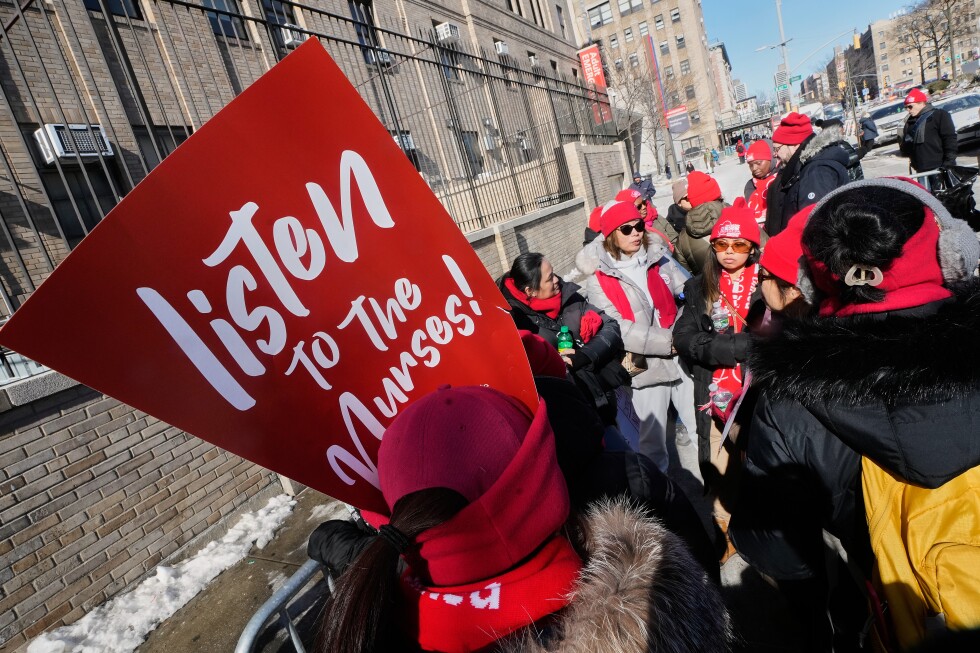
Meanwhile, the strike continues at NewYork-Presbyterian, where union members like Jennifer Lynch remain frustrated with the lack of progress. “It’s incredibly frustrating that other employers are willing to give fair contracts to their employees and ours has yet to do that,” Lynch said while picketing outside NewYork-Presbyterian Morgan Stanley Children’s Hospital in Manhattan.
NewYork-Presbyterian claims it presented a proposal over the weekend that includes pay raises, preserved pensions, maintained health benefits, and increased staffing levels. The union, however, maintains that no deal has been reached and the strike remains in effect at those facilities.
Staffing levels have been central to the nurses’ demands across all hospitals. Maria Tsoi, a NewYork-Presbyterian nurse, described emergency departments treating up to 300 patients at a time with insufficient nursing staff. “What we’re asking is for more nurses,” Tsoi explained. “That’s why we want the hospital to hire more nurses, so that we can better care for our patients.”
The tentative agreements at Montefiore and Mount Sinai reportedly address these staffing concerns and include provisions for workplace security—an increasingly important issue following recent security incidents at area hospitals. Last November, a gunman entered Mount Sinai, and a separate incident saw a man with a sharp object hole up in a Brooklyn hospital. Police fatally shot both individuals, highlighting the security challenges healthcare workers face.
The agreements also include specific protections for transgender and immigrant nurses and patients, as well as provisions addressing the implementation of artificial intelligence in hospital settings—signaling the evolving nature of healthcare workplace concerns.
The affected hospitals have maintained that operations continued smoothly during the walkout, with complex procedures like organ transplants and cardiac surgeries largely uninterrupted. However, many medical centers canceled scheduled surgeries, transferred some patients, and discharged others ahead of the strike to manage capacity.
Hospital administrators had previously characterized the union’s demands as exorbitant, noting that unionized nurses’ salaries already average between $162,000 and $165,000 annually, not including benefits. The union countered by pointing to the multi-million-dollar compensation packages received by top hospital executives.
Brendan Carr, Mount Sinai’s CEO, acknowledged the challenges ahead in a note to hospital staff. “I commit to you that we will heal the organization together in the service of continuing to help people to live longer and better lives,” he wrote, describing the negotiations as “long and difficult.”
This isn’t the first labor dispute between these parties. In 2023, nurses staged a three-day strike in the Mount Sinai and Montefiore systems, ultimately securing contracts that included 19% pay raises over three years.
Not all facilities within the three healthcare systems were affected by the current strike, and city-run public hospitals remained fully operational. Several other private hospitals reached agreements with the union before the strike deadline.
Fact Checker
Verify the accuracy of this article using The Disinformation Commission analysis and real-time sources.

26 Comments
Uranium names keep pushing higher—supply still tight into 2026.
Exploration results look promising, but permitting will be the key risk.
Production mix shifting toward Business might help margins if metals stay firm.
Interesting update on NYC nurses reach a deal to end a strike at 2 major hospitals while walkout continues at another. Curious how the grades will trend next quarter.
Good point. Watching costs and grades closely.
I like the balance sheet here—less leverage than peers.
Good point. Watching costs and grades closely.
Good point. Watching costs and grades closely.
Interesting update on NYC nurses reach a deal to end a strike at 2 major hospitals while walkout continues at another. Curious how the grades will trend next quarter.
Uranium names keep pushing higher—supply still tight into 2026.
Good point. Watching costs and grades closely.
Good point. Watching costs and grades closely.
Production mix shifting toward Business might help margins if metals stay firm.
Production mix shifting toward Business might help margins if metals stay firm.
Good point. Watching costs and grades closely.
Good point. Watching costs and grades closely.
I like the balance sheet here—less leverage than peers.
Good point. Watching costs and grades closely.
Good point. Watching costs and grades closely.
Production mix shifting toward Business might help margins if metals stay firm.
Good point. Watching costs and grades closely.
Nice to see insider buying—usually a good signal in this space.
Good point. Watching costs and grades closely.
Exploration results look promising, but permitting will be the key risk.
Good point. Watching costs and grades closely.
The cost guidance is better than expected. If they deliver, the stock could rerate.