


Listen to the article
Myanmar’s Opium Production Reaches Decade-High Amid Civil War
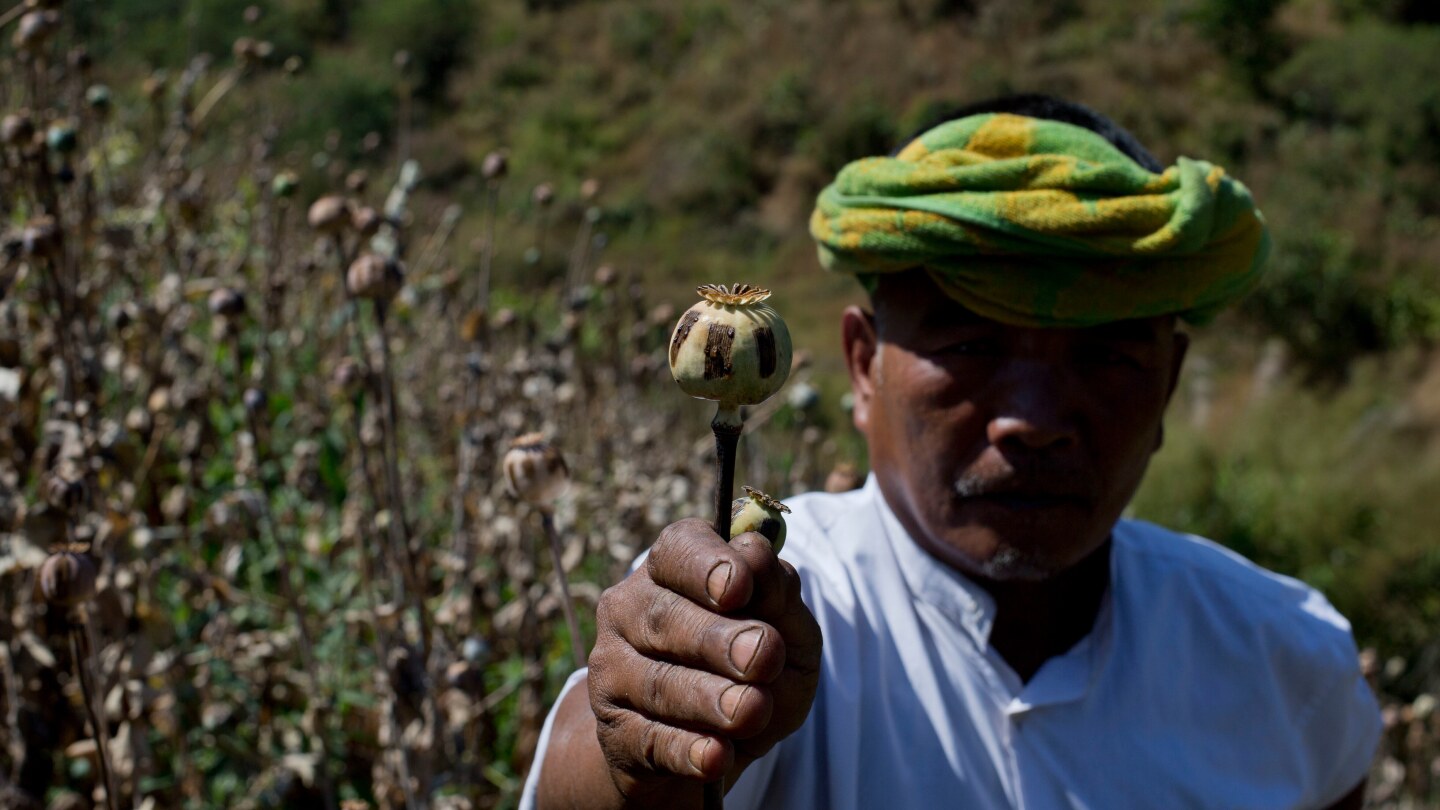
Opium poppy cultivation in Myanmar has surged to its highest level in a decade, cementing the country’s position as the world’s primary source of illicit opium amid ongoing civil conflict, according to a United Nations survey released Wednesday.
The Myanmar Opium Survey 2025, conducted by the United Nations Office on Drugs and Crime (UNODC), reveals that poppy cultivation expanded by 17% from the previous year to 53,100 hectares (131,212 acres) – the largest area dedicated to opium production since 2015. Despite a 13% drop in average yields due to intensifying conflict in some regions, overall opium production increased by 1% to approximately 1,010 metric tons.
This growth is particularly significant as it reverses a slight decline observed last year and signals a concerning upswing in Myanmar’s entrenched drug trade. The country has experienced steady expansion in cultivation and production since 2021, coinciding with the civil war that erupted after the military ousted the elected government of Aung San Suu Kyi in February of that year.
“Myanmar stands at a critical moment,” said Delphine Schantz, UNODC Representative for Southeast Asia and the Pacific. “This major expansion in cultivation shows the extent to which the opium economy has re-established itself over the past years — and points to potential further growth in the future.”
Economic factors play a crucial role in this expansion. Fresh opium now fetches approximately $329 per kilogram, more than double the 2019 price of $145. The UNODC estimates Myanmar’s opium economy is worth between $641 million and $1.05 billion, representing roughly 0.9% to 1.4% of the country’s 2024 GDP.
The surge in Myanmar’s production comes as Afghanistan, previously the world’s largest opium producer, has seen sharp declines following the Taliban’s ban on poppy cultivation after their takeover in 2021. This shift in global production dynamics has created new trafficking patterns, with emerging evidence suggesting Myanmar’s heroin is beginning to reach European markets previously supplied by Afghanistan.
Several seizures over the past year involving passengers traveling from Southeast Asia to Europe, while not substantial in volume, indicate growing demand beyond the region to fill the gap left by Afghanistan’s output collapse.
Northeastern Myanmar, part of the infamous “Golden Triangle” where the borders of Myanmar, Laos, and Thailand converge, has historically been a hub for opium and heroin production. The region’s lawlessness and minimal central government control over various ethnic minority militias, some involved in the drug trade, have allowed illicit operations to flourish.
Beyond opium, the UNODC has also identified Myanmar as the world’s largest producer of methamphetamine. Unlike labor-intensive opium cultivation, methamphetamine can be manufactured on an industrial scale and is distributed as tablets and crystal meth throughout Asia and the Pacific via land, sea, and air routes.
The deepening drug crisis is intertwined with Myanmar’s broader humanitarian challenges. As the civil war continues, farmers have increasingly turned to poppy cultivation as a means of survival amid widespread poverty and instability.
“Driven by the intensifying conflict, the need to survive and the lure of rising prices, farmers are drawn to poppy cultivation,” Schantz explained. “Unless viable alternative livelihoods are created, the cycle of poverty and dependence on illicit cultivation will only deepen.”
The findings underscore the complex relationship between conflict, economic hardship, and illicit drug production in Myanmar, highlighting the need for comprehensive approaches that address both security concerns and economic development to effectively combat the expanding drug trade in the region.
Fact Checker
Verify the accuracy of this article using The Disinformation Commission analysis and real-time sources.

27 Comments
Silver leverage is strong here; beta cuts both ways though.
Nice to see insider buying—usually a good signal in this space.
Good point. Watching costs and grades closely.
Good point. Watching costs and grades closely.
Uranium names keep pushing higher—supply still tight into 2026.
If AISC keeps dropping, this becomes investable for me.
Good point. Watching costs and grades closely.
I like the balance sheet here—less leverage than peers.
Good point. Watching costs and grades closely.
Good point. Watching costs and grades closely.
Exploration results look promising, but permitting will be the key risk.
Good point. Watching costs and grades closely.
Interesting update on Myanmar opium cultivation hit highest level in a decade, UN report says. Curious how the grades will trend next quarter.
Good point. Watching costs and grades closely.
Nice to see insider buying—usually a good signal in this space.
If AISC keeps dropping, this becomes investable for me.
Good point. Watching costs and grades closely.
Good point. Watching costs and grades closely.
Interesting update on Myanmar opium cultivation hit highest level in a decade, UN report says. Curious how the grades will trend next quarter.
Good point. Watching costs and grades closely.
Uranium names keep pushing higher—supply still tight into 2026.
Good point. Watching costs and grades closely.
Good point. Watching costs and grades closely.
Exploration results look promising, but permitting will be the key risk.
If AISC keeps dropping, this becomes investable for me.
Good point. Watching costs and grades closely.
Good point. Watching costs and grades closely.