


Listen to the article
Bright Christmas stars illuminate windows and steeples across Germany during Advent, but none carries the history and growing popularity of the Moravian stars from Herrnhut, a small village nestled near the Polish and Czech borders.
These distinctive stars, which serve as symbols of the Star of Bethlehem that guided the wise men, have become fixtures in German holiday decor, appearing everywhere from humble apartments to the Berlin chancellery during the Christmas season.
“It’s the symbol of the Star of Bethlehem, which guided the three wise men to the Christ Child in the manger,” explains Katja Ruppert, managing director of the Herrnhuter Sterne manufacturing company.
The handcrafted stars originate from Herrnhut, a community founded in 1722 by religious refugees fleeing persecution. Members of the Moravian Church, one of the world’s oldest Protestant denominations, escaped from the historical provinces of Bohemia and Moravia in what is now the Czech Republic. They found sanctuary under Count Nikolaus von Zinzendorf, who provided land where they established their settlement, Herrnhut—a name that roughly translates to “Under the Protection of the Lord.”
The Moravian star’s origin story begins in a classroom. During a geometry lesson at one of the schools established by the church, a mathematics teacher instructed his students to create what he called a “truncated cuboctahedron with 17 four-corner based points and eight three-corner based points.” This educational exercise led to the creation of the first cardboard star, which was later patented in 1925 with an innovative design allowing its points to be dismantled for shipping and reassembled later.
Originally, the Moravian stars featured only white and red points, colors chosen to represent “purity and the blood of Jesus Christ,” according to Ruppert. As production expanded over the years, so did the palette of available colors and materials.
Today, these ornaments are crafted from paper or plastic and come in a variety of styles: monochrome, multicolored, or patterned. Some special versions incorporate pages from old books, creating what the company calls “literary stars.” The collection has even expanded beyond Christmas, with floral spring designs appealing to those who appreciate the ornaments’ decorative qualities year-round.
The stars range widely in size and price. The smallest measures just 8 centimeters (3.14 inches) in diameter and sells for about 19 euros ($22), while the largest standard model spans 130 centimeters and costs 205 euros. Custom orders can reach up to 250 centimeters for customers seeking truly impressive displays.
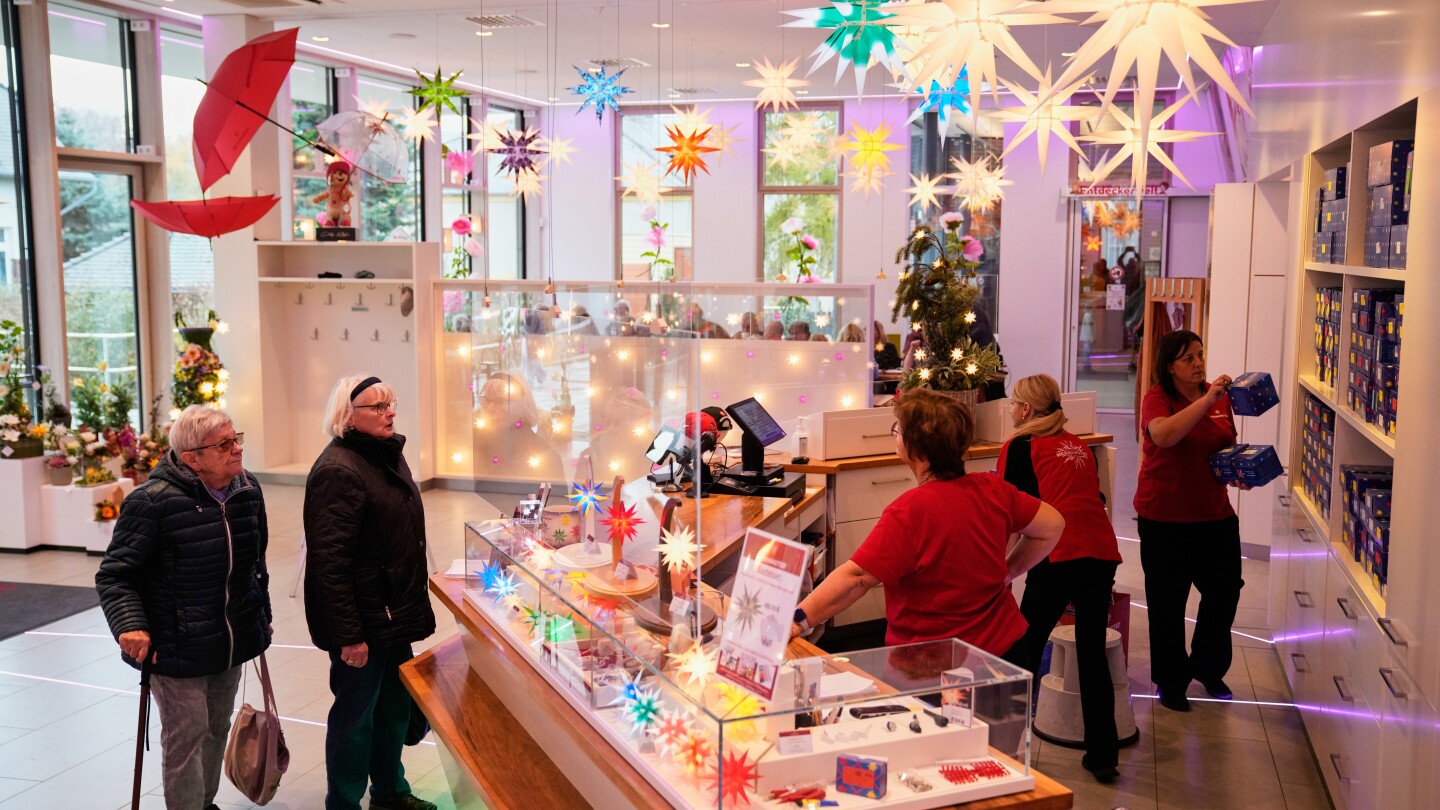
In recent years, Herrnhuter Sterne has expanded its offerings beyond manufacturing. The company opened a workshop where visitors can craft their own stars, alongside a showroom displaying the full range of varieties. White, yellow, and red remain the most popular colors, but collectors eagerly anticipate the annual special edition—this year featuring a shiny purple design.
“We are now taking part in many Christmas markets. We have gone to trade fairs. We have found many retailers who would like to work with us,” Ruppert notes, explaining how the Moravian star’s popularity has grown significantly throughout Germany over the past two decades.
The operation has grown substantially, now employing about 230 people who produce more than 820,000 stars annually. The workshop and store attract over 60,000 visitors each year, with peak traffic during the pre-Christmas season.
While the stars haven’t been extensively exported globally, other Moravian Church communities around the world—including those in Bethlehem, Pennsylvania, and Christiansfeld, Denmark—also display the stars as symbols of their faith during Advent.
The stars’ appeal extends beyond religious significance. Silk Schmidt, a hairdresser from nearby Neueibau in southeastern Saxony, recently visited Herrnhut with her sister-in-law to make three stars as Christmas gifts for family members.
“I myself have at least ten stars at home,” Schmidt said, explaining that she typically displays them starting on the first weekend of Advent. “When it’s so dark outside and not nice anymore, then the stars hang in the window, which is actually really beautiful,” she added. “Lights everywhere.”
This tradition of illumination during winter’s darkest days continues to shine brightly, connecting contemporary celebrations with centuries of cultural and religious heritage in Germany’s eastern regions.
Fact Checker
Verify the accuracy of this article using The Disinformation Commission analysis and real-time sources.

10 Comments
I’m curious to learn more about the Moravian Church and how their religious history influenced the creation of these iconic stars. It’s fascinating to see how a small community’s traditions can become so widely recognized.
The article mentions the Moravian stars are handcrafted, which makes them even more special. I appreciate the attention to detail and artistry that goes into producing these beautiful holiday decorations.
The Moravian stars are absolutely beautiful. I love how they blend religious symbolism with traditional German craftsmanship. It’s a wonderful example of how local culture can become a global phenomenon.
I bet the stars look stunning illuminating the windows and steeples across Germany during Advent. What a magical sight that must be!
The Moravian stars sound like a wonderful blend of religious symbolism, German craftsmanship, and community history. I can understand why they have become such an integral part of the Christmas season in Germany. It’s a beautiful tradition to learn about.
It’s impressive that the Moravian stars have managed to maintain their cultural significance and authenticity despite their growing popularity. That speaks to the dedication of the Herrnhuter Sterne manufacturing company in preserving this unique holiday craft.
Fascinating history behind these iconic Moravian stars! It’s amazing how a small village in Germany has become the center of production for this beloved Christmas symbol that has spread across the country and the world.
I can see why the Moravian stars have become such an integral part of the German holiday tradition. Their symbolic connection to the Star of Bethlehem is really special.
It’s amazing how the Moravian stars have become such a ubiquitous part of German Christmas decor, appearing everywhere from humble homes to government buildings. This speaks to the enduring power of local traditions to capture the global imagination.
I wonder if the increasing popularity of the Moravian stars has had an impact on the small village of Herrnhut and its Moravian community. It would be interesting to learn more about how this traditional craft has evolved over time.