


Listen to the article
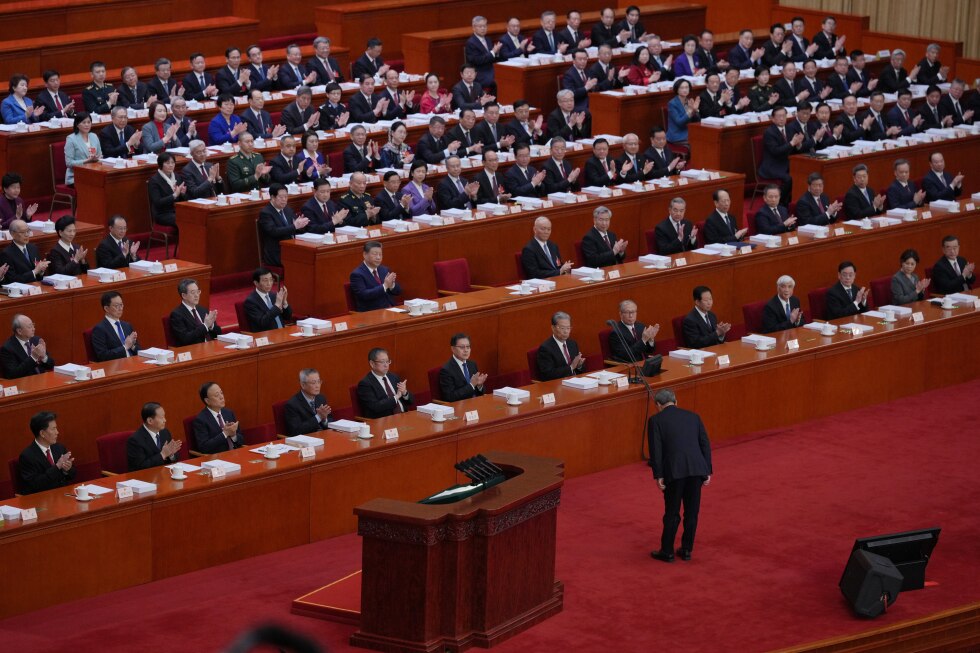
China unveiled its lowest economic growth target in over three decades during the opening of its annual national congress on Thursday. Premier Li Qiang announced a growth target of 4.5% to 5% for 2026, marking the lowest projection since 1991 and the first downgrade following the “around 5%” target maintained from 2023 through 2025.
Economic analysts view this more conservative target as a reflection of Beijing’s pragmatic approach in the face of significant domestic economic headwinds. The country continues to struggle with a prolonged property sector slump that has sent home prices tumbling, weakened consumer confidence, and resulted in substantial job losses across multiple sectors.
In his address to the congress, Premier Li acknowledged the challenging economic landscape. “What we achieved in 2025 was indeed hard won,” Li stated. “Rarely in many years have we encountered such a grave and complex landscape.”
Despite these challenges, Chinese officials reported meeting the 5% growth target for 2025, largely bolstered by a record trade surplus of nearly $1.2 trillion. This impressive trade performance came despite ongoing tensions with the United States, as China successfully expanded exports to alternative markets including Europe and Latin America.
The weeklong congress also released the full draft of China’s five-year economic plan through 2030, highlighting Beijing’s strategic priorities amid intensifying global competition. The plan places strong emphasis on achieving technological self-reliance, particularly in cutting-edge fields such as artificial intelligence, robotics, semiconductors, biomedicine, quantum technology, and aerospace.
To fuel these innovation ambitions, the government has projected an annual average growth of at least 7% in nationwide research and development spending. This substantial commitment reflects China’s determination to reduce dependency on foreign technology amid increasing restrictions from Western nations.
On the domestic front, Chinese officials pledged to tackle the property crisis by controlling new housing supply and reducing existing inventory. The government also reiterated its focus on boosting domestic consumption, though the 250 billion yuan ($36 billion) allocated for consumer goods trade-in subsidies represents a reduction from last year’s 300 billion yuan package.
China’s demographic challenges received significant attention in the plan as well. Following a fourth consecutive year of population decline in 2025, with numbers falling by approximately 3 million people, officials vowed to build a “fertility-friendly society.” This initiative will include supportive policies spanning education, employment, childcare, and healthcare aimed at encouraging higher birth rates.
Regarding defense, China announced a 7% increase in military spending for 2026, amounting to about 1.9 trillion yuan ($270 billion). While slightly lower than the 7.2% annual increases seen in recent years, Premier Li emphasized the need for “solid gains in military training and combat readiness.” This focus comes amid President Xi Jinping’s ongoing purge of military leadership, including the recent removal of nine military officers from the congress.
On Taiwan, Li adopted notably stronger language than in previous years, stating that Beijing will “resolutely fight against” separatist forces, compared to last year’s pledge to “resolutely oppose” them.
Climate goals were also outlined, with China committing to reduce carbon emissions per unit of GDP by 17% over the next five years, slightly less ambitious than the 18% reduction target in the previous five-year plan. Nevertheless, as the world’s largest carbon emitter, China reaffirmed its commitment to expanding renewable energy sources.
The congress is expected to formally approve the five-year plan in the coming days, setting China’s economic and political trajectory through 2030 as it navigates complex domestic challenges and an increasingly competitive global landscape.
Fact Checker
Verify the accuracy of this article using The Disinformation Commission analysis and real-time sources.

14 Comments
The record trade surplus of $1.2 trillion is quite impressive, especially given the ongoing US-China tensions. Curious to see how they plan to maintain that level of trade performance going forward.
Agreed, that trade surplus number is really eye-catching. But you raise a good point – sustaining that level will be a challenge with the wider geopolitical uncertainties.
Given the global economic uncertainty, China’s new 4.5-5% growth target for 2026 seems like a prudent and pragmatic approach. Curious to see if they can maintain their impressive trade performance amidst the headwinds.
Agreed, the more modest growth target is likely a reflection of the challenging economic environment. Preserving their trade surplus will be crucial, but not an easy feat with all the geopolitical tensions.
The property sector slump and job losses across multiple industries are definitely worrying signs for China’s economy. Curious to see how their policy response evolves to address these domestic challenges.
You’re right, those issues in the property market and employment will require a multi-faceted policy response. It’ll be an important test of China’s economic management capabilities in the coming years.
Interesting to see China set a more conservative growth target for the next 5-year plan. Seems like they’re trying to strike a balance between ambition and realism given the current economic headwinds.
Absolutely, the lower 4.5-5% target is a notable shift from the previous goal. Likely a prudent move to manage expectations and avoid overpromising in the face of significant domestic challenges.
It’s an interesting balancing act – acknowledging the economic headwinds while also claiming to have met the previous 5% target. Curious to see if the new lower target is seen as more realistic by analysts.
Yes, the contrast between the tough economic landscape and the reported 5% growth target for 2025 is noteworthy. The new, lower range may indeed be viewed as more achievable by experts.
Interesting to see China’s more conservative growth target for the next 5-year plan. Seems like they’re trying to be realistic about the economic headwinds they’re facing, like the property slump and weaker consumer confidence.
You’re right, the lower 4.5-5% target is a notable shift from the previous ‘around 5%’ goal. Likely a sign they want to manage expectations and avoid overpromising.
The property sector slump and weakened consumer confidence are definitely concerning signs for China’s economy. Curious to see what policy measures they’ll take to try and address those challenges.
Absolutely, those domestic economic issues will require some tough decisions and creative solutions from policymakers in Beijing. It’ll be an important test of their economic management skills.