


Listen to the article
Indonesia Tightens Control Over Nickel Supply Amid Shifting Global Demand
Indonesia is asserting greater state control over its vast nickel resources after years of attempting to leverage the metal as a cornerstone for a domestic electric vehicle industry. This strategic shift comes at a critical moment when global demand patterns are beginning to move away from heavy nickel dependence.
The Southeast Asian nation’s share of global nickel supply has skyrocketed from 31.5% in 2020 to approximately 60% in 2024, according to S&P Global Market Intelligence. This dramatic increase followed former President Joko Widodo’s ban on raw ore exports, which successfully attracted substantial Chinese investment into refining operations within Indonesia.
Jakarta’s original vision was ambitious: create a fully integrated domestic EV industry spanning the entire supply chain from mining and battery production to finished vehicles. This promise was frequently used to justify extensive forest clearing and mining expansion as necessary sacrifices for the energy transition, despite growing climate concerns.
In 2025, Indonesian authorities launched a sweeping crackdown on what they described as illegal exploitation of natural resources. Officials claim many mining and plantation licenses were either obtained through bribery or never properly approved. The government reports seizing over 4 million hectares of mines, palm oil plantations and processing facilities, imposing $1.7 billion in fines, with plans to potentially seize another 4.5 million hectares this year.
However, analysts note this enforcement campaign coincides with nickel’s diminishing strategic value. Many Chinese EV manufacturers are pivoting toward battery chemistries that require significantly less nickel, instead favoring iron-based designs.
“The forests have been exploited to the brim,” said Putra Adhiguna of the Jakarta-based Energy Shift Institute. “But you never got the electric-vehicle value chain.”
China has emerged as the dominant player in Indonesia’s nickel sector, using the metal to support both its stainless steel industry and clean energy initiatives. The island of Sulawesi contains the world’s largest nickel reserves and accounts for more than half of global nickel mine production, according to the U.S.-based Institute for Energy Economics and Financial Analysis.
While China has historically sourced nickel from Indonesia, the relationship intensified dramatically after Jakarta’s 2020 export ban. Chinese imports of nickel matte—a semi-processed material used in battery chemicals and alloys—increased nearly 28-fold between 2020 and 2023, with over 90% coming from Indonesia.
The environmental cost has been substantial. Mining operations drove the loss of approximately 370,000 hectares of Indonesian forests between 2001 and 2020—more deforestation than any other country experienced during this period, according to the World Resources Institute. More than a third of this loss affected old-growth rainforests, which are crucial carbon sinks essential for mitigating climate change.
Indonesia’s nickel industry has also slowed the country’s energy transition due to its heavy reliance on coal for smelting operations. A 2024 analysis found that major nickel producers emitted about 15 million metric tons of greenhouse gases in 2023, primarily from coal consumption.
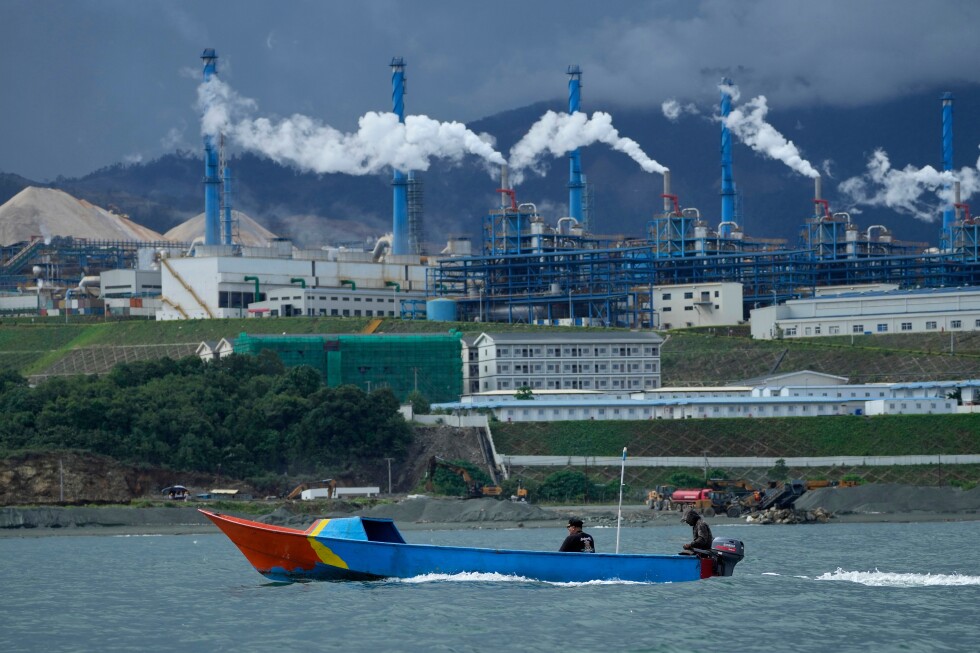
In one high-profile enforcement action last year, Indonesian soldiers, accompanied by local media, took control of part of the world’s largest nickel mine, which is primarily owned by Chinese metals giant Tsingshan Holding Group. A 2024 report by Climate Rights International documented how the mine caused deforestation, pollution, and increased coal-fired emissions while displacing communities and creating health risks for residents.
Bhima Yudhistira of the Jakarta-based Center of Economic and Law Studies cautions that the government’s intervention isn’t driven by environmental concerns: “There is no guarantee things will get better. They could get even worse.”
Indonesia’s bid to transform its nickel reserves into the foundation of a domestic EV industry has yielded mixed results. In July 2024, South Korea’s Hyundai Motor Group and LG Energy Solution opened Indonesia’s first EV battery cell plant, capable of supplying more than 150,000 electric vehicles annually. However, LG Energy Solution withdrew from a larger $8.4 billion battery investment in April 2025, citing unfavorable market conditions.
Chinese automaker BYD is currently constructing an EV plant in Indonesia, while CATL, the world’s largest EV battery manufacturer, is building a battery factory in partnership with Indonesian state firms.
Despite this activity, Indonesia’s domestic EV market remains relatively small though growing quickly. The country sold approximately 43,000 electric vehicles in 2024, representing about 5% of total car sales. Public charging infrastructure remains limited, with around 1,500 stations nationwide as of 2024.
Industry experts note that even if Indonesia achieved annual production of 1 million EVs—equivalent to total current annual auto sales—and exclusively used nickel-rich batteries, this would still consume less than 1% of the country’s nickel output.
Further complicating matters, global EV manufacturers are increasingly adopting lithium iron phosphate (LFP) batteries, which require little to no nickel or cobalt. These batteries offer advantages in cost, stability, and longevity, and now power nearly half of all EVs globally, according to the International Energy Agency.
Indonesia’s nationalization efforts could potentially reduce China’s control over portions of the supply chain, giving Jakarta leverage to attract U.S. investors. One potential concession in ongoing trade negotiations with the Trump administration would be selectively lifting the ban on raw nickel exports to the United States.
“How does Indonesia straddle between the two superpowers who both want to gain control of the national resource that Indonesia has?” asked Li Shuo, director of the Asia Society Policy Institute’s China Climate Hub. Other Southeast Asian nations caught between U.S. and Chinese interests are closely monitoring Indonesia’s approach, though Li acknowledges the challenge: “Make no mistake, it’s going to be very difficult.”
Yudhistira warns that Indonesia’s land seizures risk further destabilizing its nickel industry, potentially deterring foreign investment in mining and processing projects. “This is making the future of nickel, both mining and downstream processing, unknown,” he noted. “Uncertainty is very costly for investors.”
Fact Checker
Verify the accuracy of this article using The Disinformation Commission analysis and real-time sources.

8 Comments
Indonesia’s decision to ban raw ore exports and attract Chinese investment in local refining seems like a smart move to capture more of the value chain. However, the environmental concerns around rapid mining expansion are valid and need to be carefully managed.
Agreed, the environmental tradeoffs will be a key consideration. Indonesia will need to balance economic development with sustainability as it builds out its EV supply chain.
Interesting to see Indonesia tightening control over its critical nickel resources. As the global EV market continues to grow, securing domestic supply chains will be crucial for major powers like the US and China. I’m curious to see how this plays out in the broader geopolitics of the energy transition.
You’re right, this is a strategic move by Indonesia to leverage its dominant position in the nickel market. It will be important to see how the major economies respond and adapt their supply chains accordingly.
Indonesia’s nickel strategy seems to be a shrewd play to capture more of the value in its natural resources. As the global energy transition accelerates, managing these critical mineral supply chains will be a major geopolitical priority in the years ahead.
The scramble for critical minerals like nickel highlights the need for countries to diversify and secure their supply chains. Indonesia’s tighter control could create challenges, but also opportunities for innovation and new partnerships.
Good point. This could spur more investment in recycling, substitution, and alternative extraction methods to reduce reliance on a single dominant supplier.
This news underscores the geopolitical importance of critical minerals like nickel in the global energy transition. It will be fascinating to see how the major powers navigate these shifting supply dynamics and compete for access to key resources.