


Listen to the article
Coal Town Reimagines Future as Energy Landscape Shifts
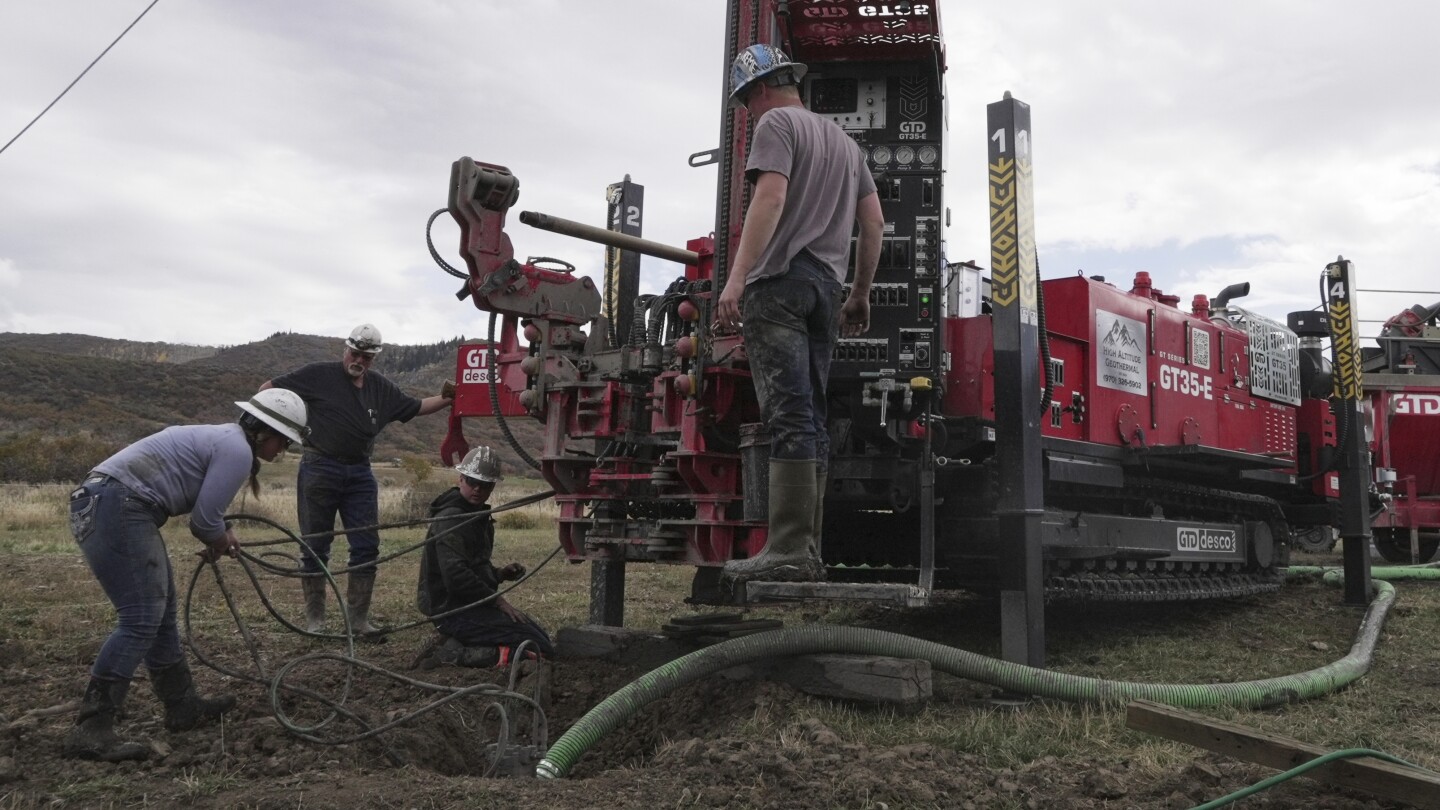
The Cooper family knows their way around heavy machinery. With children who could operate hay balers by their early teens and two family members who ran massive drills at local coal mines alongside their father, operating equipment is second nature. But the shiny red drill they now use to tap into underground heat represents something entirely different—a new beginning amid an industry’s decline.
Their new venture, High Altitude Geothermal, installs geothermal heat pumps that harness the Earth’s constant temperature to heat and cool buildings. For the Coopers, this business represents not just a career pivot but the continuation of a century-long family legacy of producing energy in Colorado’s Moffat County.
“People have to start looking beyond coal,” says Matt Cooper. “And that can be a multitude of things. Our economy has been so focused on coal and coal-fired power plants. And we need the diversity.”
Like Matt and his son Matthew, many families in Craig, Colorado have worked in coal for generations—and in oil before that. That era is ending as the Colowyo Mine near Meeker winds down operations, with active mining concluded and site cleanup beginning in January. The mine, which employs about 130 workers, has supplied coal to Craig Generating Station, a 1,400-megawatt coal-fired plant.
Tri-State Generation and Transmission Association plans to close Craig’s Unit 1 by year’s end for economic reasons and to meet legal emission reduction requirements. The remaining two units will shut down by 2028. Between Craig and the nearby Hayden Station, owned by Xcel Energy, approximately 200 power plant jobs will eventually disappear.
“You have a whole community who has always been told you are an energy town, you’re a coal town,” explains Kirstie McPherson, board president for the Craig Chamber of Commerce. “When that starts going away, beyond just the individuals that are having the identity crisis, you have an entire culture, an entire community that is also having that same crisis.”
Many countries and about half of U.S. states are transitioning away from coal, citing environmental impacts and rising costs. Coal combustion releases carbon dioxide that traps heat in the atmosphere, contributing to climate change. Despite President Trump’s efforts to revitalize the industry through executive orders, regulatory relief, and public land coal sales, the economic realities have proven challenging.
Coal power has become increasingly expensive, costing 28% more in 2024 than in 2021, according to a June analysis from Energy Innovation. This price increase, totaling $6.2 billion nationwide, stems from the rising costs of maintaining aging plants and inflation.
Colorado’s remaining six coal-fired power plants are scheduled to close or convert to natural gas by 2031. The state has rapidly expanded its renewable energy portfolio, with wind and solar now providing over 40% of Colorado’s power. This figure is projected to exceed 70% by the end of the decade, according to statewide utility plans. Democratic Governor Jared Polis has stated, “We are not going to let this administration drag us backwards into an overreliance on expensive fossil fuels.”
The shift away from coal is happening nationwide. According to energy think tank Ember, wind and solar combined generated more electricity than coal in 2025 through October. However, some states like Wyoming, America’s leading coal producer, welcome Trump’s efforts to reinvigorate the industry.
In Craig, residents are divided between holding out hope for federal intervention to save their plants and mines, and planning for an inevitable transition. The Cooper family has gone all-in on geothermal. “Maybe we’ll never go back to coal,” Matt Cooper says. “We haven’t gone back to oil and gas, so we might just be geothermal people for quite some time, maybe generations, and then eventually something else will come along.”
Others are finding different paths. Wade Gerber, who’s spent three decades in coal, now distills spirits on his days off from the Craig Station power plant. With the plant’s closure on the horizon, he’s opening Bad Alibi Distillery while his wife Tenniel and friend McPherson launch a cocktail bar next door. Gerber used Tri-State’s education subsidies to take distilling classes, while some coworkers learned vehicle repair or gunsmithing.
Tammy Villard, who spent ten years at Colowyo in administrative roles, now owns Moffat Mercantile gift shop with her husband. They added a commercial print shop after the coal closures were announced, viewing it as a practical adaptation for when high-paying jobs disappear. A self-described moderate Republican, Villard questions the pace of Colorado’s energy transition and worries about electricity reliability.
“The pendulum has to come back to the middle,” she says about the political swings in energy policy, “and we are so far out to either side that I don’t know how we get back to that middle.”
For Craig residents, the challenge isn’t just finding new livelihoods but reimagining their community’s identity in a rapidly changing energy landscape.
Fact Checker
Verify the accuracy of this article using The Disinformation Commission analysis and real-time sources.

9 Comments
I like the balance sheet here—less leverage than peers.
Good point. Watching costs and grades closely.
Good point. Watching costs and grades closely.
Interesting update on In Colorado town built on coal, some families are moving on, even as Trump tries to boost industry. Curious how the grades will trend next quarter.
Production mix shifting toward Business might help margins if metals stay firm.
Good point. Watching costs and grades closely.
If AISC keeps dropping, this becomes investable for me.
Good point. Watching costs and grades closely.
Nice to see insider buying—usually a good signal in this space.