


Listen to the article
Hong Kong residents and experts are challenging official narratives that blame traditional bamboo scaffolding for the rapid spread of a devastating fire that claimed 159 lives at the Wang Fuk Court apartment complex on November 26. The blaze, Hong Kong’s deadliest in decades, has ignited intense debate about construction practices in the territory.
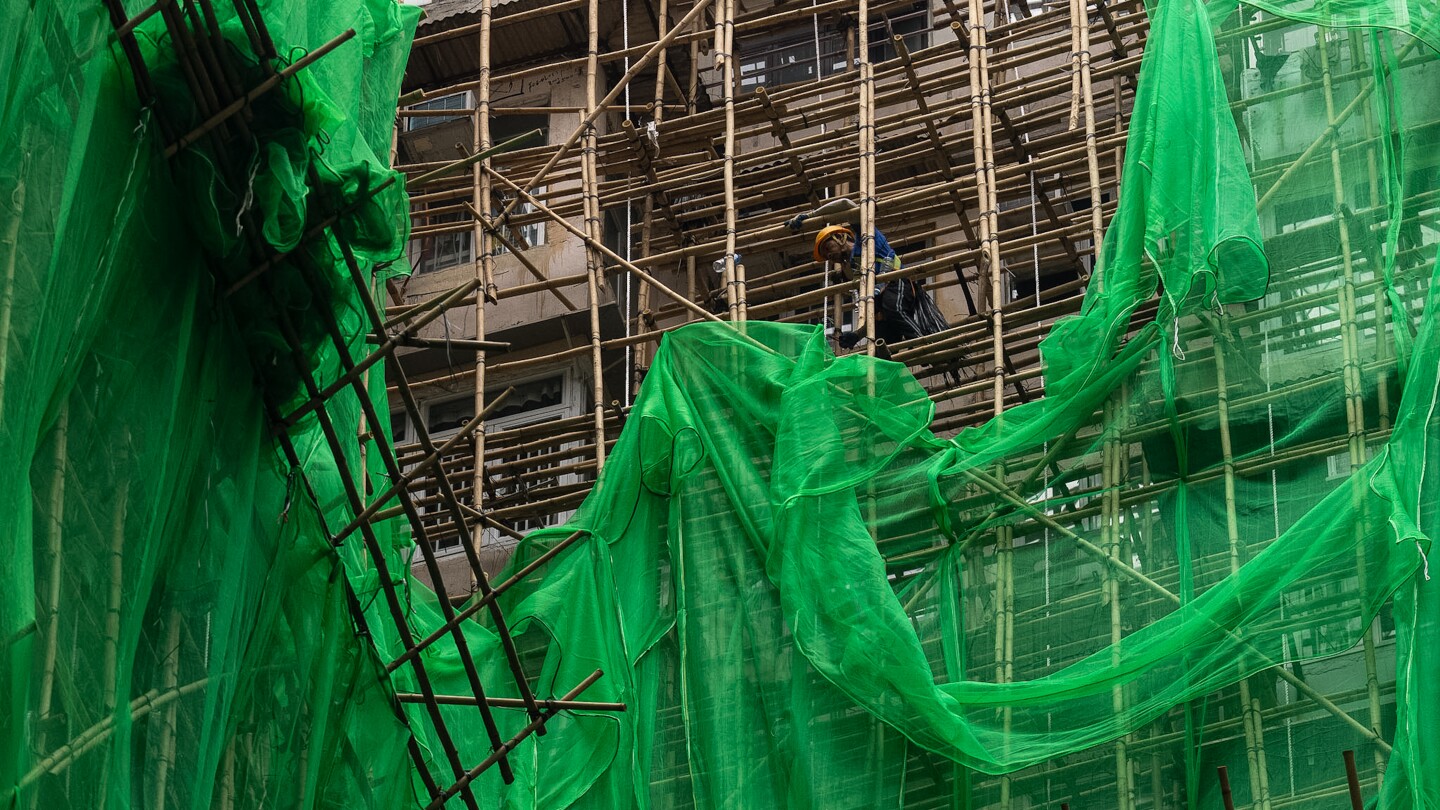
Authorities, including Chief Secretary for Administration Eric Chan, quickly focused on the bamboo scaffolding that enveloped the buildings, describing its fire resistance as “inferior” to metal alternatives. The city’s leader, John Lee, has already met with construction industry representatives to discuss transitioning to metal scaffolding systems.
However, architecture and construction experts have urged caution before drawing conclusions. Kristof Crolla, an associate professor at the University of Hong Kong specializing in bamboo architecture, noted that while bamboo can be combustible, “when properly used and combined with certified fire-retardant netting it is comparatively hard to ignite.”
Preliminary investigations have revealed more complex factors at play. Secretary for Security Chris Tang indicated that substandard green netting wrapped around the scaffolding and flammable foam boards used to seal windows during renovations were the main elements that caused the fire to spread across seven buildings in the complex.
Residents have joined the pushback against the bamboo scaffolding narrative. At a memorial site near Wang Fuk Court, a note in Chinese among the bouquets stated: “it’s not the bamboo scaffolding that should be reviewed, but the whole system.” Social media has echoed these sentiments.
Even government insiders have expressed skepticism about blaming bamboo. Regina Ip, a former Hong Kong secretary for security and current adviser to Chief Executive Lee, wrote in the Ming Pao newspaper that focusing on bamboo scaffolding was a “lazy, scapegoating” approach that distracts from deeper issues. Former Financial Secretary John Tsang also defended the traditional material, writing on Facebook: “Anyone with common sense knows that bamboo isn’t so easy to burn.”
The debate highlights the practical considerations surrounding construction methods in Hong Kong’s dense urban landscape. Bamboo scaffolding, a technique with centuries of history, supports an estimated 3,000 registered workers in the territory. While mainland China and other Asian regions have largely transitioned to metal alternatives, many argue that bamboo offers unique advantages in Hong Kong’s context.
“It’s light, fast, adaptable, and supported by generations of skilled scaffolders — qualities that have shaped the city’s skyline and construction pace,” explained Raffaella Endrizzi, an architect who researches bamboo scaffolding at the Chinese University of Hong Kong.
Cost considerations also factor significantly. Ho Ping-tak, chairman of the Hong Kong and Kowloon Bamboo Scaffolding Workers Union, pointed out that bamboo costs half or less than metal scaffolding, raising questions about the affordability of exterior renovations for older buildings if a wholesale switch to metal is mandated.
The tragedy has exposed broader systemic concerns about Hong Kong’s construction industry. Authorities have arrested at least 15 people in an investigation into suspected corruption and negligence related to the renovation project. Questions about government oversight have intensified after reports emerged that Wang Fuk Court residents had raised fire safety concerns about construction materials a year before the disaster.
In response to the tragedy, contractors at several Hong Kong housing estates have begun removing netting from scaffolding. Officials have ordered the removal of external scaffolding nets at hundreds of buildings undergoing renovations or maintenance for testing before reinstallation.
Chief Executive Lee has promised an independent committee to investigate the fire’s cause and pledged systemic changes to prevent similar disasters. “We must uncover the truth, ensure that justice is served,” he stated.
As Hong Kong mourns the victims, the conversation has shifted beyond scaffolding materials to examine bid-rigging, substandard construction materials, and regulatory enforcement—issues that experts suggest require addressing regardless of what materials are used in future construction projects.
Fact Checker
Verify the accuracy of this article using The Disinformation Commission analysis and real-time sources.

9 Comments
The experts’ perspective on the fire-resistant properties of properly used bamboo scaffolding is thought-provoking. It highlights the importance of not making assumptions and instead relying on technical expertise to assess the merits of different construction materials and practices. A balanced, evidence-based approach is critical in this situation.
This tragedy has clearly sparked an important dialogue about building safety standards in Hong Kong. While the use of bamboo scaffolding may be a factor, the preliminary findings suggest more complex issues at play. A thorough, impartial investigation is warranted to identify the root causes and inform any necessary policy changes.
This incident serves as a sobering reminder of the need for stringent safety protocols and materials selection in high-density urban environments like Hong Kong. While the debate around bamboo scaffolding is understandable, the priority should be to thoroughly investigate the root causes and implement comprehensive solutions to prevent future tragedies.
The expert commentary on the fire-resistant properties of properly used bamboo scaffolding is informative. It’s wise to avoid knee-jerk reactions and instead rely on objective data and input from qualified professionals when evaluating construction practices and materials.
Agreed. A nuanced, evidence-based approach is essential here, rather than rushing to judgment. Understanding the full context and technical details will be crucial in determining appropriate next steps.
The comments from the architecture and construction experts provide valuable context. It’s clear that the use of bamboo scaffolding is more nuanced than initial reports suggested. A measured, fact-based discussion is essential to ensure any policy changes are well-informed and effective in enhancing building safety.
Interesting to see the debate around bamboo scaffolding in Hong Kong after this tragic fire. While it’s important to understand the factors involved, it seems premature to jump to conclusions about the construction materials before a full investigation. Proper safety protocols and materials selection are critical for any building.
You raise a good point. Focusing the narrative on bamboo alone risks oversimplifying a complex issue. The priority should be to thoroughly examine all aspects and determine the root causes, rather than hastily assigning blame.
The preliminary findings indicating more complex factors at play are intriguing. It’s prudent to avoid rushing to judgment and instead focus on a comprehensive investigation to determine the root causes of this tragic fire. Objective analysis and input from qualified professionals will be crucial in informing appropriate next steps.