


Listen to the article
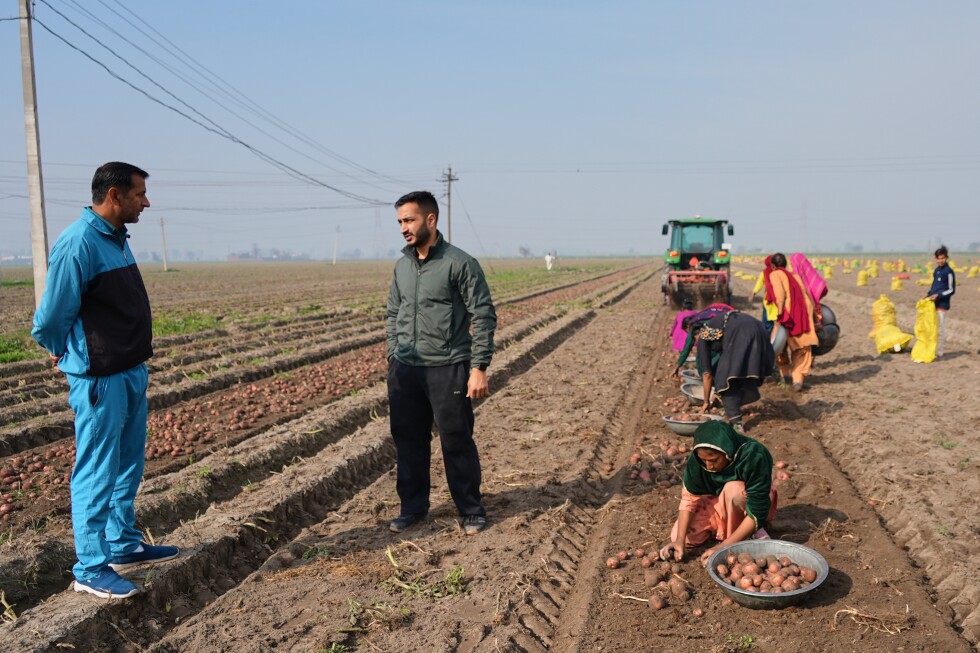
In a rural field in Karnal, northern India, farmer Bir Virk taps an iPad mounted next to his tractor’s steering wheel. The vehicle springs to life, autonomously harvesting potatoes with precision that would have amazed his ancestors. Nearly 145 kilometers away in New Delhi, educator Swetank Pandey uses algorithms to rapidly scan and grade thousands of handwritten exam papers for India’s competitive civil services exams.
Both innovators represent the quiet revolution of artificial intelligence sweeping across India, transforming traditional sectors with technology that enhances efficiency and productivity.
“I am able to farm very efficiently and I feel very happy that I do the work what my grandfather and father used to do. Now I am carrying the tradition forward with the right technology,” says Virk, whose AI-enabled tractor has slashed his work time by half.
As AI adoption surges globally, India is experiencing rapid integration of the technology across various sectors. The Indian government has launched national initiatives to fund AI research and workforce training, highlighted by this week’s five-day AI summit in New Delhi that has attracted heads of state and top technology executives.
With nearly a billion internet users, India has become a strategic battleground for global tech giants eager to scale their AI businesses in one of the world’s fastest-growing digital markets. Microsoft recently announced a $17.5 billion investment over four years to expand its cloud and AI infrastructure in India, following Google’s commitment of $15 billion over five years, which includes plans for the company’s first AI hub in the country.
“There’s some good use cases that have started. There are these scaling platforms that are now embedding AI into them,” notes Sangeeta Gupta, senior vice president at NASSCOM, a leading organization representing India’s technology industry.
Despite this progress, India faces significant challenges in AI development. The country has yet to develop its own large-scale AI model comparable to U.S.-based OpenAI or China’s DeepSeek. This gap highlights obstacles including limited access to advanced semiconductor chips, insufficient data center capacity, and the complexity of incorporating hundreds of local languages into AI systems.
The transition to AI has also created workforce disruption. Tata Consultancy Services, India’s largest private employer, cut more than 12,000 jobs last year as it pivoted toward AI-powered operations. This underscores the dual nature of technological advancement – creating opportunities for some while displacing others.
For Virk, AI’s benefits are clear. After encountering AI-driven farming technology while working in the United States, he imported a system from a Swedish company upon returning to India in 2021. His automated tractor can plant seeds, spray fertilizer, and harvest crops with remarkable precision.
“Technology and intelligence play a big role in this. The tractor works in a straight line. It maintains an accuracy of 0.01 centimeter,” explains Virk. The system, costing approximately $3,864, combines a steering motor, satellite navigation, and AI-driven software that converts data into movement. It also logs errors and uploads them to a cloud platform, where the software company analyzes the information and sends updates back to the machine.
“Its most special feature is that it is self-learning,” adds Virk, highlighting the adaptive capabilities that distinguish modern AI systems.
In education, AI is transforming India’s famed coaching centers, where millions of young Indians compete for coveted civil service positions. Pandey’s coaching center employs large language models like ChatGPT, Gemini, and Claude, alongside other automation tools, to evaluate answer sheets, create targeted study materials, and structure syllabuses for aspirants.
This technology enables Pandey’s team to evaluate tens of thousands of answer sheets in as little as 20 to 25 minutes. “If you have a better machine, bigger system, you can do it in two minutes,” he says.
Currently, his coaching academy uses a hybrid approach where AI handles initial evaluations before teachers review the output, improving both efficiency and quality. Interestingly, Pandey has observed that AI often produces study materials that students find more relatable than those created by teachers.
“AI is able to give us in advance a basic idea what the student is doing right now and what next he or she should do to be able to achieve their goals,” Pandey explains.
As India continues its AI journey, the experiences of early adopters like Virk and Pandey illustrate both the transformative potential of the technology and the pragmatic, problem-solving approach that characterizes its implementation across the country’s diverse economic landscape.
Fact Checker
Verify the accuracy of this article using The Disinformation Commission analysis and real-time sources.

13 Comments
Streamlining exam grading with AI algorithms seems like a smart way to improve productivity and consistency. However, I hope there are still safeguards in place to ensure fair and impartial assessments of students’ work.
The examples of AI-enabled tractors and exam grading algorithms showcased in this article are really fascinating. I’m curious to learn more about how these technologies could potentially be applied in other resource-based industries like mining and energy.
The AI-enabled tractor that cuts harvesting time in half is an impressive example of how technology can enhance traditional practices. I wonder what other applications of AI we might see in agriculture going forward.
India’s AI summit sounds like an important forum for advancing the technology and addressing key challenges. I’ll be interested to see what policy initiatives or industry collaborations emerge from these high-level discussions.
The article highlights how AI is transforming traditional sectors in India, from farming to education. I wonder what other industries, like mining and energy, might benefit from similar efficiency-boosting applications of the technology.
It’s encouraging to see India taking a proactive approach to AI adoption and development. Nurturing a strong talent pipeline and fostering responsible innovation in this field will be crucial for the country’s future competitiveness.
It’s great to see India embracing AI to drive efficiency and productivity gains. However, we’ll need to keep a close eye on how these technologies impact jobs and livelihoods, especially in more rural and traditional sectors.
While the efficiency gains from AI seem impressive, I hope India will also focus on the ethical deployment of these technologies. Safeguards around data privacy, algorithmic bias, and job displacement will be crucial.
Good point. Responsible AI development and implementation should be a priority as these systems become more widespread.
India’s national initiatives to fund AI research and workforce training are a step in the right direction. Developing a skilled talent pool will be crucial as this technology becomes more widely adopted across industries.
Agreed. Investing in AI education and training will help India stay competitive globally in this fast-evolving field.
The AI-powered tractor and exam grading systems highlighted in this article demonstrate the versatility of the technology. I’m curious to learn more about other use cases emerging in India’s mining, energy, and commodities industries.
Fascinating to see AI driving innovation in traditional sectors like farming and education in India. Automation can certainly boost efficiency, but it will be important to ensure these technologies are implemented responsibly and equitably.