


Listen to the article
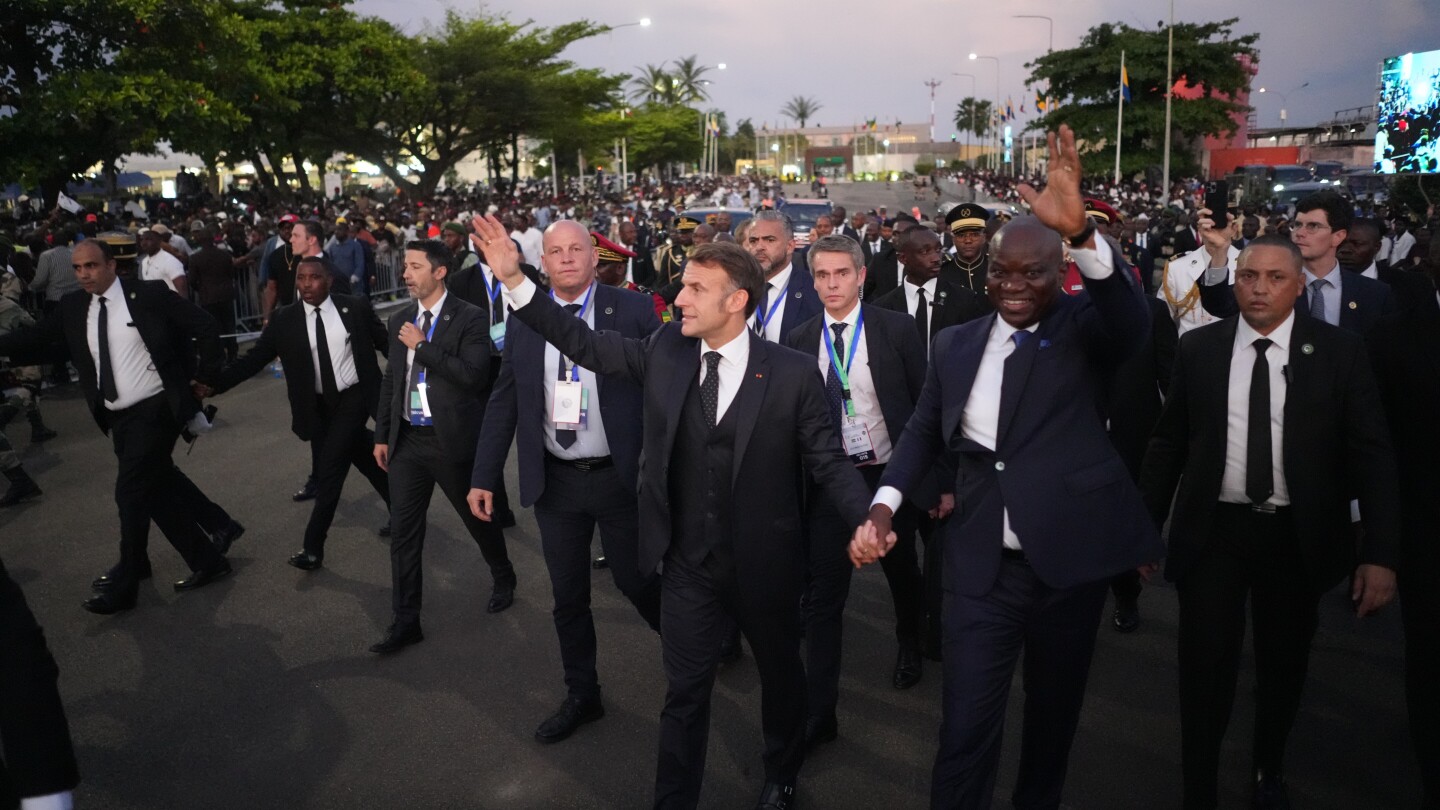
French President Emmanuel Macron embarked on a significant diplomatic mission to Gabon this week, marking another chapter in France’s evolving relationship with its former African colonies.
The high-profile visit comes at a pivotal moment for Franco-African relations, as France seeks to redefine its presence and influence across the continent amid growing competition from China, Russia, and other global powers.
Arriving in Libreville on Wednesday, Macron was greeted with an official welcome ceremony by Gabonese President Ali Bongo Ondimba at the presidential palace. The two leaders posed for photographs, exchanging warm handshakes against a backdrop of both nations’ flags, signaling what officials described as a “renewal of dialogue” between the countries.
During his stay, Macron toured several significant sites across the Central African nation, including the newly constructed Port-Gentil International Airport, a project that symbolizes the ongoing economic cooperation between France and Gabon. French companies have played a substantial role in the nation’s infrastructure development, with firms like Eramet and TotalEnergies maintaining significant investments in Gabon’s mining and energy sectors.
The presidential entourage also visited Gabon’s famed Lopé National Park, a UNESCO World Heritage site that houses some of Central Africa’s most diverse rainforest ecosystems. There, Macron announced new French initiatives to support biodiversity conservation and sustainable development in the Congo Basin, often referred to as the “second lung of the planet” after the Amazon.
“France remains committed to partnering with Gabon and other African nations to address our shared environmental challenges,” Macron stated during a press conference at the park. “Climate change knows no borders, and protecting these vital ecosystems is a responsibility we all share.”
Economic cooperation dominated the agenda during formal talks between the two presidents. Gabon, with its significant oil reserves and strategic position in the Gulf of Guinea, remains an important economic partner for France in the region. The nation has been working to diversify its economy beyond petroleum, with French expertise being sought in sectors ranging from renewable energy to digital infrastructure.
However, the visit was not without controversy. A small group of demonstrators gathered in Libreville to protest France’s continued influence in the country, reflecting a growing sentiment across parts of francophone Africa that questions the post-colonial relationship. Critics argue that France’s economic and military presence in its former colonies represents a form of “neo-colonialism” that limits true independence.
Political analysts note that Macron’s Gabonese trip is part of a broader strategy to reset France’s approach to Africa. Since taking office, he has acknowledged the complex and sometimes painful colonial history while attempting to establish more equal partnerships based on mutual interests rather than historical dominance.
“This visit reflects the changing dynamics of Franco-African relations,” said Jean-Pierre Mbelu, a political scientist at the University of Libreville. “Both sides are trying to navigate a relationship that honors historical ties while acknowledging that Africa’s future partnerships must be based on respect and mutual benefit.”
The visit also comes amid increasing security concerns in the broader region, particularly in the Sahel, where France has been gradually reducing its military presence. While Gabon remains relatively stable compared to its northern neighbors, regional security cooperation was reportedly discussed during closed-door meetings.
French media coverage captured numerous ceremonial moments throughout the trip, including cultural performances featuring traditional Gabonese music and dance that welcomed the French delegation. These photographs, widely circulated in both countries, portrayed the official narrative of friendship and cooperation that both governments sought to project.
As Macron concluded his visit on Friday, joint statements emphasized new agreements on educational exchanges, healthcare collaboration, and trade facilitation measures that both leaders characterized as “forward-looking” initiatives.
The diplomatic engagement in Gabon represents just one stop in France’s ongoing effort to recalibrate its African strategy, a process that continues to evolve as both France and its former colonies navigate their complex shared history and uncertain common future.
Fact Checker
Verify the accuracy of this article using The Disinformation Commission analysis and real-time sources.

10 Comments
France has had a complex colonial history with its former African territories, so it will be worth watching how Macron navigates those dynamics during this visit. Renewing the dialogue with Gabon is an important step, but there are likely some lingering tensions to address as well.
The new Port-Gentil International Airport project is a significant infrastructure investment that highlights the ongoing economic cooperation between France and Gabon. It will be interesting to see how this facility supports the country’s mining and energy industries going forward.
Absolutely. Improving transportation infrastructure is crucial for resource-rich countries like Gabon to facilitate exports and economic development. This airport project seems like an important part of that strategy.
Interesting to see Macron visiting Gabon, a key partner for France in Africa. The economic and diplomatic ties between the countries seem quite strong, especially in the mining and energy sectors. I wonder how this trip might impact the broader geopolitical dynamics in the region.
Yes, France is definitely looking to maintain its influence in the region amid growing competition from other global powers. Macron’s visit is likely aimed at shoring up those economic and political connections.
Overall, this trip seems to represent an important moment in the evolving relationship between France and its former African colonies. The geopolitical dynamics in the region are shifting, and Macron’s visit is a chance for France to reassert its presence and commercial interests. It will be worth watching how this plays out in the months and years ahead.
Absolutely, the broader geopolitical context is crucial here. France is navigating a complex landscape as it seeks to maintain its influence in Africa amid growing competition from China, Russia, and others. This trip is just one part of that broader strategic calculation.
The role of French companies like Eramet and TotalEnergies in Gabon’s mining and energy sectors is quite significant. It will be interesting to see if any new investments or partnerships are announced during Macron’s trip, and how that might impact the country’s resource extraction industries.
Absolutely, the economic ties between France and Gabon in those key sectors are crucial. Any developments on that front could have major implications for the global commodity markets as well.
I’m curious to see how Macron’s visit is received domestically in Gabon. There may be some local skepticism or pushback against the continued French influence, even as the two countries renew their diplomatic dialogue. Managing that delicate balance will be important for Macron.