


Listen to the article
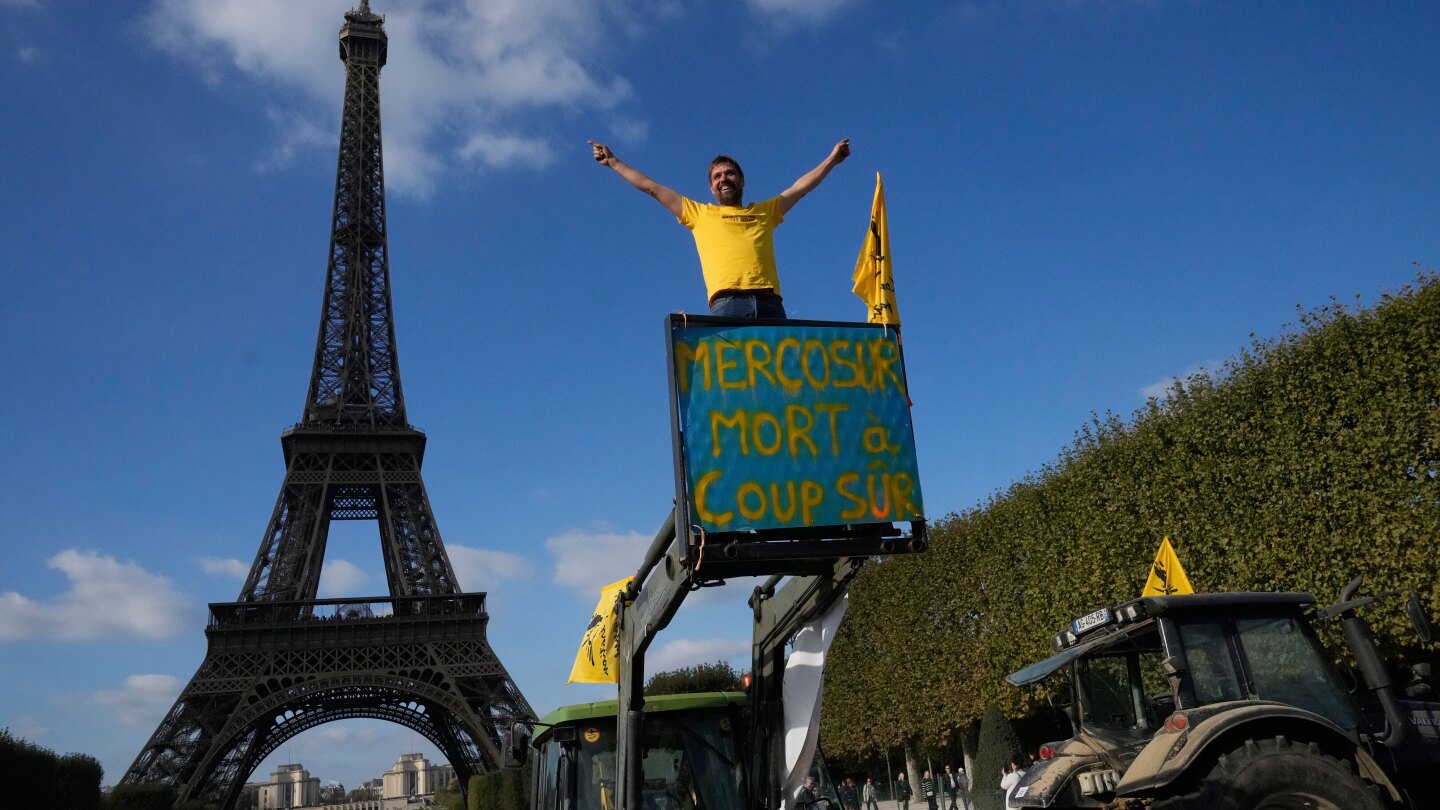
European farmers are taking to the streets of Brussels as France throws a last-minute wrench into a landmark trade deal between the European Union and South America’s Mercosur bloc, threatening years of delicate negotiations.
The ambitious pact between the EU and Mercosur countries—Brazil, Argentina, Uruguay, Paraguay, and Bolivia—would gradually eliminate duties on nearly all goods traded between the regions over 15 years. If ratified, the agreement would create a massive economic zone encompassing 780 million people and roughly a quarter of global GDP.
Though negotiators reached a tentative agreement last year, the deal now faces a critical juncture. European Commission President Ursula von der Leyen and European Council President António Costa were scheduled to sign the agreement in Brazil on December 20, but mounting opposition may derail these plans.
French Prime Minister Sébastien Lecornu declared on Sunday that the current EU-Mercosur deal was “unacceptable” and called for a delay in Thursday’s planned vote by EU heads of state. Such a postponement could push final approval to 2026 or beyond.
“It is clear in this context that the conditions are not in place for any vote by the EU Council on authorizing the signing of the agreement,” Lecornu stated, despite acknowledging recent efforts by the European Commission to address France’s concerns.
France isn’t alone in its opposition. Poland, Austria, and the Netherlands have also voiced worries that Mercosur exporters could undercut European products by avoiding the EU’s stricter labor and environmental regulations, including pesticide restrictions.
“France has failed to get Mercosur to agree to ‘mirror’ those regulations,” noted Alicia Gracia-Herrero, a senior fellow at the Brussels-based Bruegel Institute. She warned that the EU’s inability to finalize the deal could damage its credibility in other ongoing trade negotiations with countries like Indonesia and India.
The stakes are particularly high as the EU seeks to diversify its trade relationships amid growing tensions with traditional partners. Earlier this year, Washington imposed 15% tariffs on most EU imports, pushing Brussels to pursue alternative trade alliances to counter aggressive tactics from both the United States and China.
European Commission spokesperson Olof Gill emphasized the geopolitical importance of the deal: “We’re talking about bringing together two of the world’s biggest trading blocs. And in so doing, in a time of rising geopolitical uncertainty, we create a platform based on trust, based on rules, where we can work with Mercosur on the big challenges at global level of our time.”
Agriculture remains at the heart of the controversy. The sector is central to the European Union’s economy, culture, and politics, with agricultural exports valued at €235.4 billion ($272 billion) in 2024. Proponents argue the deal would save businesses approximately $4.26 billion annually in duties while opening markets for products ranging from French wine and German pharmaceuticals to Argentinian soybeans and Brazilian minerals.
However, farmers across Europe—particularly those in the dairy and beef industries—fear unfair competition and potential environmental damage from increased imports. Their concerns have prompted Brussels to propose new protections for the EU’s agricultural sector.
These measures include mechanisms allowing farmers to trigger investigations if Mercosur imports are priced at least 10% lower than competing EU products, with the possibility of temporarily withdrawing preferential tariffs for serious violators. The Commission has also proposed enhanced border inspections to check imported agricultural goods for pesticides banned in the EU.
Despite these concessions, French opposition remains firm, and agricultural unions are planning demonstrations in Brussels to coincide with Thursday’s European Council meeting. These protests follow months of farmer-led disruptions across European capitals—movements that have been embraced by far-right political groups, who performed strongly in EU elections earlier this year.
As the December 20 signing deadline approaches, the fate of this quarter-century-long negotiation hangs in the balance, testing not only EU-Mercosur relations but also the bloc’s ability to act decisively on the global trade stage amid rising protectionism and geopolitical uncertainty.
Fact Checker
Verify the accuracy of this article using The Disinformation Commission analysis and real-time sources.

10 Comments
It’s a complex situation with competing interests at play – European farmers, South American producers, and the broader economic benefits. Hopefully the parties can find a balanced solution that addresses the main concerns.
This trade agreement could reshape commodity flows and supply chains if it goes through. It will be important to watch how industries like mining and energy are impacted, both positively and negatively.
The sheer size of the economic zones involved – 780 million people and 25% of global GDP – shows the scale of this potential agreement. It could really reshape global trade dynamics if it goes through.
Absolutely, the size of the markets involved means this deal could have far-reaching implications, both positive and negative, for various industries and commodities. It will be crucial to understand the nuances as the negotiations progress.
The French opposition is an interesting development. I’m curious to hear more about their specific concerns and how they see the potential risks outweighing the benefits of the deal.
From what I’ve read, the French are worried about the potential environmental impact of increased agricultural trade with South America, especially deforestation concerns in the Amazon. That’s likely a key sticking point they want addressed.
The potential postponement to 2026 or beyond is quite a setback after years of negotiations. I wonder what factors will determine the final outcome, and whether any compromise can be reached to satisfy all sides.
This is a high-stakes situation with a lot of political and economic factors at play. I’ll be following the developments closely to see how the EU and Mercosur countries navigate these tricky waters.
This deal could have significant implications for the mining and commodities sectors, given the large economic zones involved. I’m curious to see how it impacts trade in key resources like gold, silver, copper, and emerging materials like lithium.
Interesting to see the political tensions around this EU-Mercosur trade deal. Farmers’ concerns over potential competition are understandable, but it’s also an important agreement that could boost economic ties between the regions. I wonder how the negotiations will play out.