


Listen to the article
Activity Subsides at Ethiopia’s Long-Dormant Volcano After Destructive Eruption
Volcanic activity at northern Ethiopia’s Hayli Gubbi volcano has subsided, officials confirmed Tuesday, following an eruption that brought significant destruction to nearby communities and disrupted international air travel across multiple regions.
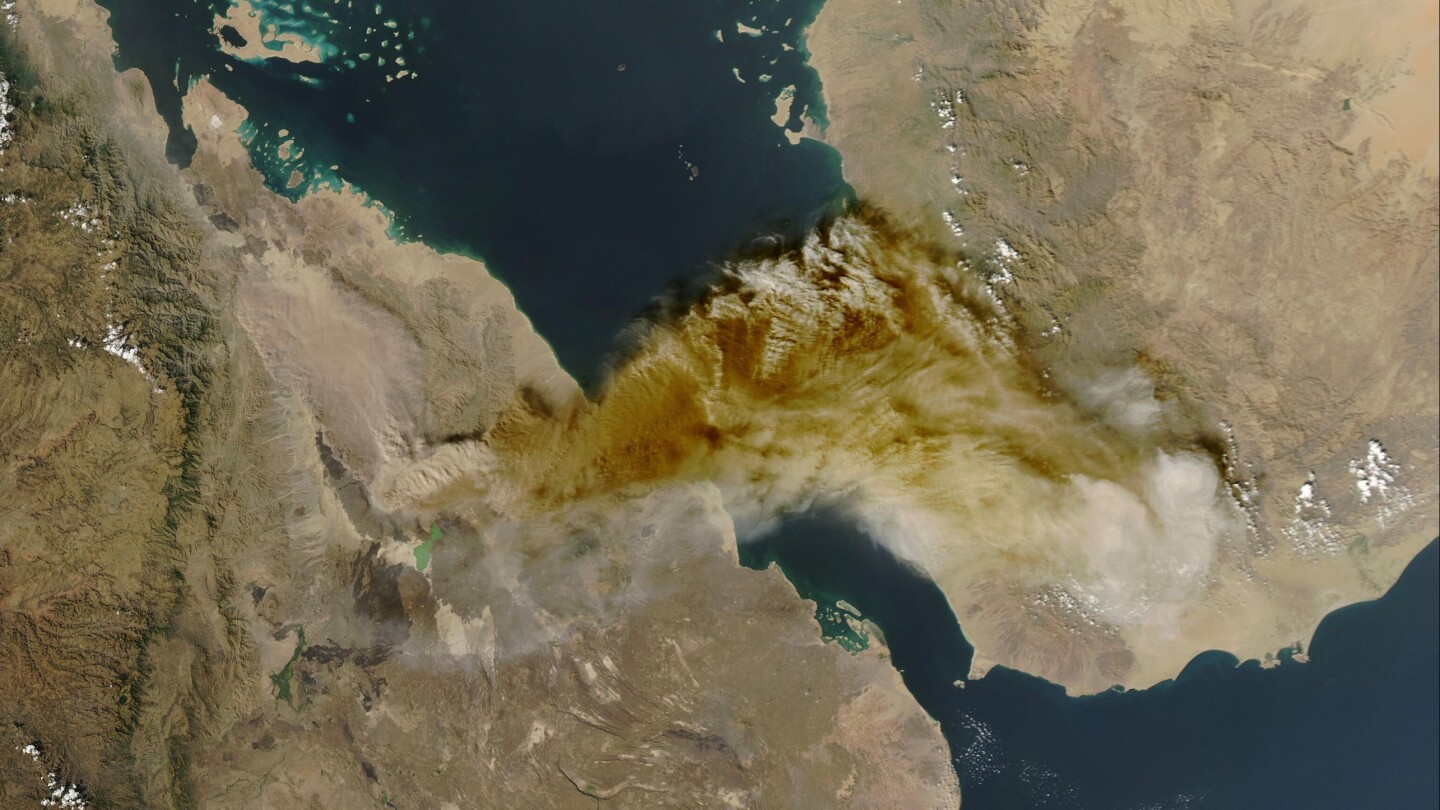
The eruption, described as the first recorded activity at Hayli Gubbi in approximately 10,000 years, blanketed villages in the Afdera district of Ethiopia’s Afar region with volcanic ash. Local residents reported respiratory issues, while livestock struggled to find clean water and uncontaminated grazing areas.
“Many animals, especially in the two affected kebeles, cannot drink clean water or feed on grass because it is covered by volcanic ash,” said Nuur Mussa, a regional official responsible for livestock management in the area.
Health authorities have deployed mobile medical teams to address growing health concerns among residents. Abedella Mussa, a health official overseeing the Afdera district, confirmed that people in the area were experiencing coughing and other respiratory symptoms as they contended with ash-filled air.
“Two medical teams have been dispatched to the affected kebeles like Fia and Nemma-Gubi to provide mobile medical services,” Abedella Mussa explained, highlighting efforts to reach these remote communities.
The eruption’s impact extended far beyond Ethiopia’s borders, as ash clouds disrupted high-altitude flight paths across multiple countries. Airlines were forced to cancel dozens of flights scheduled to travel through affected airspace, with the disruption affecting major carriers across Asia and the Middle East.
India’s national carrier, Air India, canceled 11 flights on Monday and Tuesday, most of them international routes. The airline cited a directive from India’s aviation safety regulator to inspect aircraft that may have flown through ash-affected areas. Akasa Air, another Indian carrier, also canceled flights to Middle Eastern destinations including Jeddah, Saudi Arabia; Kuwait; and Abu Dhabi in the United Arab Emirates.
New Delhi’s Indira Gandhi International Airport experienced particular disruption, with at least seven international flights canceled on Tuesday and approximately a dozen more delayed, according to airport officials.
The India Meteorological Department tracked the movement of the ash cloud, noting that high-level winds had carried it from Ethiopia across the Red Sea, Yemen, Oman, and the Arabian Sea before reaching western and northern India. Meteorologists predicted the ash would continue moving toward China and was expected to clear Indian airspace by late Tuesday.
Atalay Ayele, a geologist at Addis Ababa University, explained that such volcanic activity is not unexpected given Ethiopia’s location along an active rift system where both volcanism and earthquakes occur regularly.
“This is the first recorded eruption of Hayli Gubbi in the last 10,000 years,” Ayele told The Associated Press. “It will likely continue for a short period and then stop until the next cycle.”
The eruption underscores the geological volatility of the East African Rift System, a divergent tectonic plate boundary extending thousands of kilometers from the Afar region southward through eastern Africa. This system has created numerous active volcanoes and is gradually splitting the African continent.
For the communities directly impacted by this rare volcanic event, the immediate focus remains on addressing health concerns, securing clean water sources, and finding uncontaminated feed for livestock—all crucial elements for survival in this remote region of Ethiopia. Meanwhile, international aviation authorities continue to monitor the dispersing ash cloud as global flight schedules gradually return to normal.
Fact Checker
Verify the accuracy of this article using The Disinformation Commission analysis and real-time sources.

12 Comments
This eruption highlights the need for ongoing monitoring and research into Ethiopia’s volcanic systems. Understanding the risks and potential triggers could help improve preparedness and response in the future.
It’s good to see that the authorities are taking action to address the health and livestock concerns arising from the volcanic ash. Managing the aftermath of such an event must be a significant challenge.
The disruption to international air travel is an unfortunate consequence of this eruption. I wonder how long it will take for the situation to stabilize and for normal operations to resume.
While the immediate focus is on the human and animal welfare impacts, I’m curious to learn more about any potential economic or environmental consequences of this eruption, such as disruptions to mining or agriculture in the region.
Volcanic ash can pose serious health risks, especially for vulnerable populations. It’s good to hear that mobile medical teams have been deployed to address the respiratory issues arising from this eruption.
Yes, the ash contamination of water sources and grazing areas is particularly worrying for livestock. Restoring safe conditions for animals will be crucial.
The impact on local livelihoods, especially through the contamination of water and grazing areas, is particularly worrying. I hope the authorities can quickly mobilize resources to support affected farmers and herders.
This eruption serves as a stark reminder of the power of nature and the importance of disaster preparedness, especially in areas prone to such events. I hope the authorities are able to provide effective support and aid to the affected communities.
After 10,000 years of dormancy, this sudden eruption is a stark reminder of the unpredictable nature of volcanic activity. I wonder if climate change or other factors may have played a role in triggering this event.
That’s a good point. Increased volcanic activity has been linked to climate change in some regions. Further research may shed light on any potential connections here.
While the immediate impacts on the local community are distressing, I’m curious to learn more about the broader geological implications of this eruption. What might it reveal about the region’s volcanic history and future risks?
This eruption of the long-dormant Hayli Gubbi volcano in Ethiopia is quite concerning. The impact on local communities and livestock must be devastating. I hope the health authorities can provide adequate support to those affected.