


Listen to the article
Berkeley Developers Use State Law to Bypass Union Labor Standards
More than two years after Berkeley implemented union-backed labor standards for major construction projects, developers of three proposed apartment complexes are leveraging California’s powerful density bonus law to exempt themselves from these requirements.
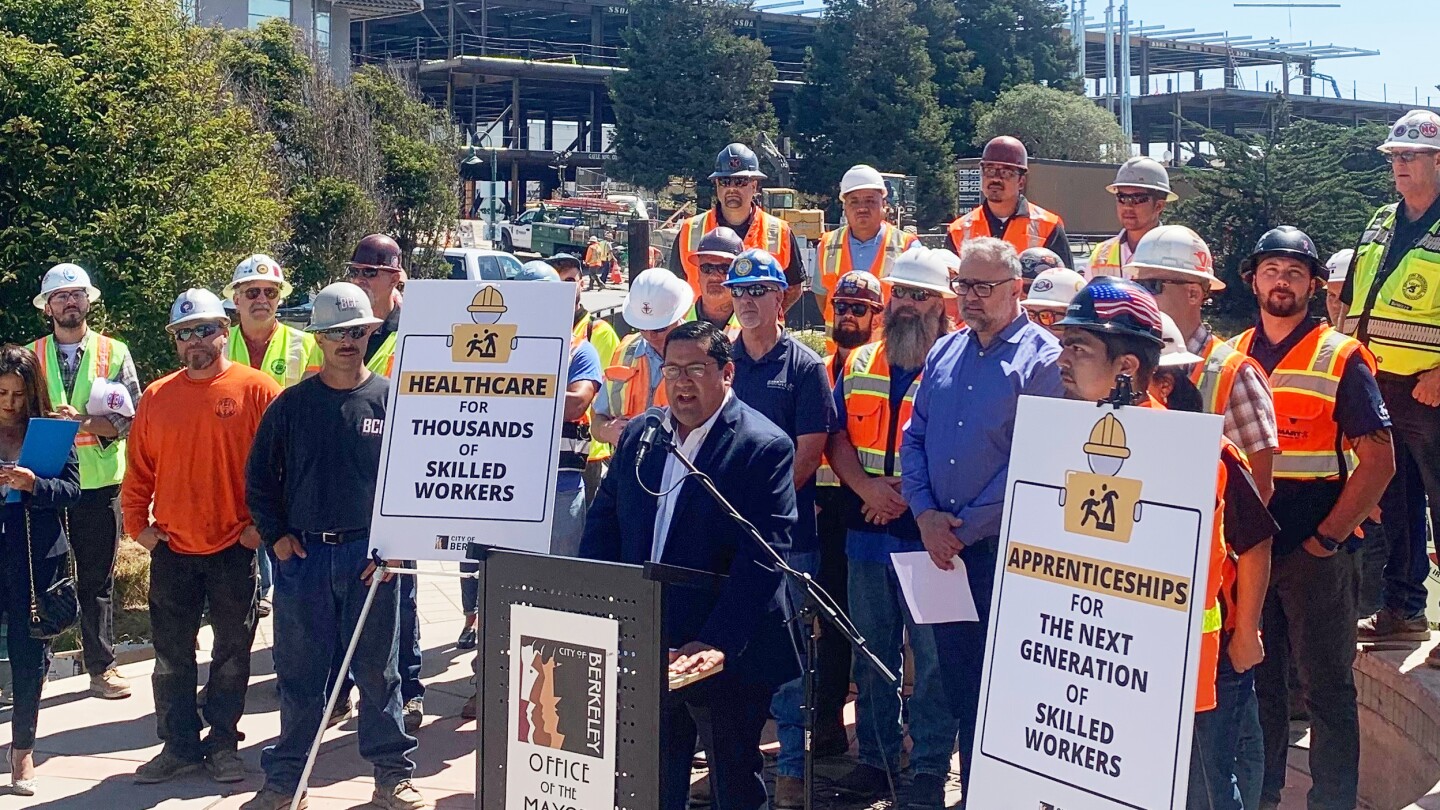
The move has sparked outrage among construction unions, who claim it undermines the law’s intent and effectively nullifies local ordinances mandating workers’ health care coverage, fair pay, and apprenticeship programs. Two labor groups have formally appealed a Zoning Adjustments Board decision to approve one of the projects, warning that this strategy could become a template for circumventing labor standards across California.
“It’s unfortunate that we find ourselves here tonight witnessing the dismantling of hard-fought worker protections,” said Daniel Gregg from the Nor Cal Carpenters Union at a recent zoning board hearing.
Last week, the board approved a 23-story complex on University Avenue in downtown Berkeley that would be exempted from health insurance and apprenticeship requirements, as well as an ordinance mandating bird-safe glass in large buildings.
Developers argue that Berkeley’s mandates would add millions in costs, making their projects financially unfeasible. They contend that California’s density bonus law—which allows builders to bypass local regulations if their projects include affordable housing—supports their position.
“Our former City Council adopted a set of standards that put enormous cost pressure on housing development in Berkeley,” said consultant Mark Rhoades. “They set the unions up for failure.”
The labor groups’ appeal will go before the City Council in February, forcing officials to choose between allowing the project to proceed without the labor standards many of them voted to implement, or risking a potentially costly legal battle.
Cost Concerns vs. Worker Protections
While the density bonus law is primarily known for allowing projects to exceed height and density limits in exchange for affordable units, it also permits exemptions from other local regulations that increase construction costs.
The Durant Avenue project from Berkeley firm Collab Home—which is the subject of the unions’ appeal—seeks exemption from requirements to provide health care coverage and apprenticeships. These requirements were established in a 2023 ordinance nicknamed “HARD HATS,” or Helping Achieve Responsible Development with Healthcare and Apprenticeship Training Standards. The developer also aims to bypass a mandate that projects in the Southside neighborhood pay prevailing wages.
A second project at 2298 Durant Avenue, developed by Berkeley private equity firm Valiance Capital, is similarly using the density bonus law to avoid these requirements. Meanwhile, Walnut Creek-based Laconia Development’s project at 2029 University Avenue is also seeking exemptions.
Travis Brooks, an attorney for Laconia Development, wrote that the mandates are “exactly the sort of costly ‘development standards’ the (density bonus law) requires local agencies to eliminate when incentives are requested.”
According to Laconia’s estimates, the requirements would add $5 million in costs—$2.8 million for health insurance, $1.9 million for apprenticeships, and $400,000 for bird-safe glass—on top of $8.4 million in other city, school, and utility fees.
“Especially now, when construction costs are so high, financing is iffy, the economy is volatile,” Rhoades said, “it’s just another layer of cost that Berkeley has put on housing production.” He warned that if developers had to comply with these mandates, “We would probably stop building housing in Berkeley again.”
Unions Claim Law Is Being Misused
Berkeley’s Planning Division staff concluded that the law entitled developers to the exemptions they requested. Zoning board members reluctantly agreed, saying their hands were tied by state law.
“It does make it very hard for us to deny (the project),” said Zoning Adjustments Board Chair Kimberly Gaffney before approving the University Avenue project.
Construction unions, however, argue that the density bonus law was intended to address physical limitations on projects—not labor regulations—and that developers can afford to comply with Berkeley’s mandates. The requirements, they say, ensure construction workers can perform dangerous jobs without risking devastating medical bills and receive proper training.
In their appeal, the Building and Construction Trades Council of Alameda County and the Northern California Carpenters Regional Council asked the City Council to reject the project, approve it without the exemptions, or send it back to the zoning board.
“The requested concessions are an attempted misuse of the (density bonus law) to avoid important labor standards that the city enacted to protect public health and safety,” wrote attorneys Jolene Kramer and Andrea Matsuoka.
Legal Risks and Political Pressure
State Senator Jesse Arreguín, who championed the labor standards as Berkeley’s former mayor, supported the unions’ appeal, expressing concern about the precedent it would set for labor policies. Construction unions were among his biggest campaign donors when he ran for state Senate.
“I never anticipated that the ordinance’s seminal requirements could be circumvented through use of the (density bonus law),” Arreguín wrote in a letter to the City Council.
Rejecting the project or its exemptions could expose Berkeley to lawsuits. Laconia’s attorney warned that denying the exceptions “would result in an actionable violation of state housing law,” and the company could sue to reverse the decision and recover legal fees.
Berkeley has already lost a similar lawsuit over attempting to block a housing development nearly a decade ago, and recently backed away from an ordinance prohibiting landlords from using rent-setting algorithms after facing legal action.
Andreas Cluver, secretary-treasurer of the Alameda County Building and Construction Trades Council, said the solution may require legislative action in Sacramento. “What we’re looking at is really a legislative loophole that allows developers to circumvent these really important labor standards,” Cluver said. “Obviously we need to change state law at some point to close the loophole.”
When asked if Arreguín plans to introduce legislation addressing these concerns, his spokesperson Stefan Elgstrand said it was “too early in the process” to specify any forthcoming bills.
Fact Checker
Verify the accuracy of this article using The Disinformation Commission analysis and real-time sources.

18 Comments
While increasing housing is important, developers exploiting legal loopholes to bypass worker protections is unacceptable. Berkeley’s labor standards, including healthcare, fair pay, and apprenticeships, exist for good reason and should not be so easily undermined.
I agree, this is a concerning development. Developers shouldn’t be able to sidestep hard-won labor policies through legal maneuvers. Balancing housing supply and worker rights is crucial, and Berkeley will need to take a firm stance to uphold its local standards.
Developers leveraging state laws to bypass local labor rules is disappointing. Construction workers deserve livable wages, healthcare, and apprenticeship opportunities. I hope Berkeley can find a way to uphold its worker protections while still enabling needed housing development.
Agreed, it’s a complex issue with valid concerns on both sides. Hopefully the city, developers, and unions can negotiate a compromise that balances housing supply and worker rights.
While increasing housing supply is crucial, I’m concerned about developers exploiting loopholes to bypass hard-won labor standards. Worker protections like healthcare, fair pay, and apprenticeships shouldn’t be sacrificed for expedited construction timelines.
Well said. Upholding worker rights while facilitating housing growth is a tricky balance, but one that Berkeley must strive to achieve. Careful regulation and stakeholder collaboration will be key.
This situation highlights the delicate balance between housing development and worker protections. While we need more housing, it should not come at the expense of fair labor standards. I hope Berkeley can find a way to maintain its worker-friendly policies while still facilitating construction.
Agreed, it’s a complex issue without easy solutions. Developers leveraging density bonus laws to bypass local labor rules is concerning and sets a troubling precedent. Finding the right compromise will require careful policymaking and stakeholder collaboration.
This is a concerning development. While increasing housing supply is crucial, it should not come at the expense of workers’ rights and protections. I hope the city and unions can find a balanced solution that supports both construction and fair labor standards.
You raise a good point. Density bonus laws can be a double-edged sword – they incentivize development but can also undermine local labor policies. Careful regulation will be key to ensuring housing growth doesn’t come at the cost of worker protections.
This is a tricky situation. On one hand, we need more housing, but on the other, labor standards should not be circumvented. I’m curious to see how Berkeley navigates this challenge to find a solution that works for all stakeholders.
That’s a fair perspective. Striking the right balance between housing development and worker protections will require creative policymaking and compromise from all parties involved.
I can understand the desire to expedite housing construction, but not at the cost of worker protections. Berkeley’s labor standards exist for good reason, and developers should not be able to circumvent them so easily. This is a concerning development that deserves close scrutiny.
Well said. Developers leveraging density bonus laws to sidestep local labor rules sets a troubling precedent. Berkeley must find a way to uphold its worker protections while still enabling much-needed housing growth.
Developers exploiting legal loopholes to sidestep hard-won worker protections is very concerning. Berkeley’s labor standards, including healthcare, fair wages, and apprenticeship programs, exist for good reason and should not be so easily undermined, even in the name of increased housing supply.
Well said. Maintaining a balance between facilitating housing development and upholding worker rights is crucial. Berkeley must take a firm stance to ensure its local labor policies are not eroded through legal maneuvers, even if it means negotiating with developers.
This is a concerning trend that could set a dangerous precedent if left unchecked. Local labor policies are in place for good reason – to protect workers and ensure fair practices. I hope Berkeley can find a way to maintain these standards while still enabling needed development.
Absolutely. Developers should not be able to simply bypass hard-won worker protections through legal loopholes. Maintaining a balance between housing supply and labor rights will be crucial going forward.