


Listen to the article
China has significantly reduced its planned tariffs on European pork imports, announcing final duties of up to 19.8% instead of the preliminary tariffs that reached as high as 62.4%, according to a statement released Tuesday by China’s Commerce Ministry.
The decision comes amid escalating trade tensions between China and the European Union, which began when the EU imposed provisional tariffs on Chinese electric vehicles. Beijing’s response has included not only the pork tariffs but also anti-dumping duties on European brandy—particularly cognac from France—though major producers received exemptions. China has also launched investigations into EU dairy product imports.
Trade relations between the two economic powers are complex. The EU currently faces a substantial trade deficit with China, which exceeded 300 billion euros ($348 billion) in 2023. However, European countries remain crucial suppliers of pork and pork byproducts to the Chinese market, where items like ears, snouts, and feet are considered delicacies.
The Commerce Ministry’s investigation, launched as a retaliatory measure, concluded that the EU was engaging in dumping practices—selling pork and related products in China at prices below production costs or domestic market rates—thereby harming China’s domestic pork industry. This finding served as the justification for the tariffs, which will take effect Wednesday and remain in place for five years.
In September, China had ordered preliminary anti-dumping duties in the form of security deposits ranging from 15.6% to 32.7% for EU companies that cooperated with the investigation, with higher rates of up to 62.4% for those that did not participate. The final rates, now set between 4.9% and 19.8%, represent a substantial reduction from these initial figures.
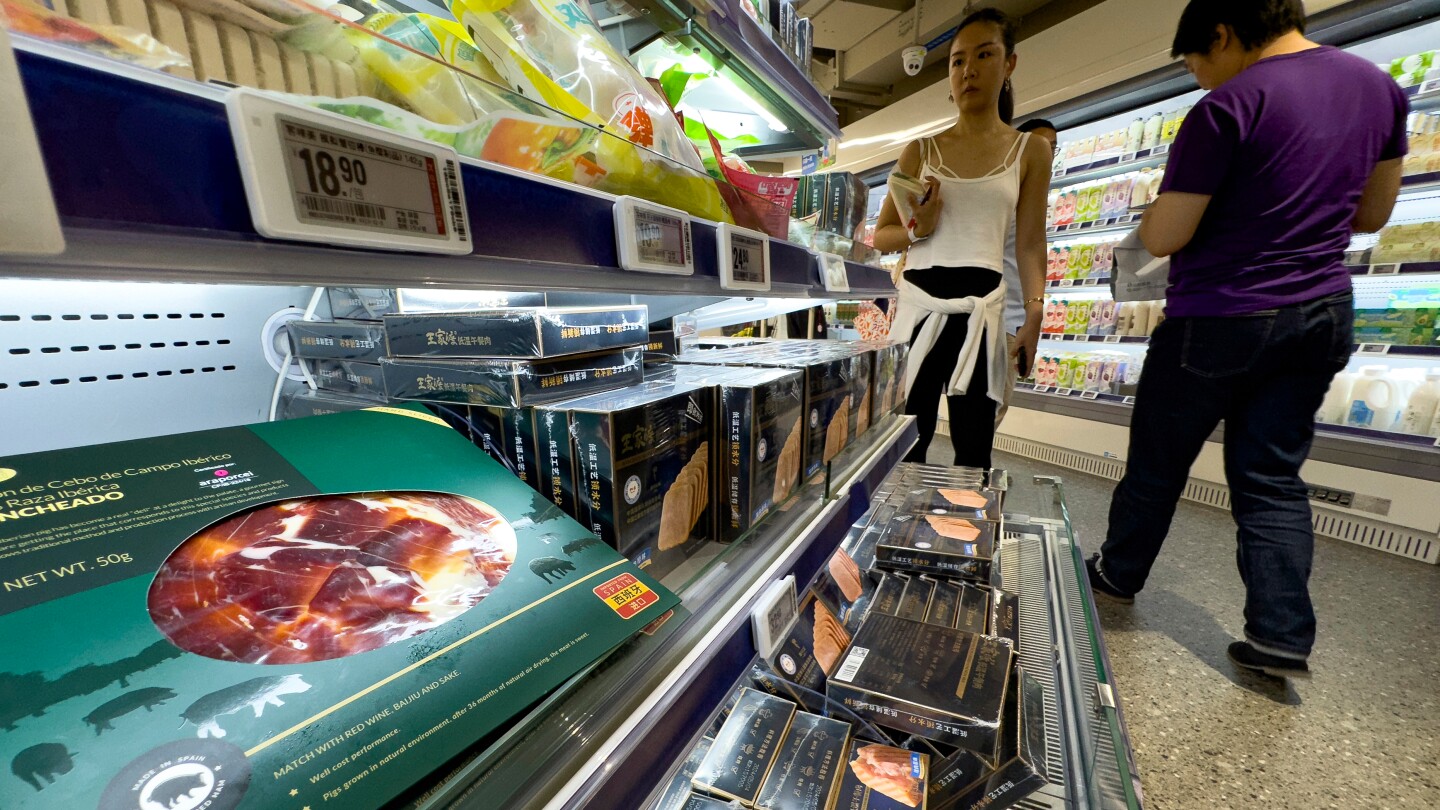
Spain, the Netherlands, and Denmark will be the most affected by the new measures, as they represent significant exporters of pork to China. The tariffs will cover a comprehensive range of products including fresh, chilled, frozen, dried, pickled, smoked, and salted pork items.
The Commerce Ministry emphasized that it reached its conclusions in an “objective, fair and impartial manner,” following standard trade investigation procedures.
The timing of these trade restrictions is particularly notable in the context of China’s pork market dynamics. EU pork exports to China reached their peak in 2020 at 7.4 billion euros ($7.9 billion) when African swine fever devastated Chinese pig farms, creating an urgent need for imports to satisfy domestic demand. Since then, as China has successfully rebuilt its domestic herds, the country has naturally reduced its reliance on foreign pork supplies.
Industry analysts suggest this tariff reduction from the initially proposed rates may represent a calibrated approach by Beijing, applying enough pressure to signal displeasure over EU policies without severely disrupting China’s own food supply chains or triggering more aggressive European counter-measures.
The move occurs against the backdrop of broader global trade tensions, with countries increasingly using tariffs and trade investigations as tools in economic diplomacy. For European pork producers, particularly those in the most affected countries, the reduced tariff rates may offer some relief compared to the initially proposed duties, though the impact will still be substantial on an industry that had grown accustomed to strong Chinese demand.
Market observers will be watching closely to see if this represents a de-escalation in trade tensions between China and the EU, or merely a tactical adjustment in an ongoing economic confrontation.
Fact Checker
Verify the accuracy of this article using The Disinformation Commission analysis and real-time sources.

14 Comments
It’s fascinating to see China leveraging anti-dumping tariffs as a tool in its trade disputes. The pork delicacy market in China must be significant for European producers to maintain such a crucial role.
Definitely an escalating trade conflict worth following, as it could have broader implications for global agricultural and commodity markets.
Interesting trade tensions between China and the EU over pork imports. I wonder how this will impact the broader trade relationship between the two economic powers moving forward.
The EU-China trade deficit is quite substantial, so I can see why China is taking these retaliatory measures on pork and other imports.
China reducing its planned tariffs on European pork imports from as high as 62.4% down to 19.8% is still a significant move. I’m curious to see if the EU will respond with any counter-measures.
The EU’s role as a crucial supplier of pork and related products to the Chinese market highlights the interdependence of the global food system.
The Chinese government’s investigation into alleged dumping practices by European pork producers is an interesting development. I wonder what evidence they’ve uncovered to justify the tariffs.
Trade relations between major economies like the EU and China are always complex. It will be important to see how this all plays out in the coming months.
The trade dispute over pork imports is another example of the complex and sometimes contentious relationship between China and the EU. It will be worth monitoring how this issue evolves.
With the EU facing a substantial trade deficit with China, these types of retaliatory tariffs are likely to continue being a point of friction between the two economic powers.
China’s use of anti-dumping duties as a trade policy tool is an interesting approach. I wonder if the EU will try to challenge the findings of the Chinese government’s investigation.
The pork delicacy market in China seems to be an important factor in this trade dispute. It highlights the complexities of global agricultural trade.
The reduction in planned tariffs on European pork imports is a notable development, but the overall trade tensions between China and the EU remain high. This is a situation worth closely following.
The interdependence of the global food system is evident in this case, with European producers playing a crucial role in supplying the Chinese market.