


Listen to the article
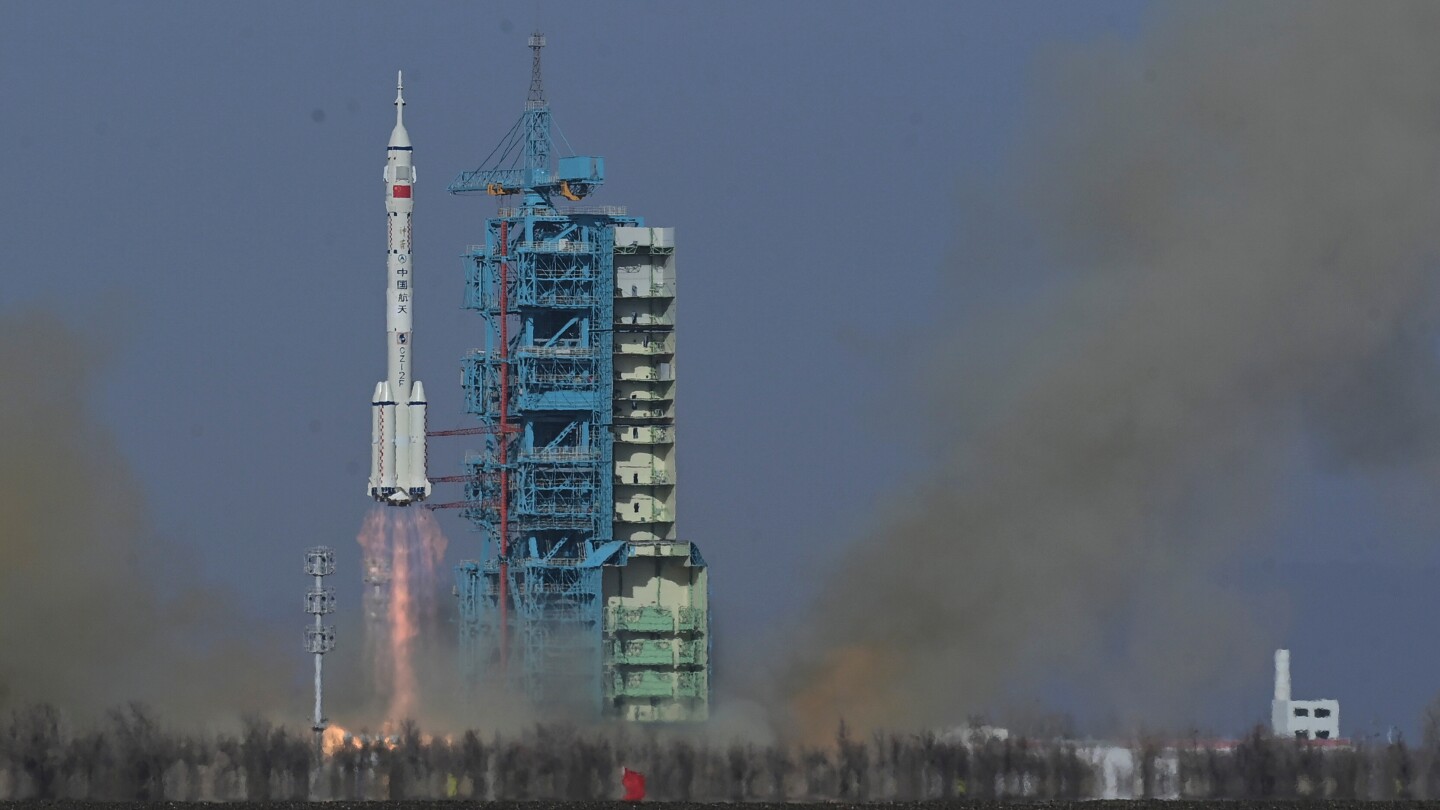
China launched the Shenzhou 22 spacecraft on Tuesday as part of a contingency plan to ensure the safe return of astronauts currently aboard the Tiangong space station, following an unexpected complication with a previously docked spacecraft.
The Shenzhou 22 successfully docked at the Tiangong station hours after launch and will remain there until 2026, when it will be used to bring home the three astronauts who arrived at the station on November 1.
The launch comes in response to a situation that developed earlier this month when the Shenzhou 20 spacecraft, which had transported the previous crew to the space station, sustained window damage that raised safety concerns about its ability to safely return astronauts to Earth.
That incident forced Chinese space officials to implement a backup plan. The Shenzhou 20 crew faced a nine-day delay in their return journey while engineers assessed the situation. Eventually, they returned safely using the Shenzhou 21 spacecraft, which had just delivered the replacement crew to the station.
This solution, however, created a new challenge: the three incoming astronauts were temporarily left without a guaranteed return vehicle in case of an emergency – a critical safety requirement for space station operations. The successful docking of Shenzhou 22 now resolves this contingency issue.
According to state broadcaster CCTV, the damaged Shenzhou 20 spacecraft remains in orbit but will eventually be brought back to Earth for thorough assessment. Space program officials determined it failed to meet safety standards for human transport after detecting the window damage.
The incident highlights both the complexity of space operations and China’s growing capability to respond to unexpected challenges in orbit. Space experts note that having backup return capabilities is standard practice in human spaceflight, though executing such contingency plans always carries inherent risk.
China’s Tiangong space station represents a cornerstone of the nation’s rapidly advancing space program. The station, whose name translates to “Heavenly Palace,” has been incrementally assembled in orbit over recent years and hosted its first crew in 2021.
Tiangong’s development came after China was excluded from participation in the International Space Station (ISS) program due to U.S. national security concerns stemming from the military oversight of China’s space activities. This exclusion prompted Beijing to pursue its own independent space station program.
While smaller than the ISS, which has been continuously occupied for 25 years, Tiangong serves as China’s platform for conducting scientific research in microgravity and demonstrating the country’s technological capabilities in space.
China’s ambitious space program has accelerated dramatically over the past decade. Beyond the space station, China became the first nation to land a rover on the far side of the moon in 2019 with its Chang’e-4 mission and successfully returned lunar samples to Earth in 2020 with Chang’e-5.
The country has announced plans for crewed lunar missions later this decade, potentially setting up a competitive space race with NASA’s Artemis program, which aims to return American astronauts to the moon.
Space policy experts note that China’s space activities reflect both scientific ambitions and strategic national priorities, with space capabilities increasingly viewed as indicators of technological prowess and global influence.
As Tiangong continues operations, it represents China’s determination to establish itself as a leading space power, despite starting its human spaceflight program decades after the United States and Russia.
Fact Checker
Verify the accuracy of this article using The Disinformation Commission analysis and real-time sources.

7 Comments
The launch of Shenzhou 22 to assist the stranded Tiangong astronauts demonstrates China’s commitment to space exploration and crew safety. Unexpected complications like this are inevitable, so it’s good they have robust backup plans in place. Looking forward to seeing the astronauts return home safely.
Agreed, the Chinese space agency is showing their dedication to the safety and success of these long-duration missions. Redundancy is key in the risky business of spaceflight.
Spaceflight can be risky and unpredictable, so having robust redundancy and backup systems is critical. Kudos to the Chinese for launching Shenzhou 22 to support the astronauts currently on the Tiangong station. Orbital logistics and crew transportation are ongoing challenges for all space programs.
Glad to hear the Chinese space program is taking proactive steps to ensure the astronauts’ safe return. The Shenzhou 22 spacecraft sounds like a prudent contingency plan given the unexpected issues with the Shenzhou 20. It’s important they have reliable backup options for these long-duration space missions.
The launch of Shenzhou 22 to assist the stranded astronauts underscores the complexity of space operations. Unexpected equipment issues can complicate mission timelines and require nimble responses. China seems to be handling this situation proactively to prioritize crew safety, which is the right call.
Absolutely, crew safety has to be the top priority in these situations. Kudos to the Chinese space agency for their quick action to launch a backup spacecraft.
Interesting to see China launching Shenzhou 22 as a contingency plan to bring home the astronauts from the Tiangong space station. Space travel is inherently risky, so having multiple backup options is prudent. Curious to learn more about the specific technical issues with the Shenzhou 20 spacecraft.